
Matthew Fosdick

Matthew Fosdick
Ok so: Grammar::import(path) imports a json file to a grammar Grammar#save(path) saves a grammar to a json file Grammar#import(path_or_grammar_object) merge another grammar into this one Grammar::get_exportable_grammar returns a new ExportableGrammar
Is importing a grammar from a path a useful feature? As it requires either converting a tag back into a pattern, or allow the grammar to store patterns as a...
Strategy 2 sounds like it better to how the preprocessor is used.
As I discussed in #485, while this is probably the best we can do, the context at the start of the `#else` range is actually the same context as write...
@jeff-hykin This should be needed only in dependant contexts; therefore, when template (and typename) is used to disambiguate a dependant context, it will always be preceded by `::`. One the...
Yep, that's a much better check. So `template` is a disambiguator if it preceded by `::` or the next non-whitespace character is not `
It does not. 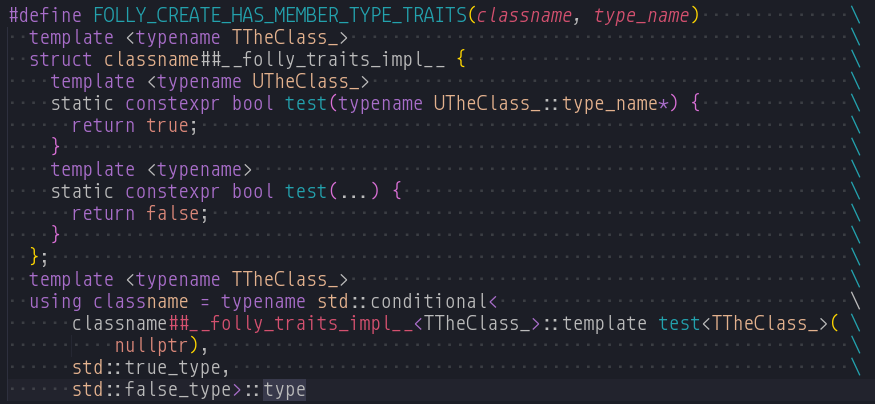 Other unreported issues: - type alias makes `class` in `classname` incorrectly - type alias does not highlight line continuation character.
That, in a perfect world, would not help due to https://github.com/jeff-hykin/cpp-textmate-grammar/issues/185#issuecomment-508938949. Additionally, type_alias potentially consumes the entire line. The line continuation pattern needs to be added to type_alias. The `classname`...
The highlighting of `class` in a qualified_type comes from. ```ruby .zeroOrMoreOf( builtin_type_creators_and_specifiers.then(std_space) ) ``` So it looks like std_space might be no longer enforcing a word boundary. Edit: the issue...
Unless I am missing something, it should just be suitable to allow ## in identifiers and have an `include` on the identifier pattern to match `/(?