

 vitotai
ESP32
BrewPiLess.v4.1r3.esp32.bin Can anyone provide the module photos and wiring diagrams needed for this file? Thank you!

Here it is what you need:
From Documentation: https://github.com/vitotai/BrewPiLess/blob/master/doc/ESP32Pins.md
Example:
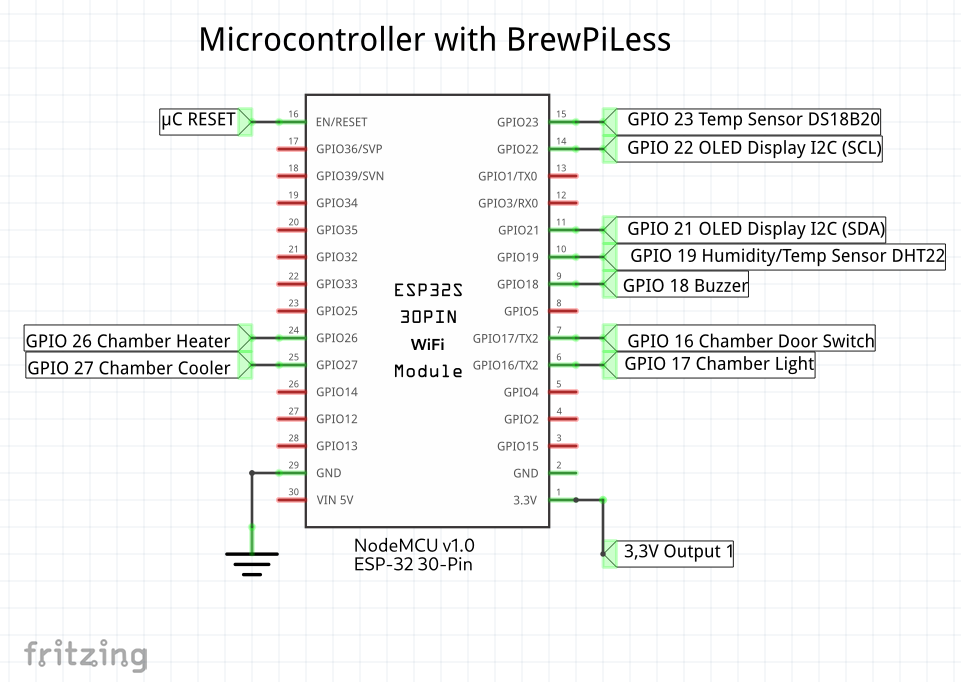
Best regards

It's just struck me that if buzzer is moved to GPIO2, GPIO18 can be freed as general IO for more actuators or sensor.

@vitotai
Excellent idea! After you informed me how to use other available pins I have been thinking about why not just permanent define in others "problematic" pins some "not so critical actuators" like for example buzzer, chamber door, light and fan. This way we can save more pins.
What do you think about the idea bellow?
GPIO 0, 2 and 4 are Strapping Pins, it means each one is connected with its internal pull-up resistor during the reset, and if they are HIGH or LOW during the boot, does not matter for those "not so critical actuators", it will not interrupt the boot as well, and the micro-controller will work normally.
So, we could use then for:
GPIO-0 to Chamber Fan (It has a PWM on boot, no worries on make some fan movements on boot. Please see also this idea I am thinking about, that idea connects with this one.) GPIO-2 to Chamber Light (just because the micro-controller board already have a LED connected on this pin) GPIO-4 to Buzzer (It is HIGH on boot, so we will only listen a "BIP" on boot, no issue at all)
GPIO-34 to Chamber Door Switch (Just becouse it is a "Input Only" available, so, no unexpected behavior on boot)
Looking at the diagram above, we would free 3 pins with this idea and also control the chamber fan.
If you liked it, I can test it on a breadboard and let you know the results.
Best regards,

@vitotai
Just tested this idea above into a protoboard and it works very well.
From the Idea above, I only changed GPIO-0 to GPIO-14 becouse the ESP32 with 30 Pins does not have a GPIO-0 available into the pin-out. Details about the test are bellow:
Photo:
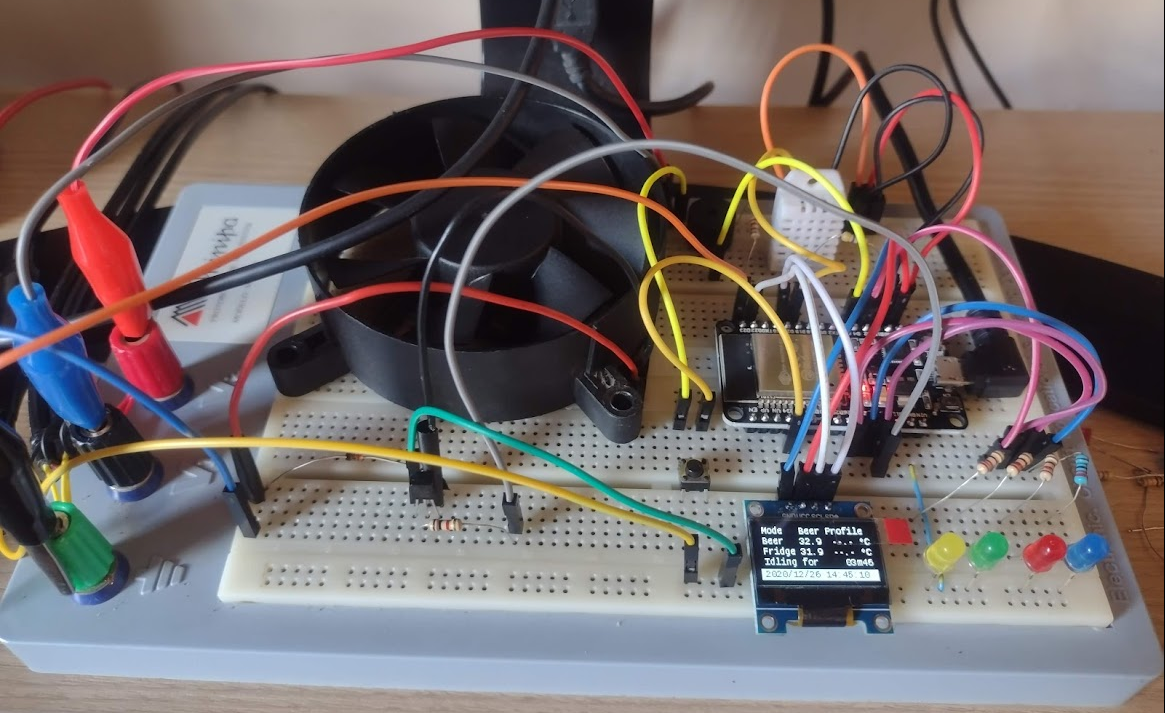
ESP32 Connections made:
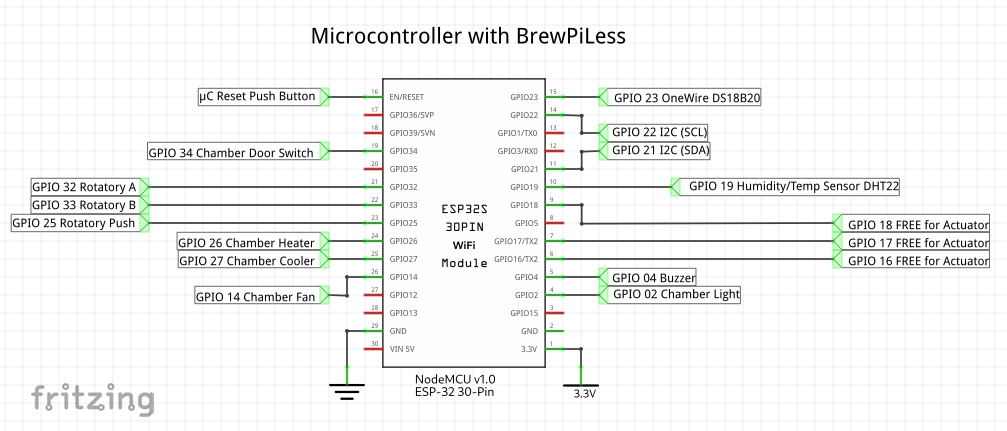
Code Changed:
-
@ DeviceManager.h, line 202 was added:
case 5: return 2;case 6: return 14;case 7: return 34; -
@ Config.h, line 335 was replaced 18 to 4:
#define BuzzPin 4
Details and Results:
- GPIO-14 to Chamber Fan (It was connected to a transistor as a switch, to supply 12V to the Fan, the result was only a small pulse of fan movement at boot)
- GPIO-2 to Chamber Light (It was also connected to a transistor as a switch, to supply 12V to the Light, no lights ON during the boot, so, very good result.)
- GPIO-4 to Buzzer (The result was that It produce two BEEPs during the microcontroller boot and that is it. So, at the end is good to know the electronics is ON, I have not tested the Buzzer working because I do not know when the system use the buzzer, I am learning about BPL yet.)
- GPIO-34 to Chamber Door Switch (Worked very well, when I make the GPIO HIGH, the Chamber light is ON)
Fan and Light Connections made:
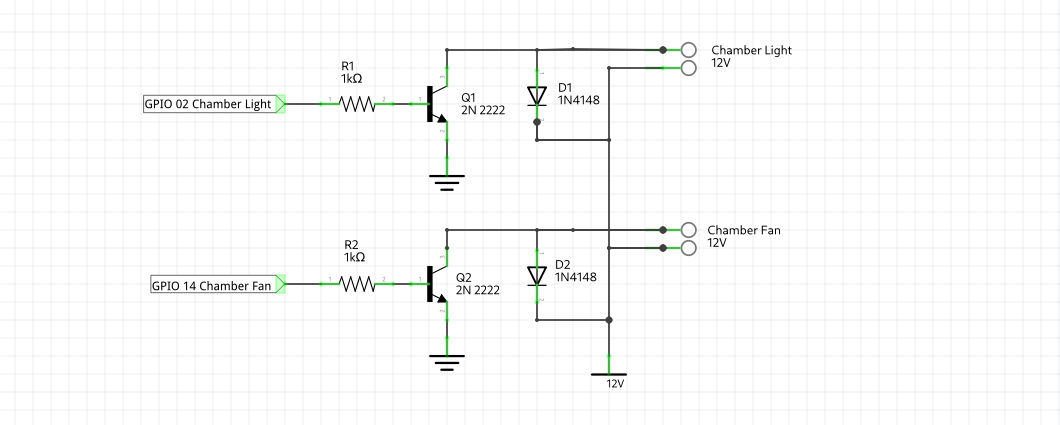
BPL Device Setup:
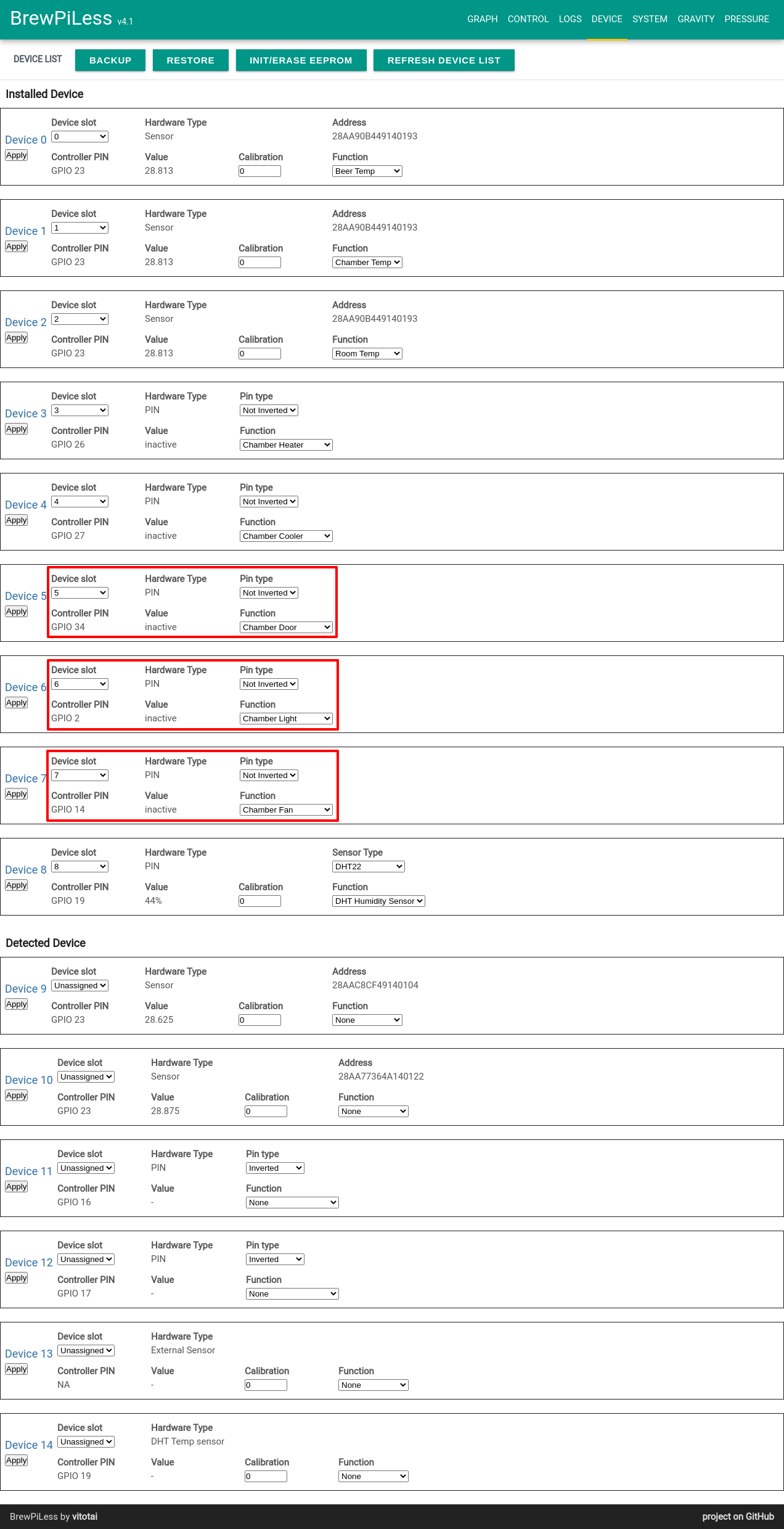
With those ideas, we produce 3 free "good" GPIOs that can be used for example to Capper, Dehumifier and Humidifier. So, people would be able to use all BrewPiLess features.
If in the feature is added the capability of use BME instead of DHT, we would generate one more free "good" GPIO. As discussed here.
Hope it can help any way.
Best regards,
Small point GPIO19 is used for Capping
@Hwerow I have not tested Capping yet, but as I understood, we can address it as we would like. There is not fixed GPIO for capping. Example: OneWire temp sensor has a fixed GPIO defined, but chamber heater as well as capping does not have one, you can define any one free available.
Please, correct me if I am wrong, so I learn with it.
Best regards,
Re the capping I guess I was too brief in my comment. It would have better read "What about the Capping?" which you have covered above. Cheers