

 spectacles-ci
Spectacles SQL raising an error on dimensions from extended views
I am working on a proof of concept for using spectacles and running into some unexpected errors when running spectacles sql. Specifically, we are seeing errors when testing an explore who's view extends another view. In our case, the extended view is used to provide some parameters for filters on the 'parent' view.
Screenshot for reference:
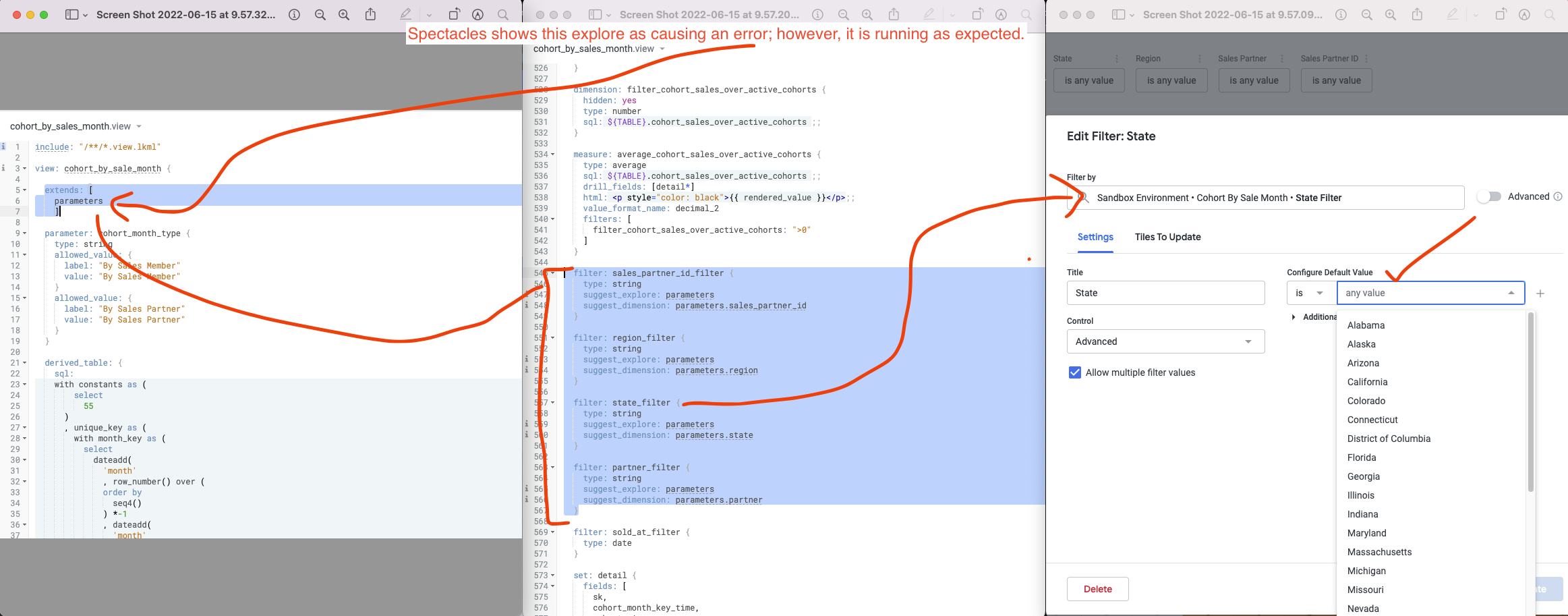
Each of the 4 dimensions in the parameters view is raising an error like:
====================== ******/cohort_by_sale_month.region =====================

The Snowflake database encountered an error while running this query. SQL Syntax
Error: SQL compilation error: error line 258 at position 4 invalid identifier
'COHORT_BY_SALE_MONTH.REGION'

LookML: https://******.cloud.looker.com/projects/******/files/****paramters.view.lkml?line=7

Test SQL: logs/queries/******__cohort_by_sale_month__cohort_by_sale_month_region.sql
When we test these parameterized filters in Looker, they work as expected.
I did a quick search of github issues and didn't see any similar issue reported.

Hi @jakeberesford-palmetto. Thanks for creating the issue. Would you be able to share the SQL that's in the file at the end of the error message?

Hey Dylan, sure thing - here's one of the errors:
The Snowflake database encountered an error while running this query. SQL Syntax
Error: SQL compilation error: error line 258 at position 4 invalid identifier
'COHORT_BY_SALE_MONTH.STATE'
And the resulting SQL (with database.schema obfuscated as ****.****) and some internal values changed
WITH cohort_by_sale_month AS (with constants as (
        select
          55
      )
      , unique_key as (
        with month_key as (
          select
            dateadd(
              'month'
              , row_number() over (
              order by
                seq4()
              ) *-1
              , dateadd(
                'month'
                , 1
                , date_trunc(
                  'month'
                  , current_timestamp::timestampntz
                )
              )
            ) as cohort_month_key
          from
            table(
              generator(
                rowcount => (
                  select
                    *
                  from
                    constants
                )
              )
            )
        )
        , over_time as (
          select
            row_number() over (
            order by
              seq4()
            ) as sk
          from
            table(
              generator(
                rowcount => (
                  select
                    *
                  from
                    constants
                )
              )
            )
        union all
          select
              0
        )
        select
          *
        from
          month_key
        cross join over_time
      )
      , user_filter as (
        select
          *
          , max(cohort_month_key) over (partition by 1) as max_cohort_month
          , datediff('month', cohort_month_key, max_cohort_month) as months_from_start
        from
          unique_key
        where 1=1 -- no filter on 'cohort_by_sale_month.sold_at_filter'

      )
      , cohort_month as (
        with get_month as (
          select
            distinct sales_member_id

                  , min(contract_received_confirmed_at::timestampntz) over (partition by sales_member_id) as cohort_month

          from
            ****.****.tmp_sales_funnel_next
          where
            tmp_sales_funnel_next.contract_received_confirmed_at is not null
            and 1=1 -- no filter on 'cohort_by_sale_month.sales_partner_id_filter'

            and 1=1 -- no filter on 'cohort_by_sale_month.state_filter'

            and 1=1 -- no filter on 'cohort_by_sale_month.region_filter'

            and 1=1 -- no filter on 'cohort_by_sale_month.partner_filter'

        )
        select
          date_trunc(
            'month'
            , cohort_month
          ) as cohort_month_key
          , count(distinct sales_member_id) as cohort_size
        from
          get_month
        group by
          1
      )
      , cohort_details as (
        with cohort_unique_month as (
          select
            tmp_sales_funnel_next.sales_member_id as cohort_id
            , tmp_sales_funnel_next.salesforce_opportunity_id as activity_id
            , tmp_salesforce_opportunity.amount as activity_amount
            , decode(
              tmp_salesforce_opportunity.installation_complete_date__c
              , null
              , 0
              , 1
            ) as activity_install
            , decode(
              tmp_salesforce_opportunity.installation_complete_date__c
              , null
              , 0
              , tmp_salesforce_opportunity.amount
            ) as activity_revenue

              , min(tmp_sales_funnel_next.contract_received_confirmed_at::timestampntz) over (
                partition by tmp_sales_funnel_next.sales_member_id
              ) as anchor_month

            , tmp_sales_funnel_next.contract_received_confirmed_at::timestampntz as over_time
          from
            ****.****.tmp_sales_funnel_next
          inner join ****.****.tmp_salesforce_opportunity tmp_salesforce_opportunity on
            tmp_sales_funnel_next.salesforce_opportunity_id = tmp_salesforce_opportunity.id
          where
            tmp_sales_funnel_next.contract_received_confirmed_at is not null
            and 1=1 -- no filter on 'cohort_by_sale_month.sales_partner_id_filter'

            and 1=1 -- no filter on 'cohort_by_sale_month.state_filter'

            and 1=1 -- no filter on 'cohort_by_sale_month.region_filter'

            and 1=1 -- no filter on 'cohort_by_sale_month.partner_filter'

        )
        , cohort_unique_month_amount as (
          select
            date_trunc(
              'month'
              , anchor_month
            ) as cohort_month_key
            , sum(activity_amount) as cohort_sales_amount
            , sum(activity_install) as cohort_installs
            , sum(activity_revenue) as cohort_revenue
          from
            cohort_unique_month
          group by
            1
        )
        , cohort_active_month as (
          select
            date_trunc(
              'month'
              , anchor_month
            ) as cohort_month_key
            , datediff(
              'month'
              , anchor_month
              , over_time
            ) as cohort_sales_over_time
            , count(distinct cohort_id) as active_cohorts
            , count(distinct activity_id) as cohort_sales
          from
            cohort_unique_month
          group by
            1
            , 2
        )
        select
            distinct cohort_active_month.cohort_month_key
          , cohort_active_month.cohort_sales_over_time
          , cohort_active_month.active_cohorts
          , cohort_active_month.cohort_sales
          , cohort_unique_month_amount.cohort_installs
          , cohort_unique_month_amount.cohort_sales_amount
          , cohort_unique_month_amount.cohort_revenue
        from
            cohort_active_month
        inner join cohort_unique_month_amount on
          cohort_active_month.cohort_month_key = cohort_unique_month_amount.cohort_month_key
        inner join user_filter on
          user_filter.cohort_month_key = cohort_active_month.cohort_month_key
          and cohort_active_month.cohort_sales_over_time <= user_filter.months_from_start
        where 1=1 -- no filter on 'cohort_by_sale_month.sold_at_filter'

      )
      , months_between_first_and_last_cohort_month as (
        select
          datediff(
            'months'
            , min(cohort_month_key)
            , dateadd('months', max(cohort_sales_over_time), min(cohort_month_key))
          ) as months_between_first_and_last_cohort_month
        from
          cohort_details
      )
      select
        unique_key.sk
        , unique_key.cohort_month_key
        , dateadd('months', unique_key.sk, unique_key.cohort_month_key) as cohort_month_x_axis
        , ifnull(cohort_month.cohort_size, 0) as cohort_size
        , ifnull(cohort_details.active_cohorts, 0) as active_cohorts
        , max(ifnull(cohort_details.cohort_installs, 0)) over (
          partition by unique_key.cohort_month_key
        ) as cohort_installs
        , max(ifnull(cohort_details.cohort_sales_amount, 0)) over (
          partition by unique_key.cohort_month_key
        ) as cohort_sales_amount
        , max(ifnull(cohort_details.cohort_revenue, 0)) over (
          partition by unique_key.cohort_month_key
        ) as cohort_revenue
        , ifnull(active_cohorts / nullif(cohort_size, 0), 0) as cohort_conversion_ratio
        , ifnull(cohort_details.cohort_sales, 0) as cohort_sales
        , ifnull(first_value(cohort_sales) ignore nulls over (partition by unique_key.cohort_month_key order by unique_key.sk), 0) as cohort_first_month_sales
        , ifnull(cohort_sales / nullif(cohort_first_month_sales, 0), 0) as cohort_improvement_ratio
        , ifnull((cohort_sales - cohort_first_month_sales) / nullif(cohort_first_month_sales, 0), -1) as cohort_improvement_change
        , ifnull(cohort_sales / nullif(active_cohorts, 0), 0) as cohort_sales_over_active_cohorts
        , case date_trunc('quarter', unique_key.cohort_month_key):: varchar
          when '2017-07-01 00:00:00.000' then 1
          when '2017-10-01 00:00:00.000' then 2
          when '2018-01-01 00:00:00.000' then 3
          when '2018-04-01 00:00:00.000' then 4
          when '2018-07-01 00:00:00.000' then 5
          when '2018-10-01 00:00:00.000' then 6
          when '2019-01-01 00:00:00.000' then 7
          when '2019-04-01 00:00:00.000' then 8
          when '2019-07-01 00:00:00.000' then 9
          when '2019-10-01 00:00:00.000' then 10
          when '2020-01-01 00:00:00.000' then 11
          when '2020-04-01 00:00:00.000' then 12
          when '2020-07-01 00:00:00.000' then 12
          when '2020-10-01 00:00:00.000' then 14
          when '2021-01-01 00:00:00.000' then 15
          when '2021-04-01 00:00:00.000' then 16
          when '2021-07-01 00:00:00.000' then 17
          when '2021-10-01 00:00:00.000' then 18
        else 19
        end as member_acquisition_spend
      from
        unique_key
      left join cohort_month on
        unique_key.cohort_month_key = cohort_month.cohort_month_key
      left join cohort_details on
        unique_key.cohort_month_key = cohort_details.cohort_month_key
        and unique_key.sk = cohort_details.cohort_sales_over_time
      where
        unique_key.sk <= (select * from months_between_first_and_last_cohort_month)
        and 1=1 -- no filter on 'cohort_by_sale_month.sold_at_filter'

  )
SELECT
    cohort_by_sale_month.state  AS "cohort_by_sale_month.state"
FROM cohort_by_sale_month
WHERE (1 = 2)
GROUP BY
    1
ORDER BY
    1
FETCH NEXT 0 ROWS ONLY
Thanks!
What I'm finding a little odd is that there's actually no reference in the code to COHORT_BY_SALE_MONTH.REGION. I presume this SQL runs when you run it in Snowflake?