rl-institut
Defining the energyVector for multi-sector assets unclear
When defining energyAsssets in the input templates, there is a parameter energyVector. There, one should define to which sector the costs should be added. This is easy for energyProduction assets etc, but for energyConversion assets this might be tricky.
As a general rule I propose:
- If there is only one output stream, the conversion asset should be defined as belonging to this
energyVector. Eg. that means that an electrolyzer may consume water and electricity, but is counted as an H2 asset. - If there are multiple output streams, the conversion asset´s
energyVectorshould be defined as the major output flow. This might be difficult to know, especially in eg. a BHKW, but I would say this has to be semi-randomly defined nevertheless.
Alternatively, this two-output asset could be attributed to two energyVectors and then we use the weighting again to distribute the costs over the outputs/two energyVectors.

I would go for your general rule and only if one of us runs into problems implement your alternative. What do the others think?

so you mean that it would depend on the user input? the general rule seems fair, however as you said, in the case of CHP it is tricky to attribute one sector.


So for the case that one would need two different LCOEs for two different sectors eg. in a CHP I think its quite elaborate to do it properly. Most consistent seems to use the technologies to produce the products seperatly as reference and share the costs accordingly "alternative generation method". So basically for a CHP: thermal share on Capex = thermal ref. Capex / (thermal ref. Capex + electrical ref. Capex) * CHP Capex electrical share on Capex = thermal ref. Capex / (thermal ref. Capex + electrical ref. Capex) * CHP Capex Similar Calculation for Opex cost and fuel cost, so in the end there would be (at least) three different cost distributions (for Capex, Opex and fuel costs). This would then have to be done individual for any relevant component and therefore is probably quite some effort.

At the point where we want and need to implement that I would suggest to add factors for the different cost distributions (k_capex, k_opex, k_fuel) for any two-source-output-components. Those should be set to different default values with the option manually overwrite them if wanted. So as decribed above we would then calculate:
CHP_Capex_electrical = k_capex_el * CHP_capex CHP_Capex_thermal = (1-k_capex_el) * CHP_capex CHP_Opex_electrical = k_opex_el * CHP_capex CHP_Opex_thermal = (1-k_opex_el) * CHP_capex CHP_Fuelcost_electrical = k_fuel_el * CHP_fuel CHP_Fuelcost_thermal = (1-k_fuel_el) * CHP_fuel
As a wild guess for default values for a CHP: k_capex_el=0.8 k_opex_el=0.8 k_fuelcost_el=0.7
In case of a variable CHP it would be necessary to calculate the share of fuelcost k_fuelcost_el with the actual prodcued amounts of heat and elecricity
Alternativly it might make sense for now to just give the LCOE unspecific for any energytype. Together with the amounts of each energytype produced the user can then decide the LCOE of one (or more) product(s) e.g. elecricity and calculate the resulting price for the other energytype(s).
I wouldn't distribute the total costs to the products of the CHP. I would rather suggest to use the total costs of the component and calculate, by taking into account the value of the respective other product, two different kinds of specific costs: electricity and heat production costs, e. g. like that:
- heat production costs = (annual total costs - annual total revenues electricity)/produced heat
- electricity production costs = (annual total costs - annual total revenues heat)/produced electricity
Still need to check the details for this procedure....
Here is a good website I am reading: https://www.bhkw-plan.de/grundlagen/wirtschaftlichkeitsrechnung https://www.ihr-bhkw-berater.de/aktuelles/bhkw-wirtschaftlichkeit
What do you think?

On the website u linked it says: "...es notwendig, entweder den Preis für die Wärme oder den Preis für den Strom vorzugeben. Daraus lassen sich dann Einnahmen berechnen, die die Gesamtkosten mindern. Der verbleibende Kostenblock ist dann dem jeweils anderen Produkt zurechenbar."
The approach has the problem that you have to set either the elecricity or heat-price. It would be labeled as "residual value method" and as in the paper posted from PF has its own limitations https://mpra.ub.uni-muenchen.de/65925/1/MPRA_paper_65925.pdf
What I was suggesting was the "alternative generation method" also in german called "finnische Methode" which is used in european law: Directive 2012/27/EU of the European Parliament, see ANNEX I and ANNEX II https://eur-lex.europa.eu/eli/dir/2012/27/oj
We also have to keep in mind the users, things should work "out of the box" and only experienced users might want to dig in
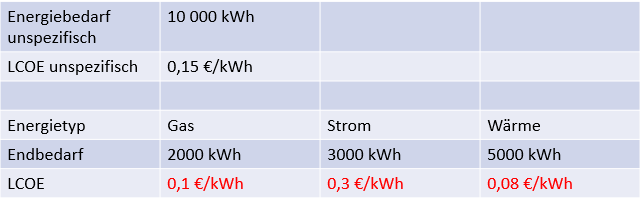
Indeed that is why I think it would be suffcient to calculate the overall costs only and dont make a division into different energy vectors. In the results we could then show the different energy-vector demands (eg. el/heat/gas) and give the option to price all products but one. This one product would then be calculated. (If there is only one energy-demand then no need for inputs)
So in the example below there would be the need to input two of the three red cells: