
botorch
 botorch copied to clipboard
 pytorch
[Feature Request]Add POI to Multi-Objective Analytic Acquisition Functions
🚀 Feature Request
Motivation
I want to employ the Multi-Objective Analytic Acquisition Function: probability of improvement (POI) (mentioned in Yang2019) in my research work. Yang, K., Emmerich, M., Deutz, A. et al. Efficient computation of expected hypervolume improvement using box decomposition algorithms. J Glob Optim 75, 3–34 (2019)
Pitch
Botorch's Multi-Objective Analytic Acquisition Functions module contains the Expected Hypervolume Improvement developed in Yang2019. Can the POI that mentioned in Yang2019 be added to Multi-Objective Analytic Acquisition Functions module. Thanks!

@sdaulton did you ever look into implementing MOO PoI? For non-batch (q=1) versions this should not be too bad (potentially using some of @j-wilson's MVN CDF work). MC sampling will be straightforward but we'd have to worry about the gradients.

@sdaulton did you ever look into implementing MOO PoI? For non-batch (
q=1) versions this should not be too bad (potentially using some of @j-wilson's MVN CDF work). MC sampling will be straightforward but we'd have to worry about the gradients. Does "MOO PoI" mean Multi-Objective Optimization PoI?If it does, this is what I want. How can I implement in botorh (just q=1)? I don't seem to find this acquisition function.
@Ruan-Yixiang please see the discussion in https://github.com/pytorch/botorch/discussions/1423. It includes an implementation of MC PoI for multi-objective case.

@Ruan-Yixiang please see the discussion in #1423. It includes an implementation of MC PoI for multi-objective case.
Thank for your reply. I see the discussion. He wants to use product of each object PI as the acquisition function to generate next candidate. But I want to calculate the probability of improvement of hypervolume as the stopping criterion of MOO (like this paper https://arxiv.org/abs/1511.07827). The discussion in #1423 may not solve my problem.
Oh, I see. In that case, you probably want to do something like replacing the mean with a differentiable approximation of the probability (e.g. sum of sigmoids as in the PoI code) in
https://github.com/pytorch/botorch/blob/main/botorch/acquisition/multi_objective/monte_carlo.py#L353
If I am not mistaken, the areas_per_segment.sum(dim=-1) gives you the HVI for each MC sample. Something like this should get you the probability of HVI:
hvi_per_sample = areas_per_segment.sum(dim=-1)
p_of_hvi = torch.sigmoid(hvi_per_sample / self.eta).mean(dim=0)
@Ruan-Yixiang I recommend you try using MVNXPB, which is a state-of-the-art approximator for Gaussian probabilities of the form P(a < f(X) < b). In the case of qPI, this would look something like:
# Compute posterior
posterior = self.model.posterior(
    X=X, posterior_transform=self.posterior_transform
)

# Define lower and upper bounds
bounds = torch.nn.functional.pad(input=best_f - posterior.mean, pad=(1, 0) value=-float("inf"))

# Evaluate log P(f(X) < best_f)
log_prob = MVNXPB(posterior.covariance_matrix, bounds=bounds).solve()

# Return 1 - P(f(X) < best_f)
prob_improvement = log_prob.expm1().neg()

Oh, I see. In that case, you probably want to do something like replacing the
meanwith a differentiable approximation of the probability (e.g. sum of sigmoids as in the PoI code) in https://github.com/pytorch/botorch/blob/main/botorch/acquisition/multi_objective/monte_carlo.py#L353If I am not mistaken, the
areas_per_segment.sum(dim=-1)gives you the HVI for each MC sample. Something like this should get you the probability of HVI:hvi_per_sample = areas_per_segment.sum(dim=-1) p_of_hvi = torch.sigmoid(hvi_per_sample / self.eta).mean(dim=0)
Thank you for your reply. I tried according to your idea. In MOO, HVI is always ≥ 0, so
p_of_hvi = torch.sigmoid(hvi_per_sample / self.eta).mean(dim=0)
p_of_hvi is always≥ 0.5(>0.75 in most cases), the POI cannot be the stopping criterion of MOO (when POI < a tiny number). So I decide to use the proportion greater than a tiny number in the HVI for MC samples as the probability of HVI. The code like this:
hvi_per_sample = self._compute_qehvi(samples=samples)
n_sample = hvi_per_sample.size()[0]
p = 0
f>or i in hvi_per_sample:
        if i > 5e-3:
        p += 1
poi = torch.tensor(p/n_sample)
The tiny number (5e-3 in the code) is like trade-off paremeter in SOO's POI.
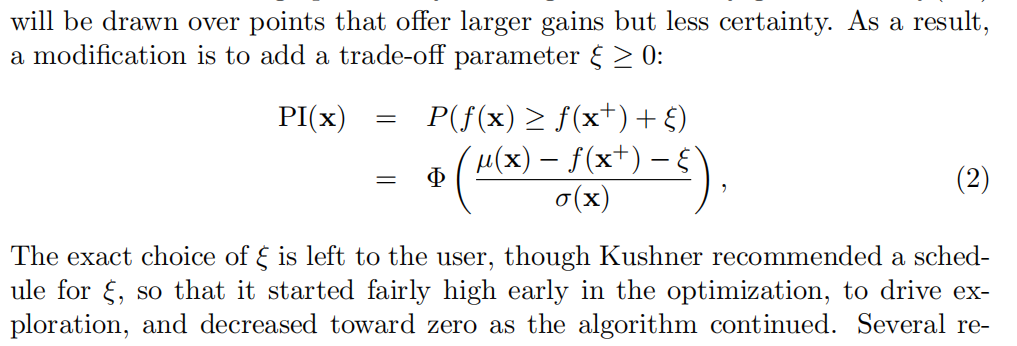 Do you think this is reasonable? It seems to be effective at present.
@Ruan-Yixiang I recommend you try using MVNXPB, which is a state-of-the-art approximator for Gaussian probabilities of the form
P(a < f(X) < b). In the case of qPI, this would look something like:# Compute posterior posterior = self.model.posterior( X=X, posterior_transform=self.posterior_transform ) # Define lower and upper bounds bounds = torch.nn.functional.pad(input=best_f - posterior.mean, pad=(1, 0) value=-float("inf")) # Evaluate log P(f(X) < best_f) log_prob = MVNXPB(posterior.covariance_matrix, bounds=bounds).solve() # Return 1 - P(f(X) < best_f) prob_improvement = log_prob.expm1().neg()
Thank you for the reply. I will try this soon.
@Ruan-Yixiang were you able to try this? Would be great if you could share your findings here.
I use the proportion greater than a tiny number (xi) in the HVI for MC samples as the probability of HVI. The code like this:
     self._compute_qehvi = areas_per_segment.sum(dim=-1)  # compute the HVI for each MC sample
    @concatenate_pending_points
    @t_batch_mode_transform()
    def forward(self, X: Tensor) -> Tensor:
        posterior = self.model.posterior(X)
        samples = self.sampler(posterior)
        hvi_per_sample = self._compute_qehvi(samples=samples)  # compute the HVI for each MC sample
        n_sample = hvi_per_sample.size()[0]  # the number of MC sample
        hvi_per_sample = torch.tensor(hvi_per_sample - self.xi).clamp_min(0)  # filter the tiny positive HVI
        sample_impr = torch.nonzero(hvi_per_sample).size()[0]
        # the proportion greater than a tiny number (xi) in the HVI for MC samples
        return torch.tensor(sample_impr / n_sample)   # p_of_hvi
The xi is equal the hypervolume/1000 here.
self.xi = partitioning.compute_hypervolume()/1000
From the current results, the code is effective.
Late to the game here, but implementing analytic PoI under the common assumption of independent objectives would also be easy to do

Closing this as inactive. If there is still interest in implementing this, we'd welcome a PR into botorch_community.