
EIP-PlantUML
 EIP-PlantUML copied to clipboard
Published
20 hours ago •
 plantuml-stdlib
plantuml-stdlib
Improve some icons based on Apache Camel EIP icons
At https://camel.apache.org/eip.html you find some variants on the typical EIP pattern icons which could be an improvement to the original icons introduced by GH. The EIP-PlantUML icons could be checked for these improvements.

To make this task more concrete, I've made a list of all the images from the linked page, and an overview of all sprites already in EIP-PlantUML
These are the 44 icons that need to be checked against those already in EIP-PlantUML:
- [ ] Aggregator

- [ ] ChannelAdapter

- [ ] Channel

- [ ] CompetingConsumers

- [ ] ContentBasedRouter

- [ ] ContentFilter

- [ ] ControlBus

- [ ] CorrelationIdentifier

- [ ] DataEnricher

- [ ] DeadLetterChannel

- [ ] Detour

- [ ] DistributionAggregate

- [ ] DurableSubscription

- [ ] DynamicRouter

- [ ] EventDrivenConsumer

- [ ] EventMessage

- [ ] GuaranteedMessaging

- [ ] MessageBroker

- [ ] MessageBus

- [ ] MessageDispatcher

- [ ] MessageEndpoint

- [ ] MessageExpiration

- [ ] MessageFilter

- [ ] Message

- [ ] MessageSelector

- [ ] MessageTranslator

- [ ] MessagingAdapter

- [ ] MessagingBridge

- [ ] MessagingGateway

- [ ] Normalizer

- [ ] PipesAndFilters

- [ ] PointToPoint

- [ ] PollingConsumer

- [ ] ProcessManager

- [ ] PublishSubscribe

- [ ] RecipientList

- [ ] RequestReply

- [ ] Resequencer

- [ ] ReturnAddress

- [ ] RoutingTable

- [ ] Splitter

- [ ] StoreInLibrary

- [ ] TransactionalClient

- [ ] WireTap

Full source from page
 |
Message Channel | How does one application communicate with another using messaging? |
 |
Message | How can two applications be connected by a message channel exchange a piece of information? |
 |
Pipes and Filters | How can we perform complex processing on a message while maintaining independence and flexibility? |
 |
Message Router | How can you decouple individual processing steps so that messages can be passed to different filters depending on a set of conditions? |
 |
Message Translator | How can systems using different data formats communicate with each other using messaging? |
 |
Message Endpoint | How does an application connect to a messaging channel to send and receive messages? |
 |
Point to Point Channel | How can the caller be sure that exactly one receiver will receive the document or perform the call? |
 |
Publish Subscribe Channel | How can the sender broadcast an event to all interested receivers? |
 |
Dead Letter Channel | What will the messaging system do with a message it cannot deliver? |
 |
Guaranteed Delivery | How can the sender make sure that a message will be delivered, even if the messaging system fails? |
 |
Channel Adapter | How can you connect an application to the messaging system so that it can send and receive messages? |
 |
Messaging Bridge | How can multiple messaging systems be connected so that messages available on one are also available on the others?? |
 |
Message Bus | What is an architecture that enables separate applications to work together, but in a de-coupled fashion such that applications can be easily added or removed without affecting the others? |
|
Change Data Capture | Data synchronization by capturing changes made to a database, and apply those changes to another system. |
 |
Event Message | How can messaging be used to transmit events from one application to another? |
 |
Request Reply | When an application sends a message, how can it get a response from the receiver? |
 |
Return Address | How does a replier know where to send the reply? |
 |
Correlation Identifier | How does a requestor that has received a reply know which request this is the reply for? |
 |
Message Expiration | How can a sender indicate when a message should be considered stale and thus shouldn’t be processed? |
|
Content Based Router | How do we handle a situation where the implementation of a single logical function (e.g., inventory check) is spread across multiple physical systems? |
 |
Message Filter | How can a component avoid receiving uninteresting messages? |
 |
Dynamic Router | How can you avoid the dependency of the router on all possible destinations while maintaining its efficiency? |
 |
Recipient List | How do we route a message to a list of (static or dynamically) specified recipients? |
 |
Splitter | How can we process a message if it contains multiple elements, each of which may have to be processed in a different way? |
 |
Aggregator | How do we combine the results of individual, but related messages so that they can be processed as a whole? |
 |
Resequencer | How can we get a stream of related but out-of-sequence messages back into the correct order? |
 |
Composed Message Processor | How can you maintain the overall message flow when processing a message consisting of multiple elements, each of which may require different processing? |
|
Scatter-Gather | How do you maintain the overall message flow when a message needs to be sent to multiple recipients, each of which may send a reply? |
 |
Routing Slip | How do we route a message consecutively through a series of processing steps when the sequence of steps is not known at design-time and may vary for each message? |
 |
Process Manager | How do we route a message through multiple processing steps when the required steps may not be known at design-time and may not be sequential? |
 |
Message Broker | How can you decouple the destination of a message from the sender and maintain central control over the flow of messages? |
 |
Threads | How can I decouple the continued routing of a message from the current thread? |
|
Throttler | How can I throttle messages to ensure that a specific endpoint does not get overloaded, or we don’t exceed an agreed SLA with some external service? |
 |
Sampling | How can I sample one message out of many in a given period to avoid downstream route does not get overloaded? |
|
Kamelet | How can I call Kamelets (route templates). |
|
Delayer | How can I delay the sending of a message? |
 |
Load Balancer | How can I balance load across a number of endpoints? |
|
Circuit Breaker | How can I stop to call an external service if the service is broken? |
|
Stop | How can I stop continue routing a message? |
 |
Service Call | How can I call a remote service in a distributed system where the service is looked up from a service registry of some sorts? |
 |
Saga | How can I define a series of related actions in a Camel route that should be either completed successfully (all of them) or not-executed/compensated? |
|
Multicast | How can I route a message to a number of endpoints at the same time? |
 |
Loop | How can I repeat processing a message in a loop? |
 |
Content Enricher | How do we communicate with another system if the message originator does not have all the required data items available? |
 |
Content Filter | How do you simplify dealing with a large message, when you are interested only in a few data items? |
 |
Claim Check | How can we reduce the data volume of message sent across the system without sacrificing information content? |
 |
Normalizer | How do you process messages that are semantically equivalent, but arrive in a different format? |
|
Sort | How can I sort the body of a message? |
|
Script | How do I execute a script which may not change the message? |
 |
Validate | How can I validate a message? |
|
Messaging Mapper | How do you move data between domain objects and the messaging infrastructure while keeping the two independent of each other? |
 |
Event Driven Consumer | How can an application automatically consume messages as they become available? |
|
Polling Consumer | How can an application consume a message when the application is ready? |
 |
Competing Consumers | How can a messaging client process multiple messages concurrently? |
|
Message Dispatcher | How can multiple consumers on a single channel coordinate their message processing? |
|
Selective Consumer | How can a message consumer select which messages it wishes to receive? |
 |
Durable Subscriber | How can a subscriber avoid missing messages while it’s not listening for them? |
|
Idempotent Consumer | How can a message receiver deal with duplicate messages? |
|
Resumable Consumer | How can a message receiver resume from last known offset? |
|
Transactional Client | How can a client control its transactions with the messaging system? |
|
Messaging Gateway | How do you encapsulate access to the messaging system from the rest of the application? |
|
Service Activator | How can an application design a service to be invoked both via various messaging technologies and via non-messaging techniques? |
 |
ControlBus | How can we effectively administer a messaging system that is distributed across multiple platforms and a wide geographic area? |
 |
Detour | How can you route a message through intermediate steps to perform validation, testing or debugging functions? |
 |
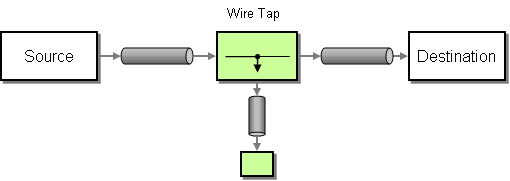
Wire Tap | How do you inspect messages that travel on a point-to-point channel? |
|
Message History | How can we effectively analyze and debug the flow of messages in a loosely coupled system? |
|
Log | How can I log processing a message? |
|
Step | Groups together a set of EIPs into a composite logical unit for metrics and monitoring. |
