
morpho-v1-deprecated
 morpho-v1-deprecated copied to clipboard
 morpho-org
Core contracts of Morpho's protocol V1.
Morpho Core Protocol V1

What is Morpho?
Morpho is a lending pool optimizer: it improves the capital efficiency of positions on existing lending pools by seamlessly matching users peer-to-peer.
- Morpho's rates stay between the supply rate and the borrow rate of the pool, reducing the interests paid by the borrowers while increasing the interests earned by the suppliers. It means that you are getting boosted peer-to-peer rates or, in the worst case scenario, the APY of the pool.
- Morpho also preserves the same experience, the same liquidity and the same parameters (collateral factors, oracles, …) as the underlying pool.
TL;DR: Instead of borrowing or lending on your favorite pool like Compound or Aave, you would be better off using Morpho-Compound or Morpho-Aave directly.
Contracts overview
Morpho protocol is designed at its core with a set of contracts acting as a proxy and communicating with upgradeable pieces of logic via calls (to implementation contracts) and delegate calls (to delegation contracts). Here is a brief overview of the Morpho protocol's contracts interactions:
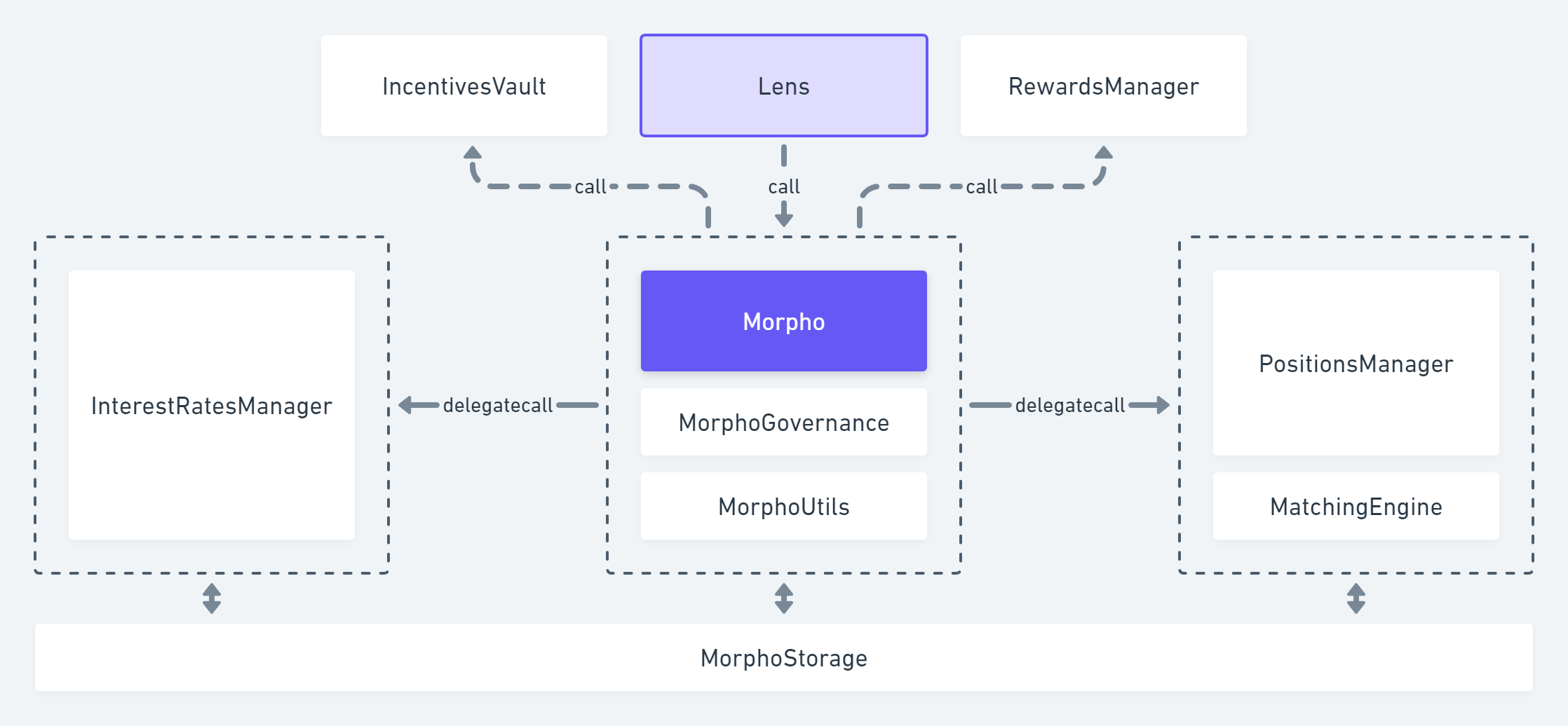
The protocol's storage, located at Morpho's main proxy contract, is defined in the MorphoStorage contract and is used by every delegation contract. Having this overview in mind, Morpho contracts typically fall under the following 4 main categories:
- Core features (supply, borrow, withdraw, repay, liquidate)
- Underlying logic (peer-to-peer matching, positions management)
- Peripheral contracts (lending/borrowing incentives, underlying protocol rewards management)
- Miscellaneous (maths, solidity calls, types)
Documentation
- White Paper
- Morpho Documentation
- Yellow Paper (coming soon)
Bug bounty
A bug bounty is open on Immunefi. The rewards and scope are defined here. You can also send an email to [email protected] if you find something worrying.
Morpho-Compound on Ethereum
- Morpho Proxy: 0x8888882f8f843896699869179fb6e4f7e3b58888
- Morpho Implementation: 0xd5ae0dabb7fc3bdb7d11d6aa13e7b5e01db4866a
- PositionsManager: 0x082bf6702e718483c85423bd279088c215a21302
- InterestRatesManager: 0xe3556899a0f9faffc20cfbc6f926e2a377a1e5f3
- RewardsManager Proxy: 0x78681e63b6f3ad81ecd64aecc404d765b529c80d
- RewardsManager Implementation: 0x70c59877f5358d8d6f2fc90f53813eb2b2698ab7
- Lens Proxy: 0x930f1b46e1d081ec1524efd95752be3ece51ef67
- Lens: 0xe8cfa2edbdc110689120724c4828232e473be1b2
- CompRewardsLens: 0x9e977f745d5ae26c6d47ac5417ee112312873ba7
Morpho-Aave on Ethereum
- Morpho Proxy: 0x777777c9898d384f785ee44acfe945efdff5f3e0
- Morpho Implementation: 0x299ff2534c6f11624d6a65463b8b40c958ab668f
- EntryPositionsManager: 0xdf93cf1ca3acf96bc26783e6fab89400d362d0b4
- ExitPositionsManager: 0xf6998f72b92b81c8f683d30ed8678d348fe9754b
- InterestRatesManager: 0x400af815ef4de9e564fbf37268351a50134e6e36
- Lens Proxy: 0x507fa343d0a90786d86c7cd885f5c49263a91ff4
- Lens: 0x8706256509684e9cd93b7f19254775ce9324c226
Common contracts on Ethereum
- ProxyAdmin: 0x99917ca0426fbc677e84f873fb0b726bb4799cd8
Licensing
The code is under the GNU General Public License v3.0 license, see LICENSE.
Setup & Testing
First, you must install dependencies with:
yarn
To conduct test or deploy contracts you must create an environment file named .env.local and fill the environment variables.
cp .env.example .env.local
For the RPC endpoint you can choose your preferred one (do not forget to update the Makefile or hardhat.config.js accordingly).
DEPLOYER_PRIVATE_KEY is only required to deploy contracts.
Testing with Foundry
Tests are run against a fork of the Ethereum mainnet, which allows us to interact directly with Compound.
You must install Foundry. Run the command below to get foundryup, the Foundry toolchain installer:
curl -L https://foundry.paradigm.xyz | bash
If you do not want to use the redirect, feel free to manually download the foundryup installation script from here.
Then in a new terminal session or after reloading your PATH, run it to get the latest forge version:
foundryup
Finally, update git submodules:
git submodule init
git submodule update
To run tests on different platforms, navigate a Unix terminal to the root folder of the project and run the command of your choice.
To run every tests:
make test-compound
or to run only the desired test contract:
make c-{TestContractName}
make c-TestBorrow
make c-TestGovernance
...
or to run individual tests:
make s-{testFunctionName}
make s-testSupply1
make s-testSupply2
...
For the other commands, check the Makefile.
Testing with hardhat
Some hardhat tests are also present on this repository (testing of the IncentivesVault contract).
You just need to run:
yarn test
For the other commands, check the package.json file.
Questions & Feedback
For any question or feedback you can send an email to [email protected].
 morpho-org