micropython
Update _sha512.py
refactoring code with var unpack which is more pythonic, concise, readable and efficient; how do think this change which has practical value?

Unpacking args requires extra memory allocation behind the scenes, which can be undesirable in some cases (e.g. can lead to memory fragmentation).

Thank you @dlech. I am not very clear about the extra memory allocation. Would you like to explain why there is extra memory allocation? Is it slice or something?
Unpacking args requires extra memory allocation behind the scenes, which can be undesirable in some cases (e.g. can lead to memory fragmentation).
Thank you. Yes, however, when I test it, the print is weird, it shows no difference about memory usage.
from memory_profiler import profile
@profile
def print_arg(*arg):
    print(*arg)
# instantiating the decorator
@profile
# code for which memory has to
# be monitored
def my_func():
    a=[i for i in range(100)]
    print_arg(a[0],a[1],a[2],a[3],a[4],a[5],a[6],a[7],a[8],a[9],a[10])
    print_arg(*a[0:11:1])


if __name__ == '__main__':
    my_func()
The output is:
Line #    Mem usage    Increment  Occurrences   Line Contents
=============================================================
     6     41.7 MiB     41.7 MiB           1   @profile
     7                                         # code for which memory has to
     8                                         # be monitored
     9                                         def my_func():
    10     41.7 MiB      0.0 MiB         103       a=[i for i in range(100)]
    11     41.7 MiB      0.0 MiB           1       print_arg(a[0],a[1],a[2],a[3],a[4],a[5],a[6],a[7],a[8],a[9],a[10])
    12     41.7 MiB      0.0 MiB           1       print_arg(*a[0:11:1])
It looks like you performed the test using Python, not MicroPython. CPython uses reference counting, so all of the implicit tuple and slice objects are most likely freed by the time the method returns. Also you would have to allocate at least 100KiB in order for anything to show up when the memory is being measured in MiB with one decimal place.
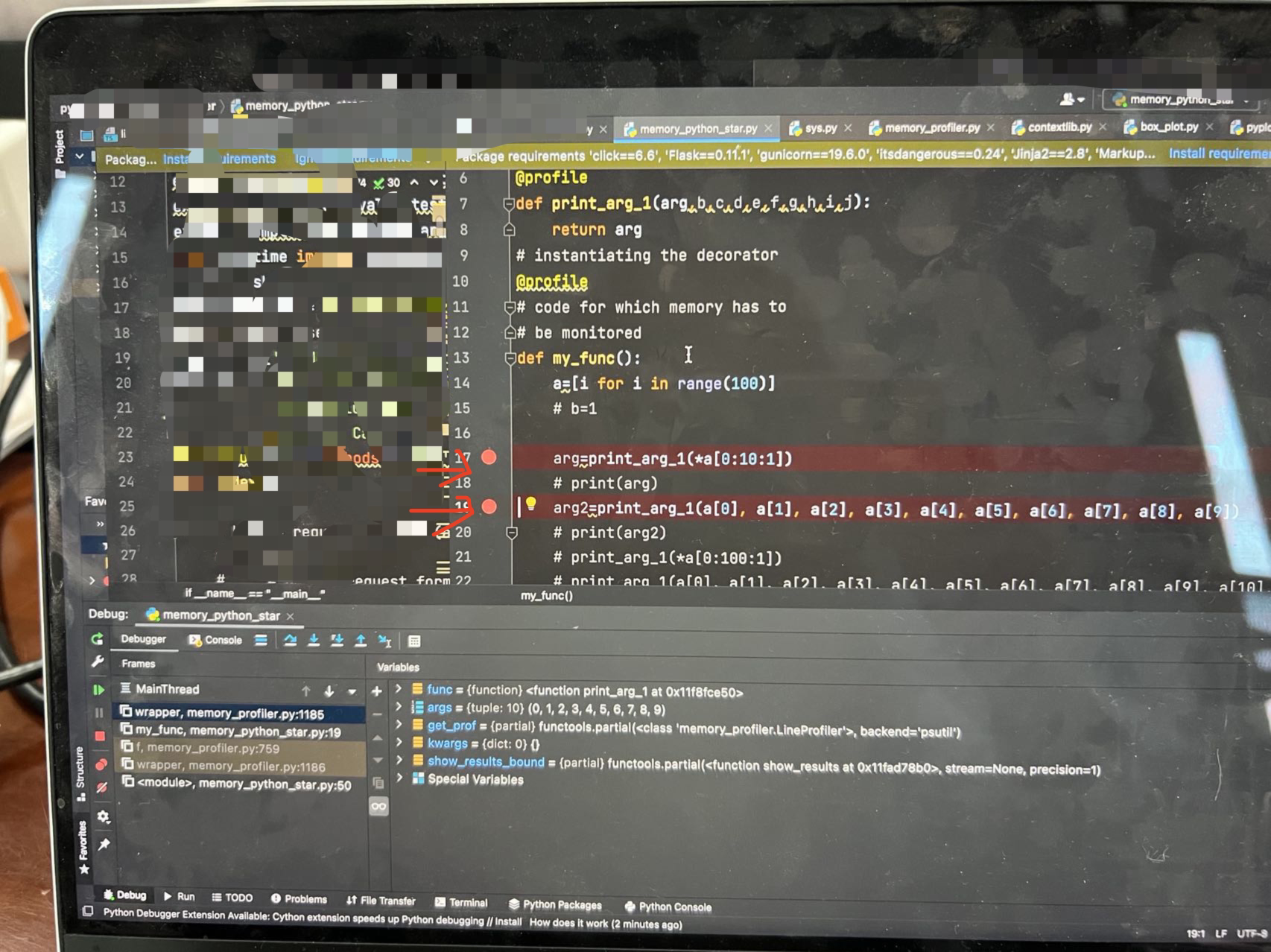
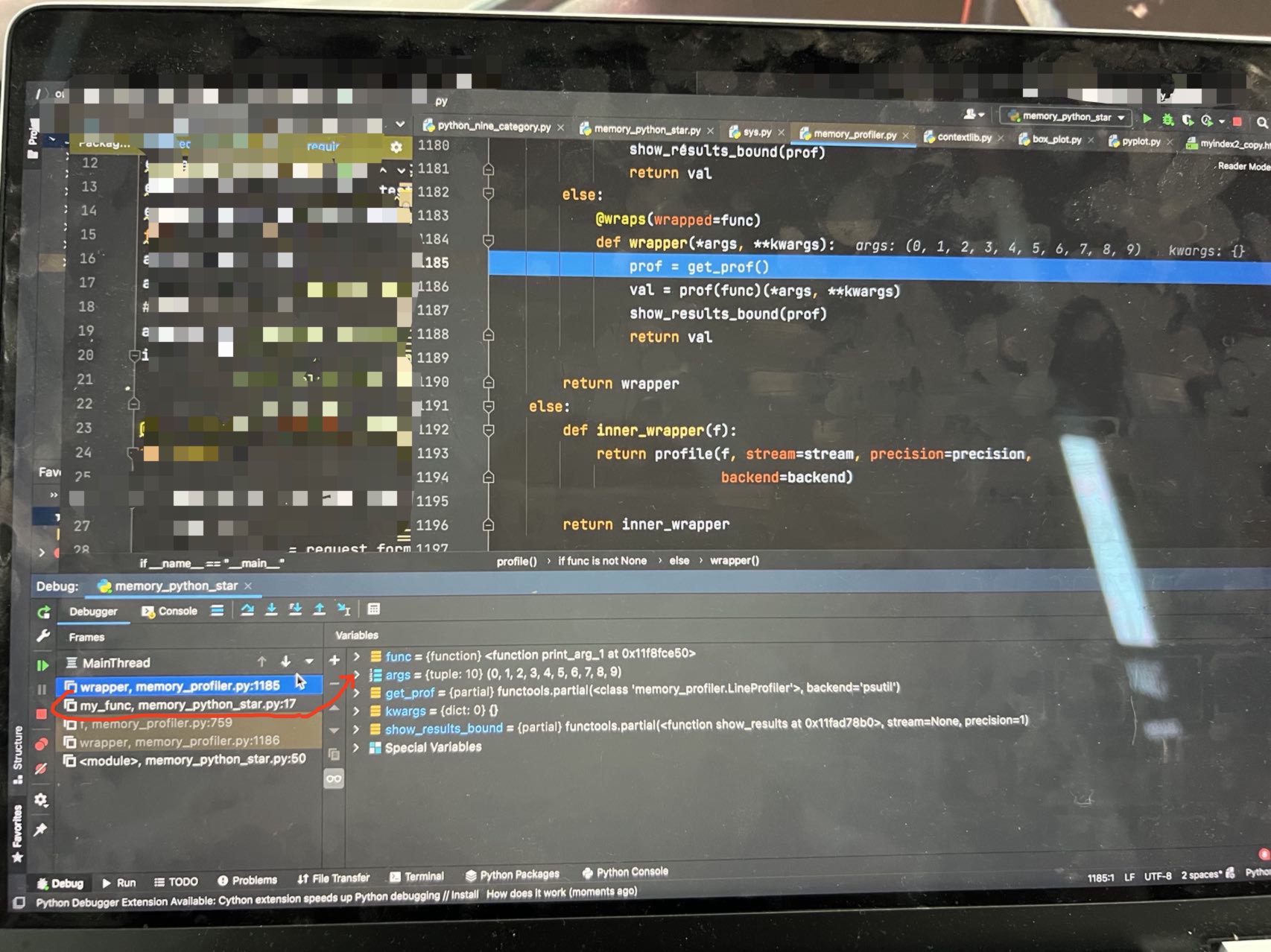
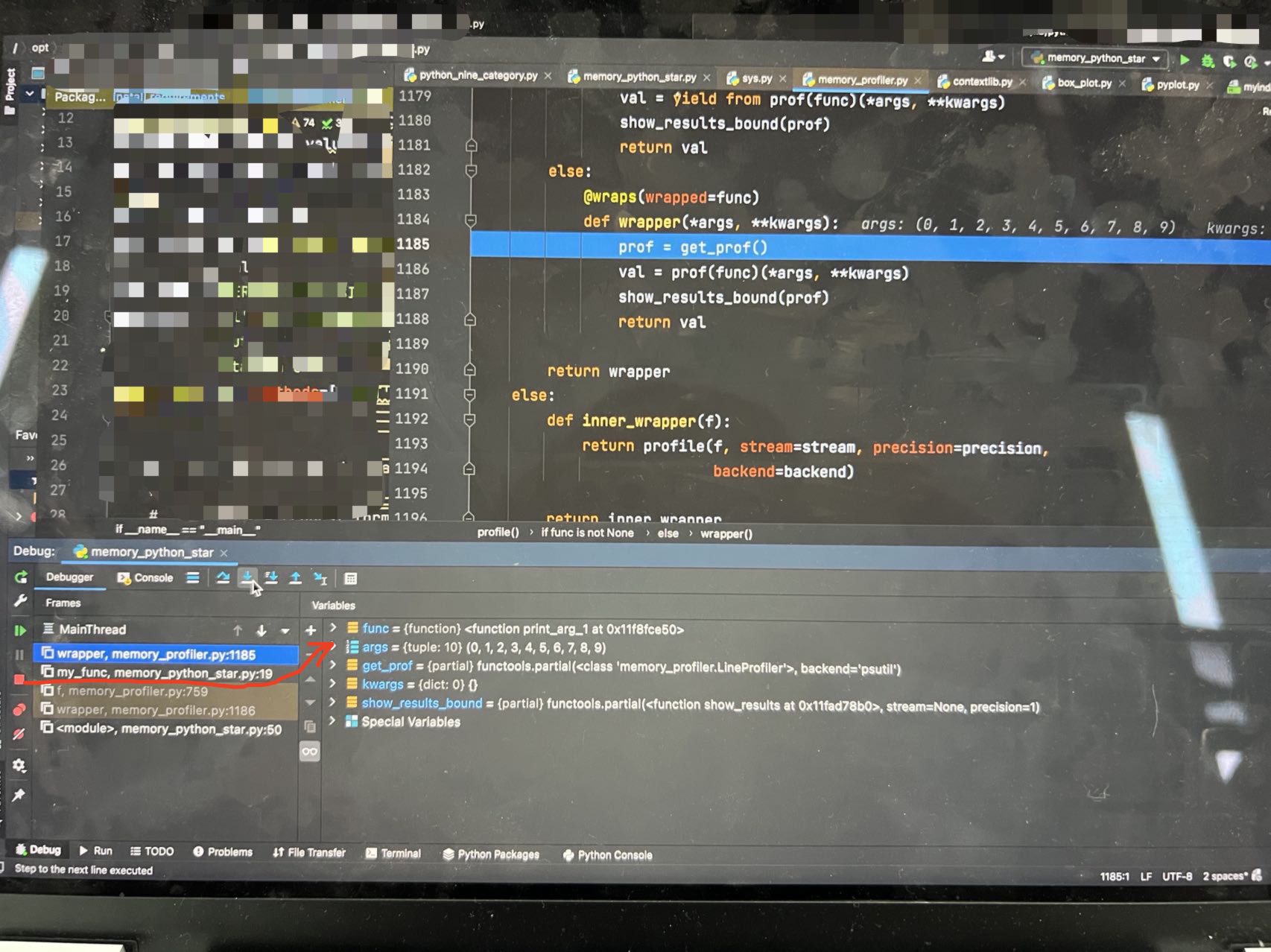
Thank you. However, I am a little confused because when I set breakpoints for the two lines of code (arg=print_arg_1(*a[0:10:1]) in line 17 and arg2=print_arg_1(a[0], a[1], a[2], a[3], a[4], a[5], a[6], a[7], a[8], a[9]) in line 19) from figure 1. It seems no additional tuple is created. Specifically, in figure 2, we could see the args is a tuple. And then in figure 3, the args is still a tuple.
Doing a slice like ss[0:7:1] will allocate a new bytes/bytearray object. So this is not an efficient way to do it.