

 malmaud
Normalize a batch of tensors
I created a function to normalize a batch. It works if my batch contains some arrays but not with some tensors.
First, I'm creating a batch like in my neural network.
batch_1 = [1.0 3 5 7 8 ; 6 8 10 11 12 ; 2 4 5 6 7]  # Output values

batch_1 = reshape(batch_1, (3,1,5))

batch_2 = [1.0; 6; 2]  # Input values

# With the following function, I will have the output value in batch[1] and the input values in batch[2]

function create_batch(batch_1, batch_2)
    return (batch_1, batch_2)
end

batch = create_batch(batch_1, batch_2)
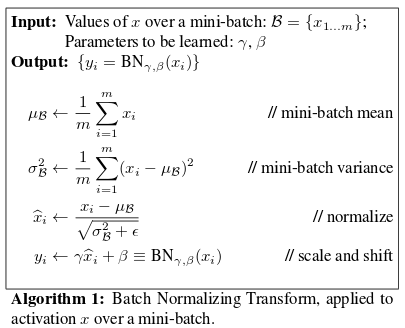
I'm working with luminance and temperatures, so it explains the names in my function to normalize the batch. I used the following picture to create the function where I taken gamma, beta and epsilon:
function Batch_norm(batch, gamma, beta, epsilon)

    lum_batch = batch[1]  # Luminance

    temp_batch = batch[2] # Temperature

    batch_size = length(temp_batch)

    mean_lum_base = sum(lum_batch,1) / batch_size  # Mean
    mean_lum = deepcopy(lum_batch)
    for i in 1:batch_size
        mean_lum[i,:,:] = mean_lum_base[:,1,:]
    end

    v_lum_base = sum((lum_batch - mean_lum).^2,1) / batch_size  # Variance

    v_lum = deepcopy(lum_batch)
    for i in 1:batch_size
        v_lum[i,:,:] = v_lum_base[:,1,:]
    end

    lum_batch_norm = (lum_batch - mean_lum) ./ sqrt.(v_lum + epsilon)

    lum_batch_new = (gamma.*lum_batch_norm) + beta


    mean_temp_base = sum(temp_batch,1) / batch_size # Mean
    mean_temp = deepcopy(temp_batch)
    for i in 1:batch_size
        mean_temp[i,:,:] = mean_temp_base[:,1,:]
    end

    v_temp_base = sum((temp_batch - mean_temp).^2,1) / batch_size  # variance

    v_temp = deepcopy(temp_batch)
    for i in 1:batch_size
        v_temp[i,:,:] = v_temp_base[:,1,:]
    end

    temp_batch_norm = (temp_batch - mean_temp) ./ sqrt.(v_temp + epsilon)

    temp_batch_new = (gamma.*temp_batch_norm) + beta

    return (lum_batch_new, temp_batch_new, temp_batch)

end
With the precedent batch, it's giving the following:
batch_norm = Batch_norm(batch, 1,1, 0)
([0.0741799; 2.38873; 0.53709]

[0.0741799; 2.38873; 0.53709]

[0.292893; 2.41421; 0.292893]

[0.53709; 2.38873; 0.0741799]

[0.53709; 2.38873; 0.0741799], [0.0741799, 2.38873, 0.53709], [1.0, 6.0, 2.0])
Now, I'm converting batch_1 and batch_2 to tensors:
batch_1_tensor = convert(TensorFlow.Tensor{Float32}, batch_1)

batch_2_tensor = convert(TensorFlow.Tensor{Float32}, batch_2)

batch_tensor = create_batch(batch_1_tensor,batch_2_tensor)
I can't normalize the batch with my function, batch_tensor_norm = Batch_norm(batch_tensor, 1, 0 , 0) return the following error:
ERROR: MethodError: no method matching start(::TensorFlow.TensorRange)
Closest candidates are:
  start(::SimpleVector) at essentials.jl:258
  start(::Base.MethodList) at reflection.jl:560
  start(::ExponentialBackOff) at error.jl:107
  ...
Stacktrace:
 [1] Batch_norm(::Tuple{TensorFlow.Tensor{Float32},TensorFlow.Tensor{Float32}}, ::Int64, ::Int64, ::Int64) at ./REPL[14]:11
Moreover, I would want my function return directly a tensor and not an array...

For usage help I recommended stack, overflow, the Julia slack, or the Julia discourse forum. Github issues are are best for bug reports and feature requests.
As a general statement without a close look at your code I think you might want to work through a tutorial or two. I say thus because TensorFlow code normally includes calls to run, after using placeholder, and get_varuable stuff to build up a graph. Remember, a TensorFlow Tensor is not a container type. It is a symbolic type. Code that works on arrays rarely trivially translates. Defining a graph that does Looping over parts of a tensor, and setting elements is nontrivial and generally not the right way to go about things. (You might have more luck with that kinda approach in say Flux.jl)

Thank you for your answer @oxinabox . I posted this question to stack overflow Flux.jl does not work with placeholders (I opened an issue about this), so I can't use it yet. I have a complete network with placeholders and calls to run but I think it is too long to post all... So, I created a minimal code
Having only looked at the error in the OP, should we be defining start(::TensorRange), @oxinabox ?

So to add features to TensorFlow.jl we'ld need indexed assignment (already an open issue) Iteration for TensorRange (i'ld leave this til Julia 0.7 since it changing)
And the code can't use deepcopy. We might be able to define similar which would do. But it might be fiddly?or do we have it already.
The result would be a very complicated graph.