

 malmaud
Graph differences between Python and Julia
I thought it be useful to have an issue that tracks how the graphs produced by the julia version differs from the graphs produced by the python version. Lets update these bullet points as the package progresses and add more examples if some come up.
-
[ ] Group optimizer nodes. In the julia version, the operations of something like
GradientDescentOptimizerare not grouped together. -
[x]
TensorFlow.summary.FileWriter(dir)fails ifdirdoes not exists, while the python version creates it. (fixed by #331 )
Linear Regression Example
Description: A simple LinReg example from the TensorFlow documentation
Source: https://www.tensorflow.org/get_started/get_started#complete_program
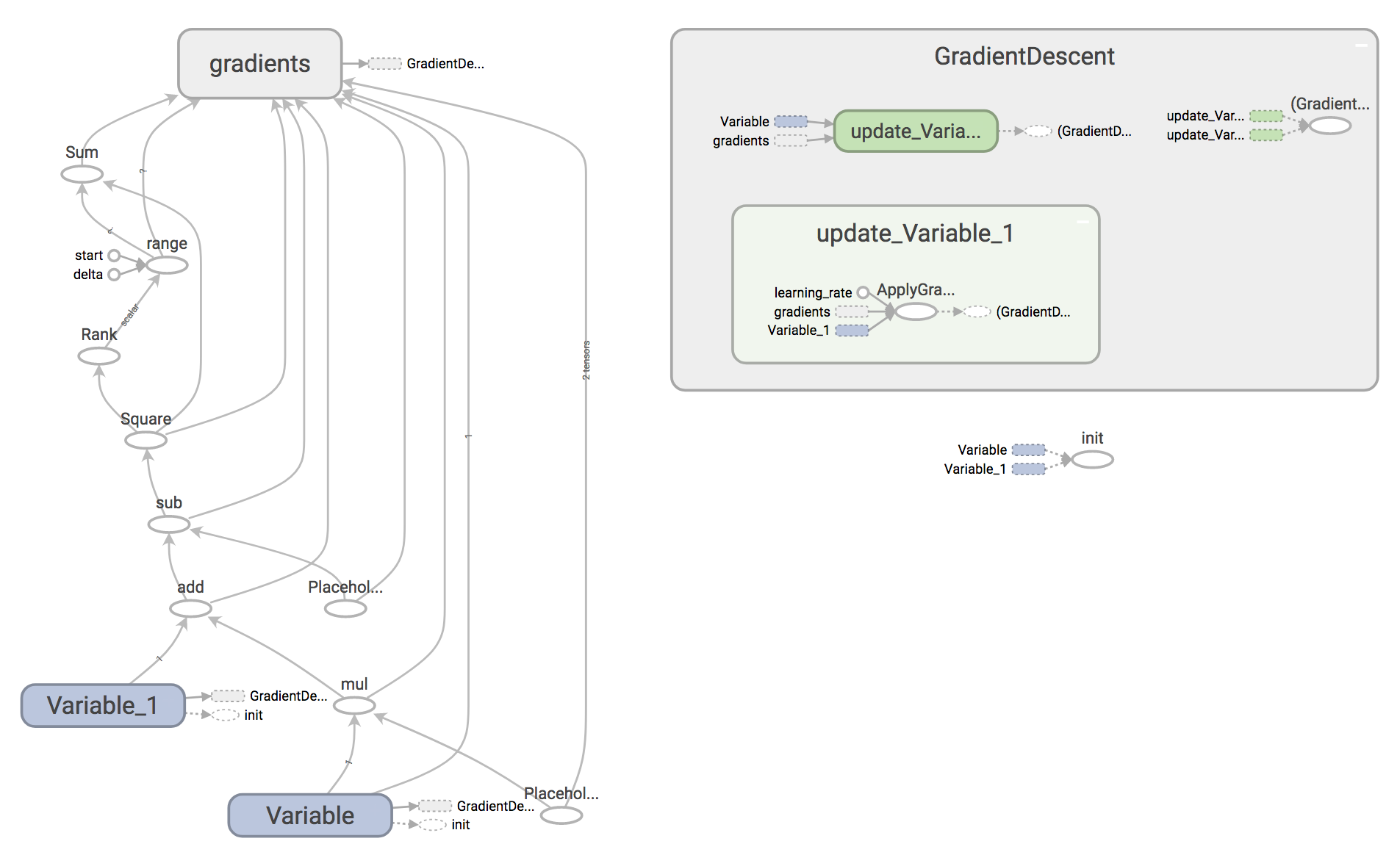
| Python (reference) | Julia |
|---|---|
 |
 |
-
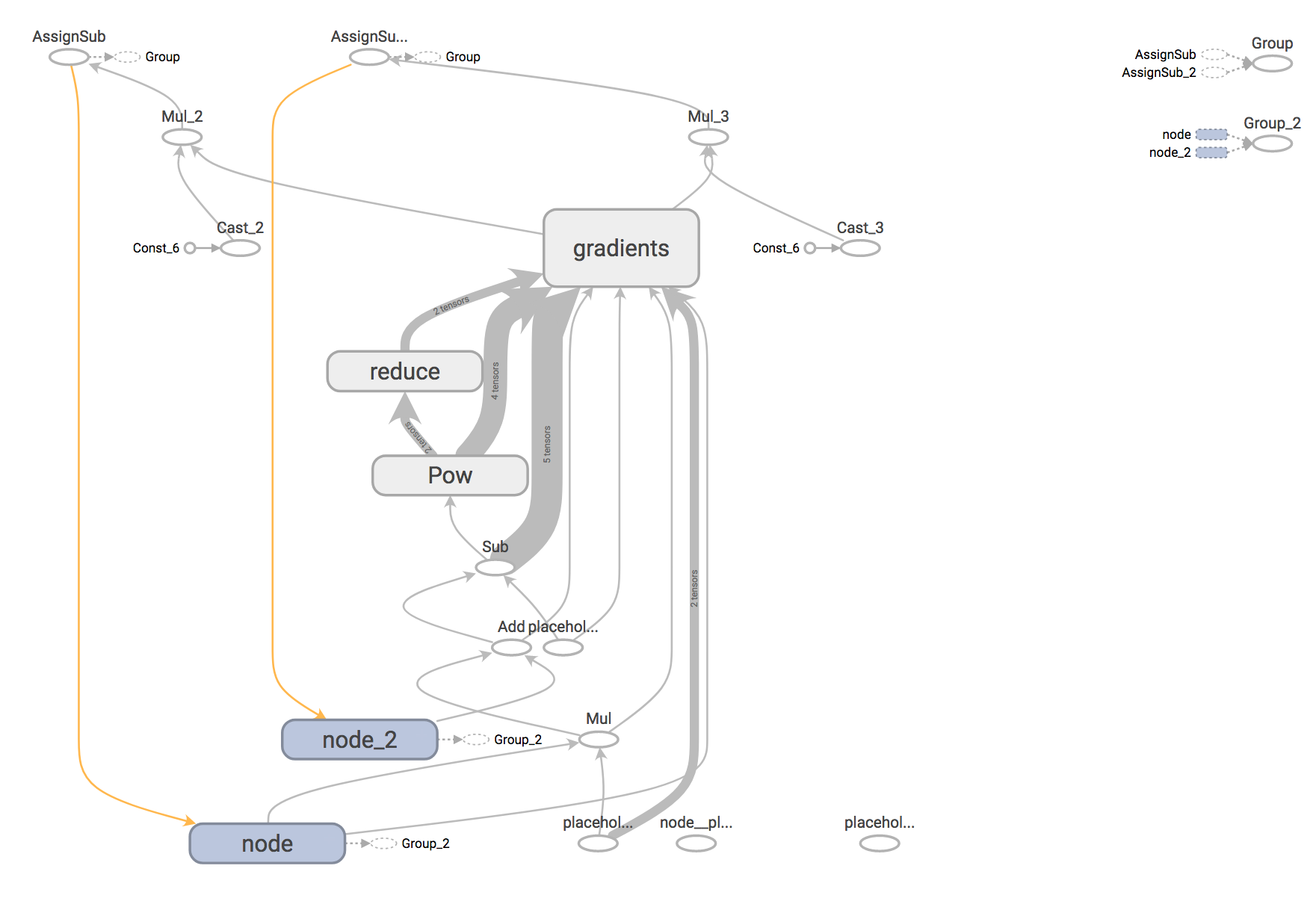
In Julia some of the operations are grouped into a
reduceblock, while python doesn't do that. That doesn't strictly seem like a bad thing that needs fixing though. -
Python groups
GradientDescentnicely together. All these free floating notes on the top left of the julia version are fromtrain(I checked that by usingwith_ops_name) -
The Julia version causes two dummy placeholder variables that are visible in the bottom right of the graph. They are named
node__placeholder__1_1andplaceholder__placeholder__1_1.
Code for the Julia version:
using TensorFlow
tfsession = Session(Graph())

# Model parameters
W = Variable([.3f0])
b = Variable([-.3f0])
# Model input and output
x = placeholder(Float32)
linear_model = W .* x + b
y = placeholder(Float32)

# loss
loss = reduce_sum((linear_model .- y).^2)
# optimizer
optimize = train.GradientDescentOptimizer(0.01)
alg = train.minimize(optimize, loss)

# training data
x_train = Float32[1, 2, 3, 4]
y_train = Float32[0, -1, -2, -3]
# training loop
run(tfsession, global_variables_initializer())
for i in 1:1000
    run(tfsession, alg, Dict(x=>x_train, y=>y_train))
end

# evaluate training accuracy
curr_W, curr_b, curr_loss = run(tfsession, [W, b, loss], Dict(x=>x_train, y=>y_train))
println("W: $(curr_W) b: $(curr_b) loss: $(curr_loss)")
summary_writer = TensorFlow.summary.FileWriter("testlog")
Example 2
...
