

 knative
Support Topology Aware Hint
What is changing? (Please include as many details as possible.)
The address that Knative registers in Revision's EndpointSlice does not include zone information. Can we include zone information to optimize traffic routing?
https://kubernetes.io/docs/concepts/services-networking/topology-aware-hints/#implementation-control-plane
How will this impact our users?
In what release will this take happen (to the best of your knowledge)?
Ex. v0.2-v0.3
Context
None
Additional info

AFAIK, we do not currently set EndpointSlice. They are generated by the k8s controller that mirrors the Endpoints.
@kahirokunn what would you need the info for? Do you have special use-case for that?

@ReToCode
AFAIK, we do not currently set EndpointSlice. They are generated by the k8s controller that mirrors the Endpoints.
What does this mean? I may have misunderstood how this part works. I am curious and would appreciate a little more explanation if possible.
what would you need the info for? Do you have special use-case for that?
I am building a microservice in Knative on EKS. I am using 3 availability zones. I am using three availability zones, and traffic crosses the zones. When traffic crosses a zone, I have to pay by the number of bytes communicated between ingress and egress of the zone. Topology Aware Hint can solve the problem of East-West Traffic.
What does this mean?
Knative does not create the EndpointSlices (at least for now). Kubernetes does this automatically based on the Endpoints object to keep them in sync. So we (meaning Knative) do not know about the topology and could not add anything to the EndpointSlices.
From your use-case I do not understand how having that would help you. Couldn't you label your nodes with their availability zones and then use this: https://kubernetes.io/docs/concepts/scheduling-eviction/assign-pod-node/ to schedule certain services to a specific zone?
@ReToCode This is the motivation behind the topology aware hint. https://github.com/kubernetes/enhancements/blob/master/keps/sig-network/2433-topology-aware-hints/README.md#motivation
Knative Serving Controller actually generates the following Endpoints.
apiVersion: v1
kind: Endpoints
metadata:
  annotations:
    argocd.argoproj.io/tracking-id: sample-service:serving.knative.dev/Service:sample-service/sample-service
    service.kubernetes.io/topology-aware-hints: auto
    serving.knative.dev/creator: system:serviceaccount:argocd:argocd-application-controller
    serving.knative.dev/lastModifier: system:serviceaccount:argocd:argocd-application-controller
  creationTimestamp: "2023-01-31T03:15:33Z"
  labels:
    argocd.argoproj.io/instance: sample-service
    serving.knative.dev/route: sample-service
    serving.knative.dev/service: sample-service
  name: sample-service
  namespace: sample-service
  ownerReferences:
  - apiVersion: serving.knative.dev/v1
    blockOwnerDeletion: true
    controller: true
    kind: Route
    name: sample-service
    uid: ba45fc94-dbab-4b69-b89a-1a0cb7ecda41
  resourceVersion: "18448192"
  uid: 80501913-352f-4f7d-bb02-d993045b47bb
subsets:
- addresses:
  - ip: 172.20.160.124
  ports:
  - name: http2
    port: 80
    protocol: TCP
I will give you one example.
Contour-external-envoy has Topology Aware Hints for Endpoint Slices.
$ kubectl get endpointslices -n contour-external contour-external-envoy-6rkdj -o yaml | yq .endpoints[].hints
forZones:
  - name: ap-northeast-1d
forZones:
  - name: ap-northeast-1c
forZones:
  - name: ap-northeast-1a
Endpoints in contour-external-envoy have nodeName and targetRef in the addresses.
apiVersion: v1
kind: Endpoints
metadata:
  annotations:
    endpoints.kubernetes.io/last-change-trigger-time: "2023-02-23T00:04:48Z"
  creationTimestamp: "2023-01-10T02:05:12Z"
  labels:
    app.kubernetes.io/component: envoy
    app.kubernetes.io/instance: contour-external
    app.kubernetes.io/managed-by: Helm
    app.kubernetes.io/name: contour
    argocd.argoproj.io/instance: contour-external
    helm.sh/chart: contour-10.1.3
    networking.knative.dev/ingress-provider: contour
  name: contour-external-envoy
  namespace: contour-external
  resourceVersion: "38885079"
  uid: 6c86fea3-9d45-4fb5-895c-c80113d21618
subsets:
- addresses:
  - ip: 10.0.102.125
    nodeName: ip-10-0-108-135.ap-northeast-1.compute.internal
    targetRef:
      kind: Pod
      name: contour-external-envoy-8666f67765-cvnr6
      namespace: contour-external
      uid: be4267e6-8e63-4672-afe6-86a2fd18fd55
  - ip: 10.0.145.30
    nodeName: ip-10-0-155-68.ap-northeast-1.compute.internal
    targetRef:
      kind: Pod
      name: contour-external-envoy-8666f67765-7xgsc
      namespace: contour-external
      uid: 86783d60-774f-4dee-acbe-af9a6bb98aa2
  - ip: 10.0.52.106
    nodeName: ip-10-0-36-223.ap-northeast-1.compute.internal
    targetRef:
      kind: Pod
      name: contour-external-envoy-8666f67765-tmhjf
      namespace: contour-external
      uid: fc36ba6e-e448-49f5-9f61-42762c9a6896
  ports:
  - name: https
    port: 8443
    protocol: TCP
  - name: http
    port: 8080
    protocol: TCP
Perhaps this lack of information is the reason why k8s controller cannot add Topology Aware Hints.
Is it possible to add nodeName and targetRef to subsets[].addresses[] of Endpoints generated by Knative Serving?
Or is there a reason not to add the nodeName and targetRef that everyone else is adding?
I found the code. Is it one of these?
https://github.com/knative/serving/blob/1d1cd7946090e3df2765be6b30865bf86434f31d/pkg/autoscaler/statforwarder/leases.go#L236
https://github.com/knative/serving/blob/45f7c054f69448695d4e9bc11f5a451b3c9f1eff/pkg/reconciler/route/resources/service.go#L127
@ReToCode I don't know the details of how knative serving works, but is it something like this? https://github.com/knative/serving/pull/13727
Hey @kahirokunn so our Revision's K8s service endpoints is manually managed by our ServerlessService controller here
https://github.com/knative/serving/blob/main/pkg/reconciler/serverlessservice/serverlessservice.go
But I believe even settings hints won't help as the activator performs it's own load balancing and it's not hint aware. A general concern I have is how some things could become unbalanced. ie. if the ingress picks an activator that's in the same AZ - it might cause an imbalance in the spread of requests.
Related to your PR #13727 it won't have the desired effect you're looking for - the statsforwarder is used to forward stats from one autoscaler to another when they're running in a high availability setup. The target autoscaler is known because it is the lease holder for a specific revision.

I don't have a great answer to your problem. You could try and run distinct clusters in the same AZ (with Knative deployed to each one) and perform some global routing over that.
Otherwise making some Knative components topology aware would require a lot of thought about how it works, what knobs operators and users can control etc. This would warrant going through the feature track process - https://github.com/knative/community/blob/main/mechanics/FEATURE-TRACKS.md
But I believe even settings hints won't help as the activator performs it's own load balancing and it's not hint aware.
Knative will initially load-balance the Activator, but as the number of pods grows, it will no longer go through the Activator. Therefore, it is still effective to set up hints.
However, in the case of a pod that handles images and video, network fees are very expensive, so we don't want to cross the zone.
So, I think it is good to separate the implementation of hints in the Service and the load balancing by the Activator as per the Hints.
ie. if the ingress picks an activator that's in the same AZ - it might cause an imbalance in the spread of requests.
This is what we would rather see happen. We would rather that this be the case, since we can just disperse them on the path to Knative Ingress. If the path from Ingress to Activator is not also concentrated in the same AZ, the cross zone fee may be added.
Now, the maximum number of times you cross over is two, so you will incur three times the network charges as if you did not cross over. This is critical for services that have a large number of users or that exchange large amounts of data.
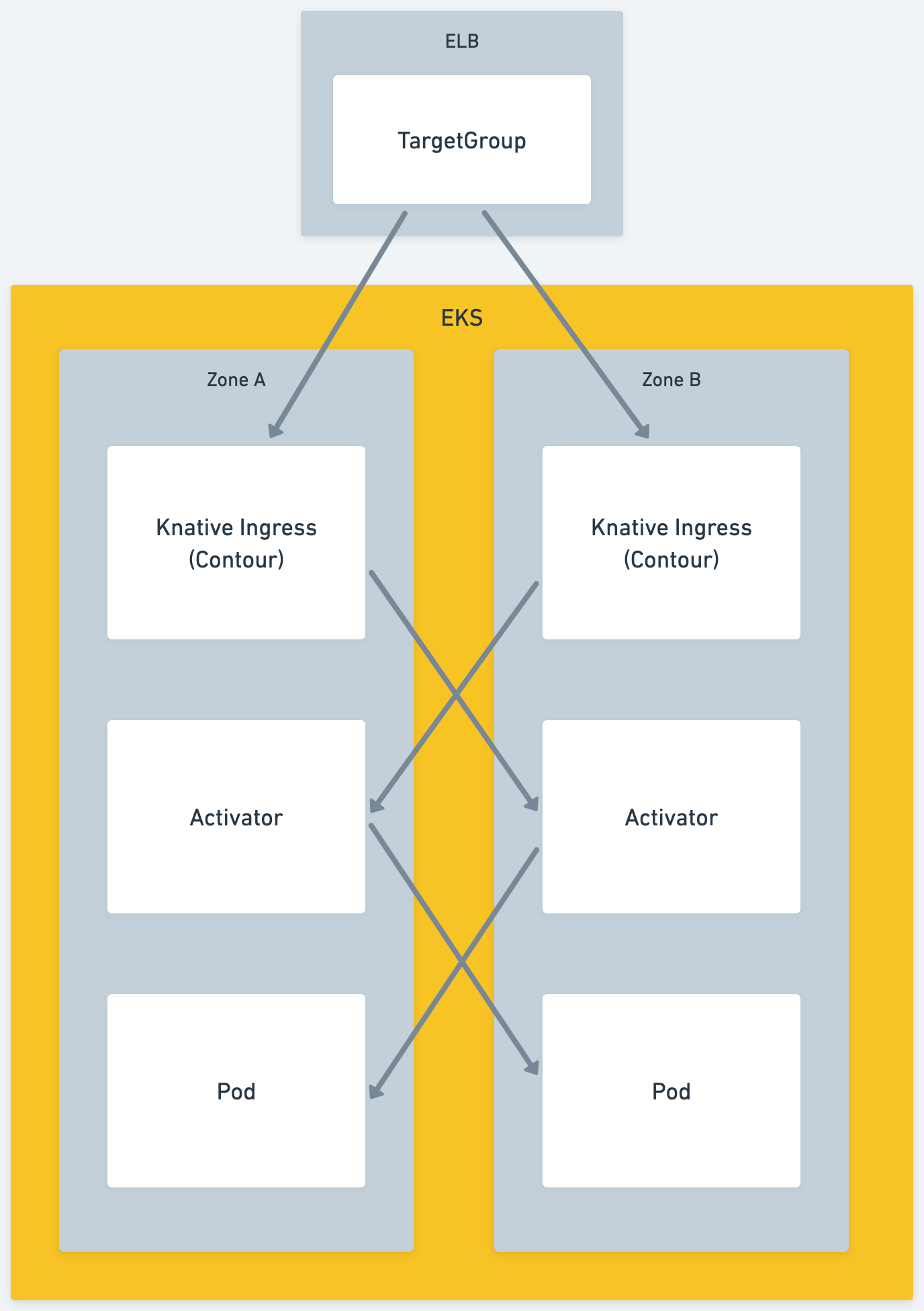
If the path from Ingress to Activator is not also concentrated in the same AZ, the charge for crossing zones may be added. For example, I distribute the ELB -> Knative Ingress route by round-robin, but I think it is enough if it is evenly distributed there.
However, there are times when you may want to focus more on evenness than network rates, so we think it would be best if feature flags could be used to switch between functions.
I have written a Knative Topology Aware Hint Feature Proposal. However, I did not have the right to save it on the team drive. 😢 https://docs.google.com/document/d/1ecA7VwsRUqfy10Z0QyVM55LHmDxbJ2Y2REJ3gDgAkAY/edit?usp=sharing
@kahirokunn I'm using grafana rollout operator to group rollouts for multiple AZ's. Created pretty much the same feature request #14045 :\
Knative could use similar rollout strategy, or just integrate with that grafana rollout operator, as is.

This issue is stale because it has been open for 90 days with no
activity. It will automatically close after 30 more days of
inactivity. Reopen the issue with /reopen. Mark the issue as
fresh by adding the comment /remove-lifecycle stale.
![github-actions[bot] avatar](https://avatars.githubusercontent.com/in/15368?v=4 "Published by a pub.dev verified publisher")
I think it is best to have compatibility in the endpoints that Knative generates, not in workarounds.
This issue is stale because it has been open for 90 days with no
activity. It will automatically close after 30 more days of
inactivity. Reopen the issue with /reopen. Mark the issue as
fresh by adding the comment /remove-lifecycle stale.