
blog
 blog copied to clipboard
 junnplus
Redis 中的 skiplist 实现
跳跃列表(skiplist)是一种有序数据结构。
Redis 中跳跃列表的结构体表示:
// 5.0.3/src/server.h

typedef struct zskiplist {
    // 头节点指针、尾节点指针
    struct zskiplistNode *header, *tail;
    // 节点数量
    unsigned long length;
    // 节点最大层数
    int level;
} zskiplist;
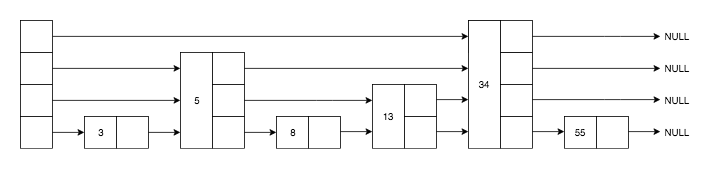
节点数量 length 和 节点最大层数 level 的计算不包括头节点。 头节点指针 header 和尾节点 tail 表示的跳跃列表节点定义:
// 5.0.3/src/server.h

/* ZSETs use a specialized version of Skiplists */
typedef struct zskiplistNode {
    sds ele;
    double score;
    struct zskiplistNode *backward;
    struct zskiplistLevel {
        struct zskiplistNode *forward;
        unsigned long span;
    } level[];
} zskiplistNode;
节点的各个属性表示:
- ele: 节点保存的简单动态字符串值
- score: 节点保存的分数,在跳跃列表中,各节点按照分数排列
- *backward: 节点的后退指针,指向当前节点的前一个节点
- level[]: 节点的层级表示,每个层级都有两个属性
- *forward: 前进指针,指向当前层级的向前跳跃的节点
- span: 跨度(前进指针所指向节点和当前节点的距离),用来计算节点的排名(rank)
跳跃列表的一个例子:

创建
// 5.0.3/src/server.h

#define ZSKIPLIST_MAXLEVEL 64 /* Should be enough for 2^64 elements */

// 5.0.3/src/t_zset.c

/* Create a new skiplist. */
zskiplist *zslCreate(void) {
    int j;
    zskiplist *zsl;

    zsl = zmalloc(sizeof(*zsl));
    zsl->level = 1;
    zsl->length = 0;
    zsl->header = zslCreateNode(ZSKIPLIST_MAXLEVEL,0,NULL);
    for (j = 0; j < ZSKIPLIST_MAXLEVEL; j++) {
        zsl->header->level[j].forward = NULL;
        zsl->header->level[j].span = 0;
    }
    zsl->header->backward = NULL;
    zsl->tail = NULL;
    return zsl;
}
zslCreate 函数创建一个新的跳跃列表,调用 zslCreateNode 函数创建一个头节点且初始化。
// 5.0.3/src/t_zset.c

/* Create a skiplist node with the specified number of levels.
 * The SDS string 'ele' is referenced by the node after the call. */
zskiplistNode *zslCreateNode(int level, double score, sds ele) {
    zskiplistNode *zn =
        zmalloc(sizeof(*zn)+level*sizeof(struct zskiplistLevel));
    zn->score = score;
    zn->ele = ele;
    return zn;
}
头节点的层级为 ZSKIPLIST_MAXLEVEL,不存储实际数据。
查找
Redis 跳跃列表的实现有没有提供直接查询节点的函数。 可以通过节点排位计算和排位查找来理解:
节点排位计算
// 5.0.3/src/t_zset.c

/* Find the rank for an element by both score and key.
 * Returns 0 when the element cannot be found, rank otherwise.
 * Note that the rank is 1-based due to the span of zsl->header to the
 * first element. */
unsigned long zslGetRank(zskiplist *zsl, double score, sds ele) {
    zskiplistNode *x;
    unsigned long rank = 0;
    int i;

    x = zsl->header;
    for (i = zsl->level-1; i >= 0; i--) {
        while (x->level[i].forward &&
            (x->level[i].forward->score < score ||
                (x->level[i].forward->score == score &&
                sdscmp(x->level[i].forward->ele,ele) <= 0))) {
            rank += x->level[i].span;
            x = x->level[i].forward;
        }

        /* x might be equal to zsl->header, so test if obj is non-NULL */
        if (x->ele && sdscmp(x->ele,ele) == 0) {
            return rank;
        }
    }
    return 0;
}
先查找节点:
- 从头节点 header 最高层 zsl->level-1 开始遍历,
- 如果当前层级指向的节点大于等于目标节点(score 相同的节点就比较 sds 值),就跳到层级指向的节点, 反之在当前节点下降一层,
- 累加跳跃节点的 span 值,
- 重复上面的步骤,直到找到相同 score 和 sds 的节点。
查找 score 等于 13 的节点,路径如下:
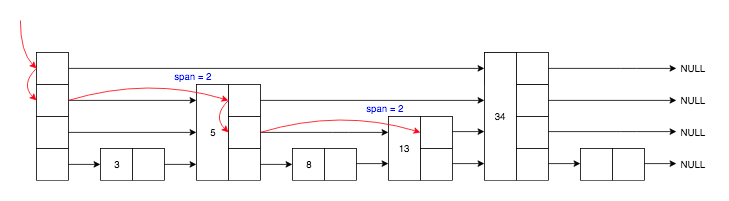
可以计算节点 rank 等于 4。
排名查找
// 5.0.3/src/t_zset.c

/* Finds an element by its rank. The rank argument needs to be 1-based. */
zskiplistNode* zslGetElementByRank(zskiplist *zsl, unsigned long rank) {
    zskiplistNode *x;
    unsigned long traversed = 0;
    int i;

    x = zsl->header;
    for (i = zsl->level-1; i >= 0; i--) {
        while (x->level[i].forward && (traversed + x->level[i].span) <= rank)
        {
            traversed += x->level[i].span;
            x = x->level[i].forward;
        }
        if (traversed == rank) {
            return x;
        }
    }
    return NULL;
}
指定 rank 来查找节点,从高层向低层累加跳跃节点的 span 值等于 rank 就结束查找。
插入
// 5.0.3/src/t_zset.c

/* Insert a new node in the skiplist. Assumes the element does not already
 * exist (up to the caller to enforce that). The skiplist takes ownership
 * of the passed SDS string 'ele'. */
zskiplistNode *zslInsert(zskiplist *zsl, double score, sds ele) {
    zskiplistNode *update[ZSKIPLIST_MAXLEVEL], *x;
    unsigned int rank[ZSKIPLIST_MAXLEVEL];
    int i, level;

    serverAssert(!isnan(score));
    x = zsl->header;
    for (i = zsl->level-1; i >= 0; i--) {
        /* store rank that is crossed to reach the insert position */
        rank[i] = i == (zsl->level-1) ? 0 : rank[i+1];
        while (x->level[i].forward &&
                (x->level[i].forward->score < score ||
                    (x->level[i].forward->score == score &&
                    sdscmp(x->level[i].forward->ele,ele) < 0)))
        {
            rank[i] += x->level[i].span;
            x = x->level[i].forward;
        }
        update[i] = x;
    }
插入节点要确保不会插入相同的节点(score 和 sds 都相同), 在插入节点之前,需要定位插入的位置,定位过程同查找节点过程不大一样:
- 从头节点 header 最高层 zsl->level-1 开始遍历,
- 如果当前层级指向的节点大于目标节点(score 相同的节点就比较 sds 值),就跳到层级指向的节点, 反之在当前节点下降一层,
- 记录每一层经过的节点,更新 update 节点指针数组,
- 重复上面的步骤,直到遍历层级第 0 层结束。
“搜索路径”每一层级最后经过的节点记录在 update 节点指针数组。
插入 score 等于 21 的节点,路径如下:
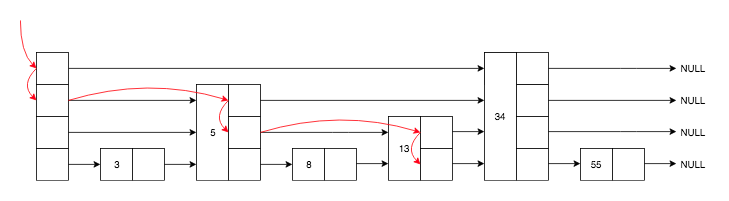
13 和 34 之间就是插入的位置。
    /* we assume the element is not already inside, since we allow duplicated
     * scores, reinserting the same element should never happen since the
     * caller of zslInsert() should test in the hash table if the element is
     * already inside or not. */
    level = zslRandomLevel();
    if (level > zsl->level) {
        for (i = zsl->level; i < level; i++) {
            rank[i] = 0;
            update[i] = zsl->header;
            update[i]->level[i].span = zsl->length;
        }
        zsl->level = level;
    }
插入节点的层数是通过 zslRandomLevel 函数随机分配的,如果层数大于当前跳跃列表的最大层数,更新 update 数组。
    x = zslCreateNode(level,score,ele);
    for (i = 0; i < level; i++) {
        x->level[i].forward = update[i]->level[i].forward;
        update[i]->level[i].forward = x;

        /* update span covered by update[i] as x is inserted here */
        x->level[i].span = update[i]->level[i].span - (rank[0] - rank[i]);
        update[i]->level[i].span = (rank[0] - rank[i]) + 1;
    }

    /* increment span for untouched levels */
    for (i = level; i < zsl->level; i++) {
        update[i]->level[i].span++;
    }

    x->backward = (update[0] == zsl->header) ? NULL : update[0];
    if (x->level[0].forward)
        x->level[0].forward->backward = x;
    else
        zsl->tail = x;
    zsl->length++;
    return x;
}
创建新插入的节点,将 update 数组上的节点和新节点通过前向后向指针联系起来,以及更新这些节点的 span。
删除
// 5.0.3/src/t_zset.c

/* Delete an element with matching score/element from the skiplist.
 * The function returns 1 if the node was found and deleted, otherwise
 * 0 is returned.
 *
 * If 'node' is NULL the deleted node is freed by zslFreeNode(), otherwise
 * it is not freed (but just unlinked) and *node is set to the node pointer,
 * so that it is possible for the caller to reuse the node (including the
 * referenced SDS string at node->ele). */
int zslDelete(zskiplist *zsl, double score, sds ele, zskiplistNode **node) {
    zskiplistNode *update[ZSKIPLIST_MAXLEVEL], *x;
    int i;

    x = zsl->header;
    for (i = zsl->level-1; i >= 0; i--) {
        while (x->level[i].forward &&
                (x->level[i].forward->score < score ||
                    (x->level[i].forward->score == score &&
                     sdscmp(x->level[i].forward->ele,ele) < 0)))
        {
            x = x->level[i].forward;
        }
        update[i] = x;
    }
    /* We may have multiple elements with the same score, what we need
     * is to find the element with both the right score and object. */
    x = x->level[0].forward;
    if (x && score == x->score && sdscmp(x->ele,ele) == 0) {
        zslDeleteNode(zsl, x, update);
        if (!node)
            zslFreeNode(x);
        else
            *node = x;
        return 1;
    }
    return 0; /* not found */
}
删除节点同插入节点,需要先将“搜索路径”找出来,然后判断向前一个节点 x->level[0].forward 是否是删除节点。
// 5.0.3/src/t_zset.c

/* Internal function used by zslDelete, zslDeleteByScore and zslDeleteByRank */
void zslDeleteNode(zskiplist *zsl, zskiplistNode *x, zskiplistNode **update) {
    int i;
    for (i = 0; i < zsl->level; i++) {
        if (update[i]->level[i].forward == x) {
            update[i]->level[i].span += x->level[i].span - 1;
            update[i]->level[i].forward = x->level[i].forward;
        } else {
            update[i]->level[i].span -= 1;
        }
    }
    if (x->level[0].forward) {
        x->level[0].forward->backward = x->backward;
    } else {
        zsl->tail = x->backward;
    }
    while(zsl->level > 1 && zsl->header->level[zsl->level-1].forward == NULL)
        zsl->level--;
    zsl->length--;
}
删除指定节点,重排 update 数组上每个层级的节点前向后向指针和更新节点的 span。
更新
/* Update the score of an elmenent inside the sorted set skiplist.
 * Note that the element must exist and must match 'score'.
 * This function does not update the score in the hash table side, the
 * caller should take care of it.
 *
 * Note that this function attempts to just update the node, in case after
 * the score update, the node would be exactly at the same position.
 * Otherwise the skiplist is modified by removing and re-adding a new
 * element, which is more costly.
 *
 * The function returns the updated element skiplist node pointer. */
zskiplistNode *zslUpdateScore(zskiplist *zsl, double curscore, sds ele, double newscore) {
    zskiplistNode *update[ZSKIPLIST_MAXLEVEL], *x;
    int i;

    /* We need to seek to element to update to start: this is useful anyway,
     * we'll have to update or remove it. */
    x = zsl->header;
    for (i = zsl->level-1; i >= 0; i--) {
        while (x->level[i].forward &&
                (x->level[i].forward->score < curscore ||
                    (x->level[i].forward->score == curscore &&
                     sdscmp(x->level[i].forward->ele,ele) < 0)))
        {
            x = x->level[i].forward;
        }
        update[i] = x;
    }

    /* Jump to our element: note that this function assumes that the
     * element with the matching score exists. */
    x = x->level[0].forward;
    serverAssert(x && curscore == x->score && sdscmp(x->ele,ele) == 0);

    /* If the node, after the score update, would be still exactly
     * at the same position, we can just update the score without
     * actually removing and re-inserting the element in the skiplist. */
    if ((x->backward == NULL || x->backward->score < newscore) &&
        (x->level[0].forward == NULL || x->level[0].forward->score > newscore))
    {
        x->score = newscore;
        return x;
    }

    /* No way to reuse the old node: we need to remove and insert a new
     * one at a different place. */
    zslDeleteNode(zsl, x, update);
    zskiplistNode *newnode = zslInsert(zsl,newscore,x->ele);
    /* We reused the old node x->ele SDS string, free the node now
     * since zslInsert created a new one. */
    x->ele = NULL;
    zslFreeNode(x);
    return newnode;
}
更新操作也需要“搜索路径”。
对于要更新 score 的节点,如果新的 score 值不会带来位置上的调整,就直接修改 score 值, 否则先删除节点,再插入新 score 的节点。

@dvoprm zslGetRank 确实没有检查 score,zslGetRank 是内部只在 zsetRank 被调用的函数,会通过 dict 来查找字符串的 score,不过理论上还是应该检查的