
blog
 blog copied to clipboard
 junnplus
Redis 中的 ziplist 实现
压缩列表(ziplist)是 Redis 中列表对象、哈希对象和有序集合对象的底层实现之一。
为了节约内存而存在,由一块连续内存空间来表示:

- zlbytes(4 byte): 整个压缩列表占用字节数
- zltail(4 byte): 压缩列表尾节点到压缩列表起始地址的偏移量
- zllen(2 byte): 压缩列表中的节点个数
- entry(? byte): 压缩列表节点
- zlend(1 byte): 压缩列表结束标志,0xFF
压缩列表元数据(zlbytes、zltail 和 zllen)大小为 10 byte:
/* The size of a ziplist header: two 32 bit integers for the total
 * bytes count and last item offset. One 16 bit integer for the number
 * of items field. */
#define ZIPLIST_HEADER_SIZE     (sizeof(uint32_t)*2+sizeof(uint16_t))
压缩列表各个元数据的起始位置可以通过下面的宏来操作:
/* Return total bytes a ziplist is composed of. */
#define ZIPLIST_BYTES(zl)       (*((uint32_t*)(zl)))

/* Return the offset of the last item inside the ziplist. */
#define ZIPLIST_TAIL_OFFSET(zl) (*((uint32_t*)((zl)+sizeof(uint32_t))))

/* Return the length of a ziplist, or UINT16_MAX if the length cannot be
 * determined without scanning the whole ziplist. */
#define ZIPLIST_LENGTH(zl)      (*((uint16_t*)((zl)+sizeof(uint32_t)*2)))
获取压缩列表中的头尾节点指针可以通过下面的宏:
/* Return the pointer to the first entry of a ziplist. */
#define ZIPLIST_ENTRY_HEAD(zl)  ((zl)+ZIPLIST_HEADER_SIZE)

/* Return the pointer to the last entry of a ziplist, using the
 * last entry offset inside the ziplist header. */
#define ZIPLIST_ENTRY_TAIL(zl)  ((zl)+intrev32ifbe(ZIPLIST_TAIL_OFFSET(zl)))

节点
一个压缩列表包括多个节点(entry),每个节点可以保存一个字符数组或者整数,节点大小不定。
节点内存表示:

节点包含了两个元数据:
- prevlen: 前一个节点的长度
- encoding: 节点数据的编码类型信息
prevlen 以字节为单位,当反向遍历压缩列表时,可以定位到前一个节点的起始位置。prevlen 的大小可以是 1 字节或者 5 字节:
- 如果前一节点的长度小于 254 字节,那么 prevlen 的大小为 1 字节。
- 如果前一节点的长度大于等于 254 字节,那么 prevlen 的大小为 5 字节,其中属性的第一字节会被设置为 0xFE(十进制值 254 ),而之后的四个字节则用于保存前一节点的长度。
宏 ZIP_DECODE_PREVLENSIZE 和 ZIP_DECODE_PREVLEN 分别计算 prevlen 的内存大小以及存储的前一个节点长度。
// 5.0.3/src/ziplist.c

#define ZIP_BIG_PREVLEN 254

/* Return the number of bytes used to encode the length of the previous
 * entry. The length is returned by setting the var 'prevlensize'. */
#define ZIP_DECODE_PREVLENSIZE(ptr, prevlensize) do {                          \
    if ((ptr)[0] < ZIP_BIG_PREVLEN) {                                          \
        (prevlensize) = 1;                                                     \
    } else {                                                                   \
        (prevlensize) = 5;                                                     \
    }                                                                          \
} while(0);

/* Return the length of the previous element, and the number of bytes that
 * are used in order to encode the previous element length.
 * 'ptr' must point to the prevlen prefix of an entry (that encodes the
 * length of the previous entry in order to navigate the elements backward).
 * The length of the previous entry is stored in 'prevlen', the number of
 * bytes needed to encode the previous entry length are stored in
 * 'prevlensize'. */
#define ZIP_DECODE_PREVLEN(ptr, prevlensize, prevlen) do {                     \
    ZIP_DECODE_PREVLENSIZE(ptr, prevlensize);                                  \
    if ((prevlensize) == 1) {                                                  \
        (prevlen) = (ptr)[0];                                                  \
    } else if ((prevlensize) == 5) {                                           \
        assert(sizeof((prevlen)) == 4);                                    \
        memcpy(&(prevlen), ((char*)(ptr)) + 1, 4);                             \
        memrev32ifbe(&prevlen);                                                \
    }                                                                          \
} while(0);
encoding 表示节点的类型(字符数组或整数),如果是字符数组,字符数组的长度也存储在 encoding 中。 Redis 通过 encoding 的高位 2 bit 来识别具体存储的数据。
-
高位以 00、01 和 10 为前缀表示字符数组,其他位表示数组长度。

-
高位以 11 为前缀表示整数,其他位表示整数的类型。
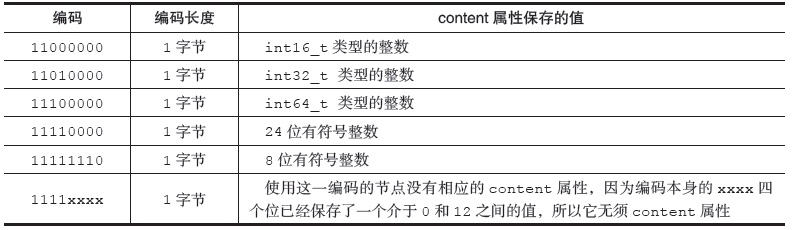 1111xxxx 低位 4 bit 的范围在(0001 ~1101)
宏 ZIP_DECODE_LENGTH 计算 encoding 表示的类型和占用的内存大小以及数据长度。
// 5.0.3/src/ziplist.c

/* Extract the encoding from the byte pointed by 'ptr' and set it into
 * 'encoding' field of the zlentry structure. */
#define ZIP_ENTRY_ENCODING(ptr, encoding) do {  \
    (encoding) = (ptr[0]); \
    if ((encoding) < ZIP_STR_MASK) (encoding) &= ZIP_STR_MASK; \
} while(0)

/* Decode the entry encoding type and data length (string length for strings,
 * number of bytes used for the integer for integer entries) encoded in 'ptr'.
 * The 'encoding' variable will hold the entry encoding, the 'lensize'
 * variable will hold the number of bytes required to encode the entry
 * length, and the 'len' variable will hold the entry length. */
#define ZIP_DECODE_LENGTH(ptr, encoding, lensize, len) do {                    \
    ZIP_ENTRY_ENCODING((ptr), (encoding));                                     \
    if ((encoding) < ZIP_STR_MASK) {                                           \
        if ((encoding) == ZIP_STR_06B) {                                       \
            (lensize) = 1;                                                     \
            (len) = (ptr)[0] & 0x3f;                                           \
        } else if ((encoding) == ZIP_STR_14B) {                                \
            (lensize) = 2;                                                     \
            (len) = (((ptr)[0] & 0x3f) << 8) | (ptr)[1];                       \
        } else if ((encoding) == ZIP_STR_32B) {                                \
            (lensize) = 5;                                                     \
            (len) = ((ptr)[1] << 24) |                                         \
                    ((ptr)[2] << 16) |                                         \
                    ((ptr)[3] <<  8) |                                         \
                    ((ptr)[4]);                                                \
        } else {                                                               \
            panic("Invalid string encoding 0x%02X", (encoding));               \
        }                                                                      \
    } else {                                                                   \
        (lensize) = 1;                                                         \
        (len) = zipIntSize(encoding);                                          \
    }                                                                          \
} while(0);

/* Return bytes needed to store integer encoded by 'encoding'. */
unsigned int zipIntSize(unsigned char encoding) {
    switch(encoding) {
    case ZIP_INT_8B:  return 1;
    case ZIP_INT_16B: return 2;
    case ZIP_INT_24B: return 3;
    case ZIP_INT_32B: return 4;
    case ZIP_INT_64B: return 8;
    }
    if (encoding >= ZIP_INT_IMM_MIN && encoding <= ZIP_INT_IMM_MAX)
        return 0; /* 4 bit immediate */
    panic("Invalid integer encoding 0x%02X", encoding);
    return 0;
}
节点信息可以用 zlentry 结构体来表示:
/* We use this function to receive information about a ziplist entry.
 * Note that this is not how the data is actually encoded, is just what we
 * get filled by a function in order to operate more easily. */
typedef struct zlentry {
    unsigned int prevrawlensize; /* Bytes used to encode the previous entry len*/
    unsigned int prevrawlen;     /* Previous entry len. */
    unsigned int lensize;        /* Bytes used to encode this entry type/len.
                                    For example strings have a 1, 2 or 5 bytes
                                    header. Integers always use a single byte.*/
    unsigned int len;            /* Bytes used to represent the actual entry.
                                    For strings this is just the string length
                                    while for integers it is 1, 2, 3, 4, 8 or
                                    0 (for 4 bit immediate) depending on the
                                    number range. */
    unsigned int headersize;     /* prevrawlensize + lensize. */
    unsigned char encoding;      /* Set to ZIP_STR_* or ZIP_INT_* depending on
                                    the entry encoding. However for 4 bits
                                    immediate integers this can assume a range
                                    of values and must be range-checked. */
    unsigned char *p;            /* Pointer to the very start of the entry, that
                                    is, this points to prev-entry-len field. */
} zlentry;

/* Return a struct with all information about an entry. */
void zipEntry(unsigned char *p, zlentry *e) {

    ZIP_DECODE_PREVLEN(p, e->prevrawlensize, e->prevrawlen);
    ZIP_DECODE_LENGTH(p + e->prevrawlensize, e->encoding, e->lensize, e->len);
    e->headersize = e->prevrawlensize + e->lensize;
    e->p = p;
}
zipEntry 用来解码一个节点,用 zlentry 结构体来表示。
创建
// 5.0.3/src/ziplist.c

/* Create a new empty ziplist. */
unsigned char *ziplistNew(void) {
    unsigned int bytes = ZIPLIST_HEADER_SIZE+1;
    unsigned char *zl = zmalloc(bytes);
    ZIPLIST_BYTES(zl) = intrev32ifbe(bytes);
    ZIPLIST_TAIL_OFFSET(zl) = intrev32ifbe(ZIPLIST_HEADER_SIZE);
    ZIPLIST_LENGTH(zl) = 0;
    zl[bytes-1] = ZIP_END;
    return zl;
}
ziplistNew 创建一个空的压缩列表,大小为 ZIPLIST_HEADER_SIZE+1(压缩列表元数据结构 + 结束标示) ,没有包含节点的空间。
获取
// 5.0.3/src/ziplist.c

/* Return the total number of bytes used by the entry pointed to by 'p'. */
unsigned int zipRawEntryLength(unsigned char *p) {
    unsigned int prevlensize, encoding, lensize, len;
    ZIP_DECODE_PREVLENSIZE(p, prevlensize);
    ZIP_DECODE_LENGTH(p + prevlensize, encoding, lensize, len);
    return prevlensize + lensize + len;
}

/* Returns an offset to use for iterating with ziplistNext. When the given
 * index is negative, the list is traversed back to front. When the list
 * doesn't contain an element at the provided index, NULL is returned. */
unsigned char *ziplistIndex(unsigned char *zl, int index) {
    unsigned char *p;
    unsigned int prevlensize, prevlen = 0;
    if (index < 0) {
        index = (-index)-1;
        p = ZIPLIST_ENTRY_TAIL(zl);
        if (p[0] != ZIP_END) {
            ZIP_DECODE_PREVLEN(p, prevlensize, prevlen);
            while (prevlen > 0 && index--) {
                p -= prevlen;
                ZIP_DECODE_PREVLEN(p, prevlensize, prevlen);
            }
        }
    } else {
        p = ZIPLIST_ENTRY_HEAD(zl);
        while (p[0] != ZIP_END && index--) {
            p += zipRawEntryLength(p);
        }
    }
    return (p[0] == ZIP_END || index > 0) ? NULL : p;
}
ziplistIndex 函数通过指定 index 来获取节点位置指针。
如果 index 为正,从头节点 ZIPLIST_ENTRY_HEAD 开始步长为 zipRawEntryLength(当前节点的长度) 的正向遍历,
如果 index 为负,从尾节点 ZIPLIST_ENTRY_TAIL 步长为节点的 prevlen 值(前一个节点的长度)的反向遍历。
// 5.0.3/src/ziplist.c

/* Get entry pointed to by 'p' and store in either '*sstr' or 'sval' depending
 * on the encoding of the entry. '*sstr' is always set to NULL to be able
 * to find out whether the string pointer or the integer value was set.
 * Return 0 if 'p' points to the end of the ziplist, 1 otherwise. */
unsigned int ziplistGet(unsigned char *p, unsigned char **sstr, unsigned int *slen, long long *sval) {
    zlentry entry;
    if (p == NULL || p[0] == ZIP_END) return 0;
    if (sstr) *sstr = NULL;

    zipEntry(p, &entry);
    if (ZIP_IS_STR(entry.encoding)) {
        if (sstr) {
            *slen = entry.len;
            *sstr = p+entry.headersize;
        }
    } else {
        if (sval) {
            *sval = zipLoadInteger(p+entry.headersize,entry.encoding);
        }
    }
    return 1;
}
知道节点的位置后,通过 ziplistGet 函数获取节点的数据。
查找
// 5.0.3/src/ziplist.c

/* Find pointer to the entry equal to the specified entry. Skip 'skip' entries
 * between every comparison. Returns NULL when the field could not be found. */
unsigned char *ziplistFind(unsigned char *p, unsigned char *vstr, unsigned int vlen, unsigned int skip) {
    int skipcnt = 0;
    unsigned char vencoding = 0;
    long long vll = 0;

    while (p[0] != ZIP_END) {
ziplistFind 函数从 p 指针位置开始查找节点直到压缩列表末尾,skip 指定查找的步长。
        unsigned int prevlensize, encoding, lensize, len;
        unsigned char *q;

        ZIP_DECODE_PREVLENSIZE(p, prevlensize);
        ZIP_DECODE_LENGTH(p + prevlensize, encoding, lensize, len);
        q = p + prevlensize + lensize;
获取当前的节点的信息。
        if (skipcnt == 0) {
            /* Compare current entry with specified entry */
            ...

            /* Reset skip count */
            skipcnt = skip;
        } else {
            /* Skip entry */
            skipcnt--;
        }

        /* Move to next entry */
        p = q + len;
    }

    return NULL;
}
以步长为 skip 查找目标节点。
插入
// 5.0.3/src/ziplist.c

/* Insert an entry at "p". */
unsigned char *ziplistInsert(unsigned char *zl, unsigned char *p, unsigned char *s, unsigned int slen) {
    return __ziplistInsert(zl,p,s,slen);
}
ziplistInsert 将 s 插入到 zl 压缩列表的 p 位置。
/* Insert item at "p". */
unsigned char *__ziplistInsert(unsigned char *zl, unsigned char *p, unsigned char *s, unsigned int slen) {
    size_t curlen = intrev32ifbe(ZIPLIST_BYTES(zl)), reqlen;
    unsigned int prevlensize, prevlen = 0;
    size_t offset;
    int nextdiff = 0;
    unsigned char encoding = 0;
    long long value = 123456789; /* initialized to avoid warning. Using a value
                                    that is easy to see if for some reason
                                    we use it uninitialized. */
    zlentry tail;

    /* Find out prevlen for the entry that is inserted. */
    if (p[0] != ZIP_END) {
        ZIP_DECODE_PREVLEN(p, prevlensize, prevlen);
    } else {
        unsigned char *ptail = ZIPLIST_ENTRY_TAIL(zl);
        if (ptail[0] != ZIP_END) {
            prevlen = zipRawEntryLength(ptail);
        }
    }
计算插入位置前一个节点长度 prevlen。
- 如果不是压缩列表末尾,直接读取 p 指针节点的 prevlen;
- 如果是压缩列表末尾,计算 zl 尾节点的长度。
    /* See if the entry can be encoded */
    if (zipTryEncoding(s,slen,&value,&encoding)) {
        /* 'encoding' is set to the appropriate integer encoding */
        reqlen = zipIntSize(encoding);
    } else {
        /* 'encoding' is untouched, however zipStoreEntryEncoding will use the
         * string length to figure out how to encode it. */
        reqlen = slen;
    }
    /* We need space for both the length of the previous entry and
     * the length of the payload. */
    reqlen += zipStorePrevEntryLength(NULL,prevlen);
    reqlen += zipStoreEntryEncoding(NULL,encoding,slen);
尝试解码 s 字符数组获得编码信息,计算新插入节点需要的内存大小 reqlen 字节。
- 编码时先按整数来解析数据内容,如果解析成功,则按照整数编码方式存储;
- 解析失败,则按照字符数组编码存储。
    /* When the insert position is not equal to the tail, we need to
     * make sure that the next entry can hold this entry's length in
     * its prevlen field. */
    int forcelarge = 0;
    nextdiff = (p[0] != ZIP_END) ? zipPrevLenByteDiff(p,reqlen) : 0;
    if (nextdiff == -4 && reqlen < 4) {
        nextdiff = 0;
        forcelarge = 1;
    }
如果不是在末尾插入节点的话,要确保插入位置旧节点 prevlen 的大小足够存储新节点的长度。
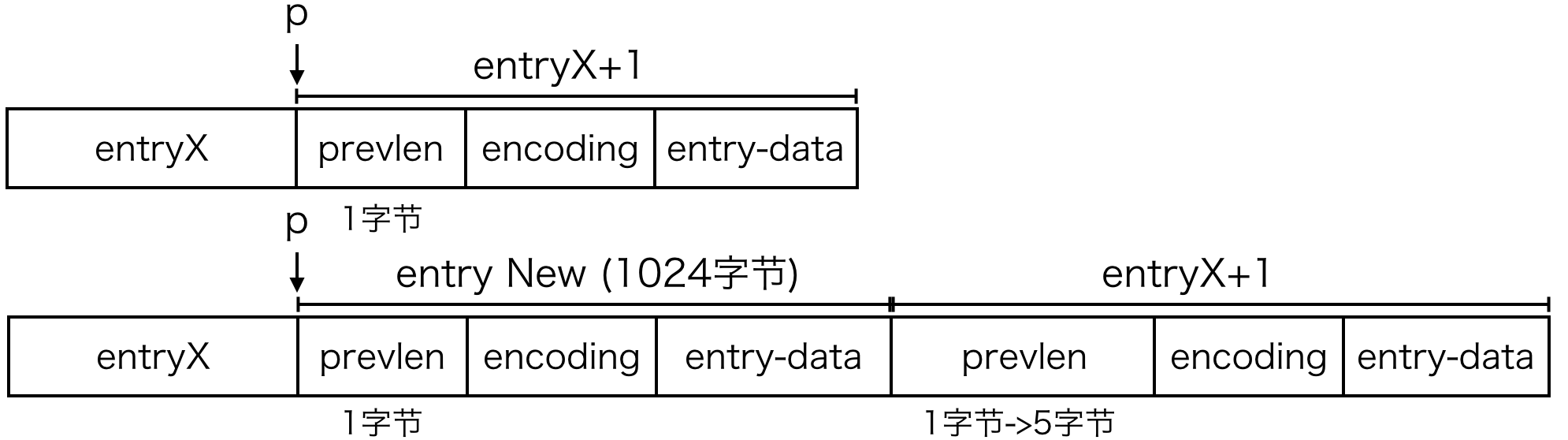
假设旧节点 prevlen 大小为 1 字节,新插入的节点大于 254 字节,那么 nextdiff 等于 5 - 1(旧节点的 prevlen 大小要更新为 5 字节)。 反之旧节点 prevlen 大小为 5 字节,新插入的节点小于 254 字节,nextdiff 等于 -4。
    /* Store offset because a realloc may change the address of zl. */
    offset = p-zl;
    zl = ziplistResize(zl,curlen+reqlen+nextdiff);
    p = zl+offset;
ziplistResize 函数调用 realloc 重新分配内存空间,新内存大小为 curlen+reqlen+nextdiff,并重新计算 p 指针位置。
    /* Apply memory move when necessary and update tail offset. */
    if (p[0] != ZIP_END) {
        /* Subtract one because of the ZIP_END bytes */
        memmove(p+reqlen,p-nextdiff,curlen-offset-1+nextdiff);

        /* Encode this entry's raw length in the next entry. */
        if (forcelarge)
            zipStorePrevEntryLengthLarge(p+reqlen,reqlen);
        else
            zipStorePrevEntryLength(p+reqlen,reqlen);

        /* Update offset for tail */
        ZIPLIST_TAIL_OFFSET(zl) =
            intrev32ifbe(intrev32ifbe(ZIPLIST_TAIL_OFFSET(zl))+reqlen);
        ...
        }
    } else {
        /* This element will be the new tail. */
        ZIPLIST_TAIL_OFFSET(zl) = intrev32ifbe(p-zl);
    }
调整内存位置,插入位置开始的内存往后挪,空出要插入的节点空间。
memmove 将从 p-nextdiff 开始 curlen-offset-1+nextdiff 字节的内容移动到 p+reqlen 位置。
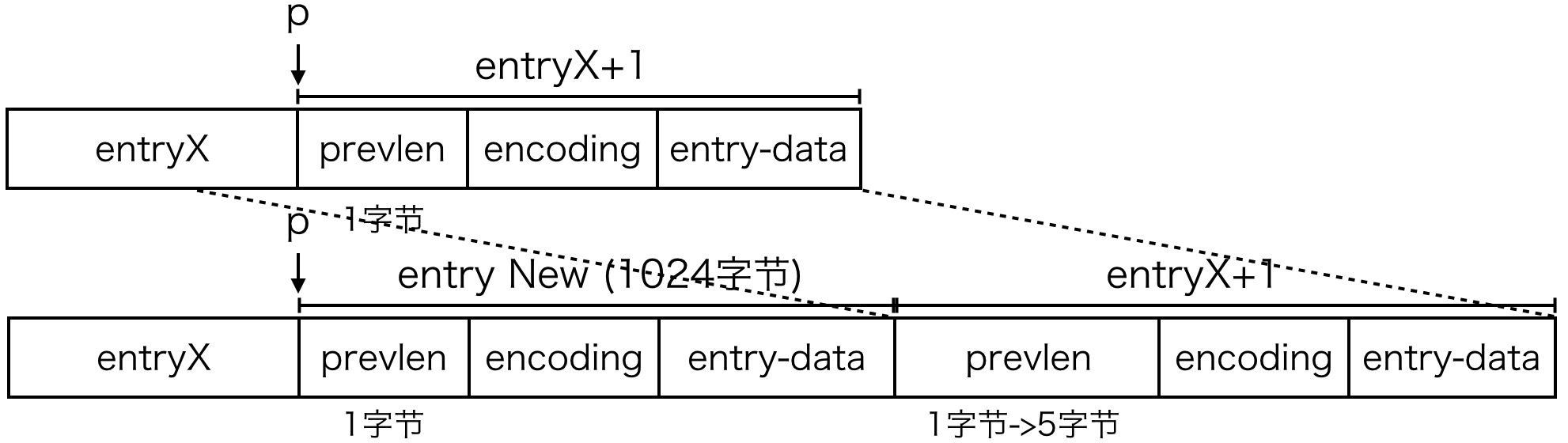
从 p-nextdiff 开始是为了保证 p 位置上的旧节点可以改变 prevlen 的大小。
这边有个问题,如果插入位置的旧节点需要扩展 prevlen 的大小,那么可能导致后面节点的 prevlen 的大小也跟着更新。这也就是下面函数 __ziplistCascadeUpdate 处理的连锁更新。
    /* When nextdiff != 0, the raw length of the next entry has changed, so
     * we need to cascade the update throughout the ziplist */
    if (nextdiff != 0) {
        offset = p-zl;
        zl = __ziplistCascadeUpdate(zl,p+reqlen);
        p = zl+offset;
    }
    /* Write the entry */
    p += zipStorePrevEntryLength(p,prevlen);
    p += zipStoreEntryEncoding(p,encoding,slen);
    if (ZIP_IS_STR(encoding)) {
        memcpy(p,s,slen);
    } else {
        zipSaveInteger(p,value,encoding);
    }
    ZIPLIST_INCR_LENGTH(zl,1);
    return zl;
}
在插入位置写入新的节点。
连锁更新
// 5.0.3/src/ziplist.c
/* When an entry is inserted, we need to set the prevlen field of the next
 * entry to equal the length of the inserted entry. It can occur that this
 * length cannot be encoded in 1 byte and the next entry needs to be grow
 * a bit larger to hold the 5-byte encoded prevlen. This can be done for free,
 * because this only happens when an entry is already being inserted (which
 * causes a realloc and memmove). However, encoding the prevlen may require
 * that this entry is grown as well. This effect may cascade throughout
 * the ziplist when there are consecutive entries with a size close to
 * ZIP_BIG_PREVLEN, so we need to check that the prevlen can be encoded in
 * every consecutive entry.
 *
 * Note that this effect can also happen in reverse, where the bytes required
 * to encode the prevlen field can shrink. This effect is deliberately ignored,
 * because it can cause a "flapping" effect where a chain prevlen fields is
 * first grown and then shrunk again after consecutive inserts. Rather, the
 * field is allowed to stay larger than necessary, because a large prevlen
 * field implies the ziplist is holding large entries anyway.
 *
 * The pointer "p" points to the first entry that does NOT need to be
 * updated, i.e. consecutive fields MAY need an update. */
unsigned char *__ziplistCascadeUpdate(unsigned char *zl, unsigned char *p) {
    size_t curlen = intrev32ifbe(ZIPLIST_BYTES(zl)), rawlen, rawlensize;
    size_t offset, noffset, extra;
    unsigned char *np;
    zlentry cur, next;

    while (p[0] != ZIP_END) {
        zipEntry(p, &cur);
        rawlen = cur.headersize + cur.len;
        rawlensize = zipStorePrevEntryLength(NULL,rawlen);

        /* Abort if there is no next entry. */
        if (p[rawlen] == ZIP_END) break;
        zipEntry(p+rawlen, &next);

        /* Abort when "prevlen" has not changed. */
        if (next.prevrawlen == rawlen) break;

        if (next.prevrawlensize < rawlensize) {
            /* The "prevlen" field of "next" needs more bytes to hold
             * the raw length of "cur". */
            offset = p-zl;
            extra = rawlensize-next.prevrawlensize;
            zl = ziplistResize(zl,curlen+extra);
            p = zl+offset;

            /* Current pointer and offset for next element. */
            np = p+rawlen;
            noffset = np-zl;

            /* Update tail offset when next element is not the tail element. */
            if ((zl+intrev32ifbe(ZIPLIST_TAIL_OFFSET(zl))) != np) {
                ZIPLIST_TAIL_OFFSET(zl) =
                    intrev32ifbe(intrev32ifbe(ZIPLIST_TAIL_OFFSET(zl))+extra);
            }

            /* Move the tail to the back. */
            memmove(np+rawlensize,
                np+next.prevrawlensize,
                curlen-noffset-next.prevrawlensize-1);
            zipStorePrevEntryLength(np,rawlen);

            /* Advance the cursor */
            p += rawlen;
            curlen += extra;
        } else {
            if (next.prevrawlensize > rawlensize) {
                /* This would result in shrinking, which we want to avoid.
                 * So, set "rawlen" in the available bytes. */
                zipStorePrevEntryLengthLarge(p+rawlen,rawlen);
            } else {
                zipStorePrevEntryLength(p+rawlen,rawlen);
            }

            /* Stop here, as the raw length of "next" has not changed. */
            break;
        }
    }
    return zl;
}
__ziplistCascadeUpdate 根据后续节点是否需要改变 prevlen 的大小进而重新分配内存。 这种方式看起来效率很低,但是实际上只有处于临界大小的 prevlen 才会进行连锁更新。