

 jdb78
jdb78
TCN of pytorch-forecasting

Check out this pull request on 
See visual diffs & provide feedback on Jupyter Notebooks.
Powered by ReviewNB
![review-notebook-app[bot] avatar](https://avatars.githubusercontent.com/in/15474?v=4 "Published by a pub.dev verified publisher")
Codecov Report
Merging #549 (d4bc616) into master (06dcc29) will decrease coverage by
0.02%. The diff coverage is88.09%.

@@            Coverage Diff             @@
##           master     #549      +/-   ##
==========================================
- Coverage   89.12%   89.09%   -0.03%
==========================================
  Files          24       25       +1
  Lines        3788     3907     +119
==========================================
+ Hits         3376     3481     +105
- Misses        412      426      +14
| Flag | Coverage Δ | |
|---|---|---|
| cpu | 89.09% <88.09%> (-0.03%) |
:arrow_down: |
| pytest | 89.09% <88.09%> (-0.03%) |
:arrow_down: |
Flags with carried forward coverage won't be shown. Click here to find out more.
| Impacted Files | Coverage Δ | |
|---|---|---|
| pytorch_forecasting/__init__.py | 100.00% <ø> (ø) |
|
| pytorch_forecasting/models/base_model.py | 87.65% <58.33%> (-0.47%) |
:arrow_down: |
| .../models/temporal_convolutional_network/__init__.py | 91.07% <91.07%> (ø) |
|
| pytorch_forecasting/models/__init__.py | 100.00% <100.00%> (ø) |
|
| pytorch_forecasting/models/baseline.py | 94.73% <100.00%> (ø) |
Continue to review full report at Codecov.
Legend - Click here to learn more
Δ = absolute <relative> (impact),ø = not affected,? = missing dataPowered by Codecov. Last update 06dcc29...d4bc616. Read the comment docs.

I'm sorry.I do not know how the checks above works? Can you give me some complete examples of code testing?So that I can do the test myself.
In the directory tests/test_models are multiple files that test a network. I suggest to pretty much copy paste the test_nbeats.py. as this is very similar to what you are trying to do.

There seems to be an import error: https://github.com/jdb78/pytorch-forecasting/pull/549/checks?check_run_id=2783133836
@wangbingnan136: How do we approach the multi-horizon forecasting issue with TCNs? Is it supposed to be re-current or a multi-horizon forecast? In case of the later, it is a bit unclear to me how to leverage covariates in the decoder.
@wangbingnan136: How do we approach the multi-horizon forecasting issue with TCNs? Is it supposed to be re-current or a multi-horizon forecast? In case of the later, it is a bit unclear to me how to leverage covariates in the decoder.
Tcn can only support the output mode of vector output, It just like nbeats or simple LSTM.
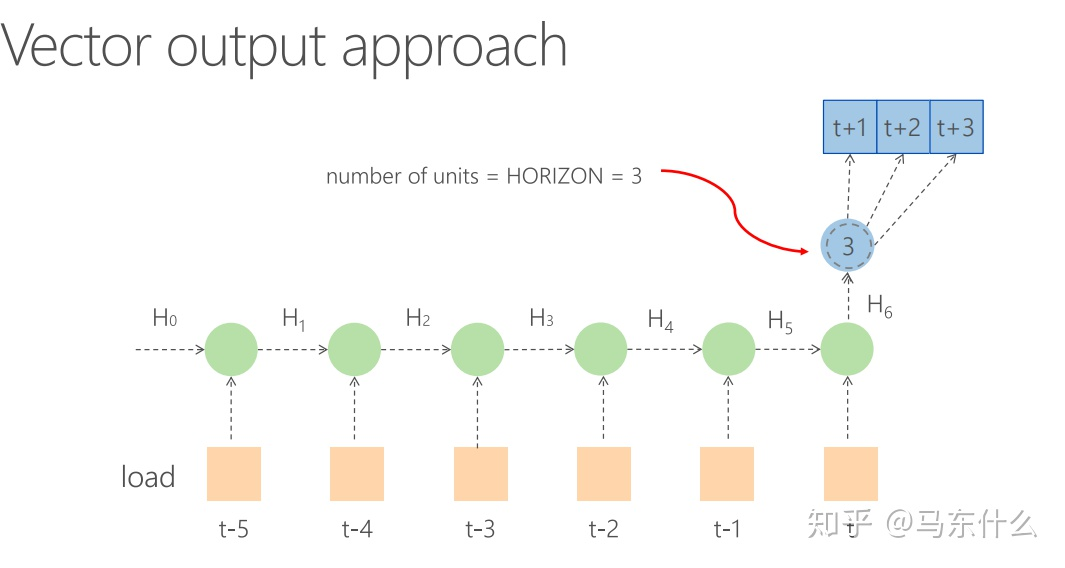
which I think is what you mean "re-current," that is, TCN only has an encoder structure and no decoder structure. We use the latent vector obtained by the encoder to directly connect to a fully connected layer to complete the forecasting task.
If we want to approach the multi-horizon forecasting issue with TCNs,we can direct use Wavenet ,which supports the structure of encoder+decoder.
@wangbingnan136 Could you check the implementation? I am not really sure it is correct. Adding a skip connection (optional in the paper) dramatically improved the performance. Could you check it and confirm the implementation is correct before we merge?
I think there are some changes required when I compare with https://www.mdpi.com/2079-9292/8/8/876
I have implemented the skip connection function according to https://github.com/philipperemy/keras-tcn/blob/master/tcn/tcn.py
and test the data in tutorial:
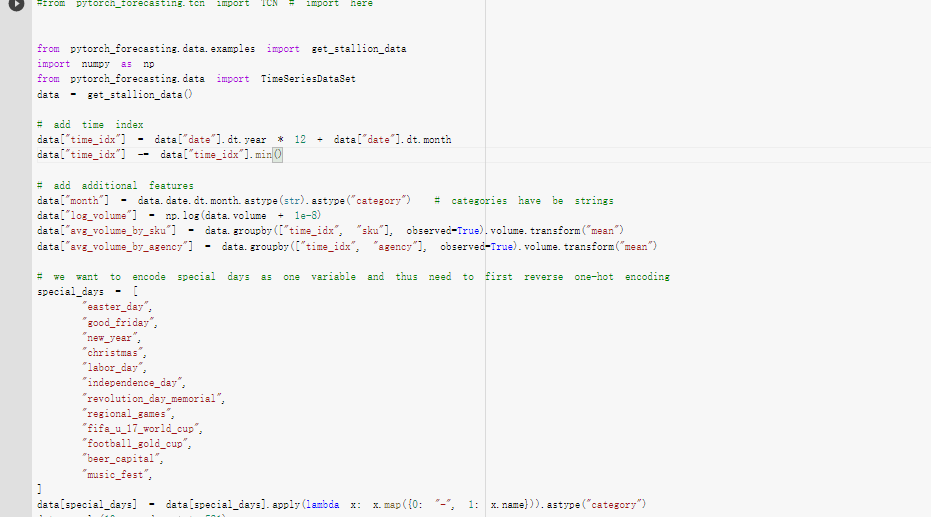
The performance of model becomes better.
@wangbingnan136 , could you revert the version to after the lock-file fix (best to use git pull before continuing the work) and use the pre-commit hooks?
I believe the main issue is that M-TCN uses a slightly modified architecture and currently, the model uses convolutions along features and not time.
@wangbingnan136 , could you revert the version to after the lock-file fix (best to use
git pullbefore continuing the work) and use the pre-commit hooks?I believe the main issue is that M-TCN uses a slightly modified architecture and currently, the model uses convolutions along features and not time.
Ok,I have reverted the version.
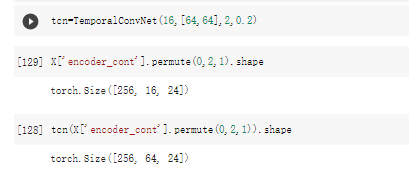
I think the model uses convolutions along time.
24 is the length of time steps
@wangbingnan136 Many thanks for making the TCN model available. However, I am not sure which version of the following you are actually implementing:
- Probabilistic forecasting with temporal convolutional neural network: Preferred one since this outputs and trains on quantile losses. Code available here.
- A Multi-Horizon Quantile Recurrent Forecaster: Available in GluonTS here.
- Multivariate Temporal Convolutional Network: A Deep Neural Networks Approach for Multivariate Time Series Forecasting.
- An Empirical Evaluation of Generic Convolutional and Recurrent Networks for Sequence Modeling. Code available here.
May I ask you to be more specific on which one you are using. I assume it is the last one?

@wangbingnan136 Many thanks for making the TCN model available. However, I am not sure which version of the following you are actually implementing:
- Probabilistic forecasting with temporal convolutional neural network: Preferred one since this outputs and trains on quantile losses
- A Multi-Horizon Quantile Recurrent Forecaster: Available in GluonTS
- Multivariate Temporal Convolutional Network: A Deep Neural Networks Approach for Multivariate Time Series Forecasting
May I ask you to be more specific on which one you are using.
Actually it is almost the same as https://github.com/philipperemy/keras-tcn. I think the related paper is this one:https://arxiv.org/pdf/1803.01271.pdf 《An Empirical Evaluation of Generic Convolutional and Recurrent Networks for Sequence Modeling》
Actually it is almost the same as https://github.com/philipperemy/keras-tcn. I think the related paper is this one:https://arxiv.org/pdf/1803.01271.pdf 《An Empirical Evaluation of Generic Convolutional and Recurrent Networks for Sequence Modeling》
Ok I see, many thanks for clarifying!
Actually it is almost the same as https://github.com/philipperemy/keras-tcn. I think the related paper is this one:https://arxiv.org/pdf/1803.01271.pdf 《An Empirical Evaluation of Generic Convolutional and Recurrent Networks for Sequence Modeling》
Ok I see, many thanks for clarifying!
You are welcome~
Actually, seeing this, we should probably switch to Probabilistic forecasting with temporal convolutional neural network as it has a proper decoder (The quantile loss is trivial and would be supported anyways).
Actually, seeing this, we should probably switch to Probabilistic forecasting with temporal convolutional neural network as it has a proper decoder (The quantile loss is trivial and would be supported anyways).
I see.I may need some time to study the network structure of the tcn in this paper。
Actually, seeing this, we should probably switch to Probabilistic forecasting with temporal convolutional neural network as it has a proper decoder (The quantile loss is trivial and would be supported anyways).
@jdb78 I would also opt for this version. Would love to be part of supporting the implementation.