

 hyperledger
use matrix to avoid copy my self in github action(pipeline as) code
Type of change
- Improvement (improvement to code, performance, etc)
Description
- use matrix to avoid copy my self in github action(pipeline as) code
- use matrix add binary file compile checking or mac and windows os
Additional details
n/A
Related issues
n/A

@denyeart , pre discussed on fabric contributor meeting, I opened this pr as a sample for metric usage. please help with pr review process.
I will squash this PR after a review, as I am not sure if split integration test into each condition as parameter, and the usage for make native is acceptable for maintainers or not.
The changes for github action can be found at https://github.com/hyperledger/fabric/actions/runs/2939710490
@denyeart , could you please ask some one take a look at this kind of idea? otherwise, I am going to close this pr.
@SamYuan1990 Sorry missed this initially... I like the new approach.
Can you look into the native test failure though, both in this PR and at https://github.com/hyperledger/fabric/actions/runs/2939710490

https://github.com/hyperledger/fabric/actions/runs/2939710490
ok, if it looks worth to discuss, I am going to rebase and update.
Github Actions seems to handle many jobs well so I think it is fine to run the integration tests per directory now. It does make the pipeline simpler and more easily extensible, and the check output is more clear now since it shows the integration test directory.
What do you think @jcastrence
@denyeart At worst the matrix job can't take longer than the current workflow set up and it seems to be working fine so I don't see why we don't implement this strategy. I would however recommend using a more recent patch version of Go 1.18 and Ubuntu 22.04 as was suggested in this PR.

I'm confused as to why this verify build run took 49 min, I thought that all the integration tests would be run in parallel?
this verify build run
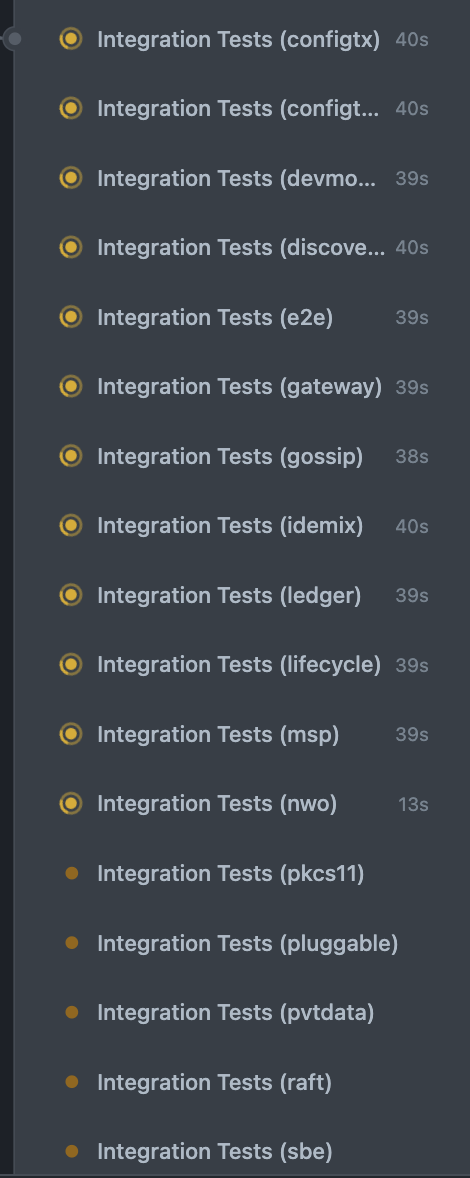
I suppose even if the jobs running in parallel, they still need to waiting for github agent ready to run the job.
As for sample:
Requested labels: ubuntu-22.04
Job defined at: hyperledger/fabric/.github/workflows/verify-build.yml@refs/pull/3617/merge
Waiting for a runner to pick up this job...
As for sample:
Requested labels: ubuntu-22.04
Job defined at: hyperledger/fabric/.github/workflows/verify-build.yml@refs/pull/3617/merge
Waiting for a runner to pick up this job...
This makes sense since GitHub Docs also says the number of concurrently running jobs is dependent on runner availability. With this in mind, I think it makes more sense to keep the faster integration tests grouped into the same jobs. We can still utilize the matrix strategy as it is definitely more readable and will be easier to maintain.
Alternatively, we can (and probably should) change the order of the integration test directory names as they appear in the strategy so that they are ordered slowest to fastest, since the order of the variables determines job creation priority.
As for sample:
Requested labels: ubuntu-22.04
Job defined at: hyperledger/fabric/.github/workflows/verify-build.yml@refs/pull/3617/merge
Waiting for a runner to pick up this job...
This makes sense since GitHub Docs also says the number of concurrently running jobs is dependent on runner availability. With this in mind, I think it makes more sense to keep the faster integration tests grouped into the same jobs. We can still utilize the matrix strategy as it is definitely more readable and will be easier to maintain.
Alternatively, we can (and probably should) change the order of the integration test directory names as they appear in the strategy so that they are ordered slowest to fastest, since the order of the variables determines job creation priority.
let me try.
I would change line 16 to
GO_VER: 1.18and line 21 toruns-on: ubuntu-22.04
updated with environment value to control go version CI.
Ok, based on the delay and large number of runners, and overhead per runner, I have to agree with Julian that it would be better to continue to group the integration test executions into a smaller set. But if it can be done with a matrix that would be an improvement over the existing approach.
Ok, based on the delay and large number of runners, and overhead per runner, I have to agree with Julian that it would be better to continue to group the integration test executions into a smaller set. But if it can be done with a matrix that would be an improvement over the existing approach.
updated, so far keep the same group runner with previous.
backport release-2.5
✅ Backports have been created
- #3674 use matrix to avoid copy my self in github action(pipeline as) code (backport #3617) has been created for branch
release-2.5
![mergify[bot] avatar](https://avatars.githubusercontent.com/in/10562?v=4 "Published by a pub.dev verified publisher")
backport release-2.4
✅ Backports have been created
- #3675 use matrix to avoid copy my self in github action(pipeline as) code (backport #3617) has been created for branch
release-2.4
backport release-2.2
✅ Backports have been created
- #3676 use matrix to avoid copy my self in github action(pipeline as) code (backport #3617) has been created for branch
release-2.2