

 hey-api
Available Clients add Nuxt.js support


Hey. I'm also quite interested in this. Nuxt has a few composables that I think @JL-Code might've referred to, useFetch and useAsyncData.
https://nuxt.com/docs/getting-started/data-fetching

@mrlubos what sort of interest are you looking for before prioritizing building new clients? (huge fan of this tool, saves so much time, so thanks a bunch 🫶)
Thank you @rigtigeEmil! Honestly I think there's enough interest in Nuxt now, I will add it to the docs so I don't forget. Can you help me understand how do you manage with the current setup? Are you using fetch? Something custom?
Yeah. With the current setup, i just use fetch. Like other SSR-frameworks it's not ideal, since it can cause hydration issues, and invoked the backing API twice (once on the server, and once on the client side). Most of my app is not SSR, and for that entire part I just use @hey-api/sdk. For the part that is SSR, I have just one it old-school, and handwritten the few endpoints I need.
Nuxt's useFetch and useAsyncData solve this problem, and provide a few more nice things that might be nice to be able to configure, although I don't personally have a need for it. useFetch is just a small wrapper around useAsyncData, so in terms of (my) need for an integration, just using useFetch would be completely fine
I'm looking into this @rigtigeEmil, will let you know if I have any updates. There are like 6 different APIs that need to be handled, I'll see what we can come up with
EDIT: Related:
- https://nuxt.com/docs/guide/recipes/custom-usefetch
- https://github.com/nuxt/nuxt/issues/14736
- https://github.com/nuxt/nuxt/discussions/17416
Hey all, have a look at the pull request referenced above if you're interested in progress.
@rigtigeEmil et al., how does this API look to you? https://github.com/hey-api/openapi-ts/blob/d3fccb07871fd5e6d8977a45760c2c0fe0466ae3/examples/openapi-ts-nuxt/components/home.vue
I've included native Nuxt methods for comparison vs the generated client. It will look very similar to the current clients, with a few caveats:
- we need to return the same response Nuxt APIs return, i.e. we cannot await the result inside and do fancy stuff with it
- you'll need to specify the Nuxt API you want to use in SDKs/clients
That's what I've got so far. Here's how it would look
const data = await getPetById({
  composable: '$fetch',
  path: {
    petId: 8,
  },
});
I tried doing away with the composable field, but we need it. Otherwise, you'd need to define data and error types on each call manually and that would defeat the whole purpose of generating SDKs.
The available composable values are:
$fetchuseAsyncDatauseFetchuseLazyAsyncDatauseLazyFetch
So far, this is how each API is implemented in the client. It's far from finished, but it should give you an idea https://github.com/hey-api/openapi-ts/blob/d3fccb07871fd5e6d8977a45760c2c0fe0466ae3/packages/client-nuxt/src/index.ts#L42-L89
You'll be able to pass the key argument if necessary, or configure composable APIs through fetchOptions and asyncDataOptions fields respectively. Regular $fetch will be configurable through the main call, just like the existing clients. Lastly, you can pass requestFetch if needed and that will be used instead of $fetch.
Any thoughts so far?
With this implementation, would we still have access to some of the goodies the various composables provide?
I'm not sure how familiar you are with Nuxt, but these composables react automatically to reactive variables, meaning I can provide reactive variables to useFetch (or the other composables), and whenever these variables change, the endpoint is invoked automatically:
const message = ref('foo');
const { data } = await useFetch('/echo', {
	method: 'POST',
	body: message,
});
// data will be `foo`

// useFetch will automatically re-trigger after this assignment since the ref has changed
message.value = 'bar';
// data will now be `bar`
It seems like we're returning the useFetch composable directly, which is generally not something you'd want to do in a typical Nuxt component - you generally want to setup the composable once, and the either
- rely on the reactive variables changing to make new calls
- explicitly set
immediateand trigger the invocation manually from the returnedexecutefunction I'm not sure this is a problem though, when used through a library, if we're limited on these functionalities
Would it be possible to specify a default in settings? For instance, I would probably want to use useFetch in most cases, simply to avoid duplicate calls on server/client, and just be able to use some of the other composables (where a key is almost mandatory)
edit: there's a nice video going over some of the caveats here, if you're interested and haven't seen it already: https://www.youtube.com/watch?v=njsGVmcWviY
@rigtigeEmil
With this implementation, would we still have access to some of the goodies the various composables provide?
That's the goal! Otherwise, you could use the good old Fetch or Axios client. If this goal isn't achieved, it won't make sense to release and maintain another client.
It seems like we're returning the
useFetchcomposable directly, which is generally not something you'd want to do in a typical Nuxt component.
What would you return instead? If we look at your example...
const message = ref('foo');
const { data } = await useFetch('/echo', {
	method: 'POST',
	body: message,
});
// data will be `foo`

// useFetch will automatically re-trigger after this assignment since the ref has changed
message.value = 'bar';
// data will now be `bar`
...this is how it would change with the Nuxt client.
const message = ref('foo');
const { data } = await postEcho({
	body: message,
	composable: 'useFetch',
});
// data will be `foo`

// postEcho will automatically re-trigger after this assignment since the ref has changed
message.value = 'bar';
// data will now be `bar`
Can you describe why this isn't recommended? In my view, this would give you the most control over the Nuxt response. Back to your points:
you generally want to setup the composable once
This has been accomplished by calling the client function.
rely on the reactive variables changing to make new calls
This will continue working, no need to use the awaited result.
explicitly set immediate and trigger the invocation manually from the returned execute function
This can be done by passing an option to the call and using the awaited result. Totally up to you though.
Would it be possible to specify a default in settings? For instance, I would probably want to use
useFetchin most cases, simply to avoid duplicate calls on server/client, and just be able to use some of the other composables (where akeyis almost mandatory)
I thought about it, but didn't go there with this first iteration, so we can focus on the underlying mechanics. In theory, nothing against specifying the default, though I am worried that hiding that detail is not preferable over manually specifying composable. The reason is the function name does not convey which API it uses and could be accidentally misused. Of course, you can make the reverse argument too: if you specify the default, you should be familiar with the codebase and generated client enough to know what it's calling under the hood.
What do you think?
Ah, I think I've been looking at it wrong; I was expecting the API to look like it does with the fetch client, but this will actually mirror the Nuxt API's of the different composables, which is so much better!
I think my example was a bit flawed, but it's also completely irrelevant with what I just wrote above, what I actually meant was, that you generally only want to call the useFetch (and other API's) composable directly in script setup, middleware etc., and not inside of a function that gets invoked whenever data changes. A more accurate example of what you don't want is here. Any time password/username changes, the api would be re-invoked:
<template>
	<form @submit="onSubmit">
		<input v-model="username">
		<input v-model="password">
	</form>
</template>

<script lang="ts" setup>
const username = ref('');
const password = ref('');

const body = computed(() => ({
	username: username.value,
	password: password.value,
}));

async function onSubmit() {
	const { data, error } = await useFetch('sign-in', {
		body,
		method: 'POST',
	});
}
</script>
This would be completely fine, when using the current fetch client, since there's no reactivity based on Vue's ref/reactive. So today, with the fetch client, similar onSubmit code would something like this:
async function onSubmit() {
	const data = await postSignIn(body.value);
}
Hopefully I've explained myself a bit better now, but again, I think I just completely misunderstood the direction you're going in, making this completely obsolete.
For the last point, I personally would prefer to have the possibility of supplying an overridable default, mostly since I have a tendency to use useFetch/$fetch in most scenarios, but this is just to remove a tiny bit of duplication. I agree completely with your point regarding this; I just think being agnostic to this point might be beneficial
Hey all! This isn't available on npm yet, but you can test drive the latest by running
npm i https://pkg.pr.new/hey-api/openapi-ts/@hey-api/client-nuxt@1519
npm i https://pkg.pr.new/hey-api/openapi-ts/@hey-api/openapi-ts@1519
Please let me know your thoughts!
@mrlubos have been testing for the past hour or so. So far, $fetch composable drop-in feels super clean, and no issues yet around SSR or similar (still have yet to go through auth and whatnot, so TBD on that). Trying some more complex usecases, like infinite scrolling data fetching, and it looks like the onResponse hook isn't called. It does look like onRequest is, however. Simple example:
const page = ref(1)
const events = ref<GithubEvent[]>([])

const githubEvents = await listGithubEvents({
  composable: "useAsyncData",
  query: {
    page: page.value,
    per_page: 50,
    "public.eq": true,
    sort: "created_at",
    order: "desc",
  },
  asyncDataOptions: {
    watch: [page],
  },
  onRequest: (ctx) => {
    console.log("onRequest invoked")
  },
  onResponse: (ctx) => {
    console.log("onResponse invoked")
    // TODO.
  },
})
Could use watch() in this context, however, I assume onResponse should work?

Another issue using the above example, is that the way query parameters are added inline in the first invocation, they won't receive updates, even when using asyncDataOptions.watch. See here for how nuxt suggests watch-ing (not using watch()) reactive variables when using useAsyncData: https://nuxt.com/docs/api/composables/use-async-data#watch-params
However, they use a callback, which means they can re-invoke the callback when the inputs change. Not sure what that would look like with this new client.
Some of the graphql clients I used in the past supported a MaybeRef<T> approach for all inputs, allowing any portion of the input to optionally be reactive, but the client behind the scenes would need to validate if each input field is reactive, and if so, watch() (and cleanup ofc).
I am going to guess you have validators or transformers enabled @lrstanley? These set onResponse() behind the scenes which would overwrite your parameter. I will fix this, for onRequest() as well. I'll get back to you on reactivity and watching
@lrstanley try the latest, it should have fixed onRequest() and onResponse() function calls and accept ref() in path and query
@mrlubos onRequest and onResponse both look good now. As far as the usage of ref, the following example causes cyclic object value errors (though all typing is working correctly).
const page = ref(1)
// [...]

const githubEvents = await listGithubEvents({
  composable: "useAsyncData",
  query: computed(() => ({
    page: page.value,
    per_page: 50,
    "public.eq": true,
    sort: "created_at",
    order: "desc",
  })),
  asyncDataOptions: {
    watch: [page],
  },
})

// [...]
I assume this is because the path and query params are directly JSON.stringify()'d, however, since it could potentially be a ref, it needs to be un-ref'd before converting to json. In Vue, this is typically accomplished by invoking unref(object). Worth noting that it should always be stored as "maybe a ref" (if it is being stored anywhere), and only when you need to convert to json or get values out should be be unref'd on-demand, as this ensures it keeps its reactivity as far down the chain as possible. Example:
JSON.stringify(unref(originalObject))
unref returns the original object as-is if the passed in object isn't a ref.
I haven't looked at the actual code though so maybe this is already being done and it's an issue somewhere else.
@lrstanley watch should be fixed now. One difference in your example is that instead of page: page.value, you will want to do page: page (or shorthand page). The Nuxt example you shared uses a closure whereas we define a query object, so we cannot set a static value page.value.
EDIT: I wrote this before I saw the computed() example, above might not apply there
I will have a look at computed() probably tomorrow, think I need to update types for that as well
Aside, is there any feedback on the API itself? I considered moving asyncDataOptions to a separate argument instead of having a named object. Same could be done with composable, e.g.
const githubEvents = await listGithubEvents("useAsyncData", {
  query: computed(() => ({
    page: page.value,
    per_page: 50,
    "public.eq": true,
    sort: "created_at",
    order: "desc",
  })),
}, {
  watch: [page],
})
computed is just an extension upon Ref, so if Ref type is supported, both should be I think (typescript isn't complaining about types at least). My notes about unref should apply to both.
you will want to do
page: page(or shorthandpage)
This doesn't seem to work (confirmed latest version of the PR), because only the entire query type has the potential to be Ref. Each individual query/path field would have to support Ref to specify it that way (wrapping query in computed makes it so you don't have to do all that for every single field & type):
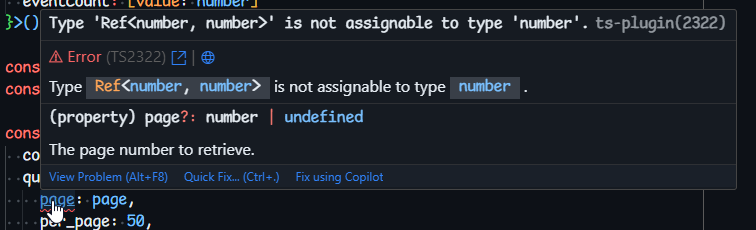
On the node of the API itself, just my opinion:
- EDIT: ignore this one. I just can't read.
- I think it's fine if
asyncDataOptionsis in the object, or an optional 3rd argument. Both may still require the user to look at the docs and examples and I don't know if much can be done as far as typescript hints. - Everything else so far seems fine.
Great, appreciate your help! I will let you know once I've polished the computed() APIs
@lrstanley try with the latest, I've got the function refetching with computed() https://github.com/hey-api/openapi-ts/pull/1519/commits/2efa6236d657111cf840e48ca7f9eb1fffa5f61c
@mrlubos getting the following error (with computed() and without).
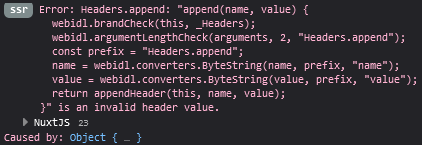
Not sure if it's something with my setup specifically or not. Can re-test with the example in the PR later today when I get some time though.
@lrstanley I didn't see headers in your previous examples. What does your code look like now? Did you try passing something to body already too?
@mrlubos same example as above. no auth, headers, etc. both this, and this without computed(). I don't have any interceptors, middleware, etc that would potentially set them.
const githubEvents = await listGithubEvents("useAsyncData", {
  query: computed(() => ({
    page: page.value,
    per_page: 50,
    "public.eq": true,
    sort: "created_at",
    order: "desc",
  })),
}, {
  watch: [page],
})
Would I be able to get access to your project? Or at least the spec you're using to generate the client? I guess it's one of these? https://github.com/github/rest-api-description
~~the frontend portion is a mess (start of a rewrite of my personal website from vue+vite as SPA to nuxt with SSR), thus if you want to wait for something based off the repo nuxt examples that's simpler, I can get that. some refs otherwise:~~
- ~~https://github.com/lrstanley/liam.sh/blob/feature/rewrite-2/cmd/httpserver/public-new/app.vue#L29-L40 - client & base URL setup.~~
- ~~https://github.com/lrstanley/liam.sh/blob/feature/rewrite-2/cmd/httpserver/public-new/components/events/events-render.vue#L42-L57 - component I was testing with (a few other pages and components also use
$fetchusing the same client)~~ - ~~spec: https://liam.sh/-/openapi.json~~
My spec does have optional header references, example here or here, the one behind that listGithubEvents operation. feel free to hit those endpoints. should work without auth & I think CORS should be *.
UPDATE: here is a simplified example, clean of all of the other cruft: https://github.com/lrstanley/nuxt-hey-api-example/tree/master
Thanks! I'll try to set up the example with your spec and see if I identify more issues. Will keep you posted
@lrstanley try the latest, I am hopeful it resolves everything on your end. The last issue was actually a broken build in a sense it would always fail due to incorrect unwrapping of headers.
@mrlubos header errors are gone, though I'm still seeing issues.
The following is still not receiving the updated version of the computed value -- if page is updated elsewhere, it stays set to 1 in the request. It is triggering another request though:
const page = ref(1)

const githubEvents = await listGithubEvents({
  composable: "useAsyncData",
  query: computed(() => ({
    page: page.value,
    "public.eq": true,
  })),
  asyncDataOptions: {
    watch: [page],
  }
})
Trying the following, which works from a type perspective, but has the exact same issue, still sends the value 1 as page:
const page = ref(1)

const githubEvents = await listGithubEvents({
  composable: "useAsyncData",
  query: {
    page: page,
    "public.eq": true,
  },
  asyncDataOptions: {
    watch: [page],
  }
})
I suspect the order of operations is going wrong somewhere and something is being statically unref'd earlier in the process than it should be. Looking through the PR code, it looks like there are a few places where this may be happening. opts is constructed inside of createClient, when it probably should be within the fetch function (inline or invoked within) that is passed to the composables, otherwise the URL, body, etc won't ever receive updates.
I've updated my example here. running that, and hitting the button to increment the page, it still sends the request for page 1, despite the page value updating, and the computed value also updating.