

 frenck
Translations update from Hosted Weblate

📝 Walkthrough
📝 Walkthrough
Walkthrough
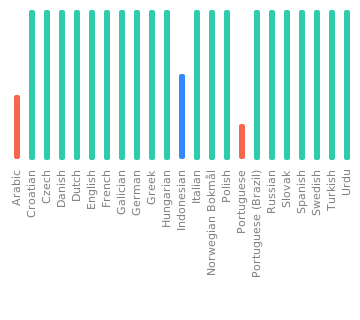
The update introduces structured JSON configurations in multiple translation files for the spook_inverse integration. New files for Afrikaans, Finnish, Estonian, Korean, Chinese (Simplified and Traditional), and Maltese enhance localization by providing detailed settings for binary sensors and switches. Each file now includes comprehensive sections for config, options, and user descriptions, improving accessibility and usability for various language speakers. Additionally, updates to Norwegian and Portuguese files refine existing translations.
Changes
| Files | Change Summary |
|---|---|
custom_components/spook/integrations/spook_inverse/... |
Added new translation files af.json, fi.json, et.json, ko.json, zh_Hans.json, zh_Hant.json, and mt.json, each containing structured JSON configurations for binary_sensor and switch, including properties like entity_id, hide_source, and name, along with user descriptions and menu options. |
custom_components/spook/integrations/spook_inverse/... |
Updated nb_NO.json to rename keys related to entity ID and source hiding options for Norwegian translations. |
custom_components/spook/integrations/spook_inverse/... |
Updated pt.json to append a ghost emoji (👻) to various titles in the configuration and options sections. |
Poem
🐰 In the digital glade where sensors play,
New options bloom like flowers in the day.
With a hop and a skip, they dance in delight,
Reversing their roles, making everything right.
So let’s cheer for the change, let joy take its flight! 🌸✨
🪧 Tips
Chat
There are 3 ways to chat with CodeRabbit:
- Review comments: Directly reply to a review comment made by CodeRabbit. Example:
I pushed a fix in commit <commit_id>, please review it.Generate unit testing code for this file.Open a follow-up GitHub issue for this discussion.
- Files and specific lines of code (under the "Files changed" tab): Tag
@coderabbitaiin a new review comment at the desired location with your query. Examples:@coderabbitai generate unit testing code for this file.@coderabbitai modularize this function.
- PR comments: Tag
@coderabbitaiin a new PR comment to ask questions about the PR branch. For the best results, please provide a very specific query, as very limited context is provided in this mode. Examples:@coderabbitai gather interesting stats about this repository and render them as a table. Additionally, render a pie chart showing the language distribution in the codebase.@coderabbitai read src/utils.ts and generate unit testing code.@coderabbitai read the files in the src/scheduler package and generate a class diagram using mermaid and a README in the markdown format.@coderabbitai help me debug CodeRabbit configuration file.
Note: Be mindful of the bot's finite context window. It's strongly recommended to break down tasks such as reading entire modules into smaller chunks. For a focused discussion, use review comments to chat about specific files and their changes, instead of using the PR comments.
CodeRabbit Commands (Invoked using PR comments)
@coderabbitai pauseto pause the reviews on a PR.@coderabbitai resumeto resume the paused reviews.@coderabbitai reviewto trigger an incremental review. This is useful when automatic reviews are disabled for the repository.@coderabbitai full reviewto do a full review from scratch and review all the files again.@coderabbitai summaryto regenerate the summary of the PR.@coderabbitai generate docstringsto generate docstrings for this PR.@coderabbitai resolveresolve all the CodeRabbit review comments.@coderabbitai configurationto show the current CodeRabbit configuration for the repository.@coderabbitai helpto get help.
Other keywords and placeholders
- Add
@coderabbitai ignoreanywhere in the PR description to prevent this PR from being reviewed. - Add
@coderabbitai summaryto generate the high-level summary at a specific location in the PR description. - Add
@coderabbitaianywhere in the PR title to generate the title automatically.
CodeRabbit Configuration File (.coderabbit.yaml)
- You can programmatically configure CodeRabbit by adding a
.coderabbit.yamlfile to the root of your repository. - Please see the configuration documentation for more information.
- If your editor has YAML language server enabled, you can add the path at the top of this file to enable auto-completion and validation:
# yaml-language-server: $schema=https://coderabbit.ai/integrations/schema.v2.json
Documentation and Community
- Visit our Documentation for detailed information on how to use CodeRabbit.
- Join our Discord Community to get help, request features, and share feedback.
- Follow us on X/Twitter for updates and announcements.
![coderabbitai[bot] avatar](https://avatars.githubusercontent.com/in/347564?v=4 "Published by a pub.dev verified publisher")
 Quality Gate passed
Issues
 0 New issues
 0 Accepted issues
Measures
0 Security Hotspots
0.0% Coverage on New Code
0.0% Duplication on New Code
See analysis details on SonarCloud
![sonarqubecloud[bot] avatar](https://avatars.githubusercontent.com/in/12526?v=4 "Published by a pub.dev verified publisher")
Quality Gate passed
Issues
0 New issues
0 Accepted issues
Measures
0 Security Hotspots
0.0% Coverage on New Code
0.0% Duplication on New Code
See analysis details on SonarQube Cloud
Quality Gate passed
Issues
0 New issues
0 Accepted issues
Measures
0 Security Hotspots
0.0% Coverage on New Code
0.0% Duplication on New Code
See analysis details on SonarQube Cloud