

 flintlib
acb_poly functions request
Would it make sense to add functions like conj, real_part, imag_part, and abs for acb_poly? My use case is that I have an acb->acb function and I am using acb_poly to find its complex derivative automatically, and the function uses conj, real_part, imag_part, and abs.

I assume that conj, real_part, imag_part apply per-coefficient. How is abs defined?

My reasoning was that if Re and Im are defined then you could do abs as sqrt(Re^2 + Im^2) using the 'series' variants of sqrt, squaring, and addition but I haven't thought too deeply about it.
Yes, that is reasonable. So it should actually be an abs_series method.
Appreciate this is an older question, but I have also hit the lack of conj, abs, max, imag & real part functions when using arb_poly and acb_poly. The work-around below (for abs, but easily adjustable for the other functions) worked fine for me.
//procedure to calculate the absolute value of an acb_poly function
void
acb_poly_abs_series(arb_poly_t res, const acb_poly_t p, slong prec)
{
    acb_t a, one;
    acb_init(a);
    acb_init(one);

    arb_t abs;
    arb_init(abs);

    acb_set_si(one, 1);
    acb_poly_evaluate(a, p, one, prec);
    acb_abs(abs, a, prec);

    arb_poly_set_arb(res, abs);

    arb_clear(abs);
    acb_clear(a);
    acb_clear(one);
}

I don't understand what that code is meant to do. Absolute value of the sum of the coefficients, how is that useful?
@fredrik-johansson
It probably not so much 'useful', but could be 'practical' once everything else is in acb-poly. Suppose we have to code a complex valued function like this one:
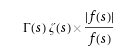
where f(s) is a complex polynomial. The Gamma and Zeta functions could be coded in ARB using acb or acb_poly functions. Once you pick the latter, it is just convenient to have all functions and variables as acb_poly hence an acb_poly_abs_series function keeps the code more readable (the actual example where we encountered this problem is much more complicated and involves many different sub-functions).
P.S.: Just to let you know that we have been quite heavily (and successfully) using ARB to find numerical evidence for this polymath project: https://terrytao.wordpress.com/2018/01/24/polymath-proposal-upper-bounding-the-de-bruijn-newman-constant/
Very impressed by the robustness of your software as well as by the tremendous speed gains that it has brought us (up till a factor 20-30 faster than pari/gp). So far we haven't encountered a single bug in the software. Well done!
Only found two minor typo's in the documentation:
 (y=z or z=y)
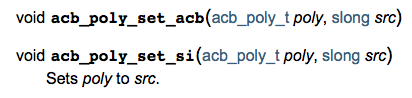
(slong src should be acb_t src in the first line)
Two questions about possible limitations/missing functions have come up that I will raise as a separate issue to keep this thread clean.
I understand the application but the acb_poly_abs_series function you provided makes no sense to me.
Thanks for the info about the polymath project and for the typos!
To convert a value in acb_poly back to an acb_t-varibale, I evaluate the polynomial for a value p at x=1 (i.e. assuming the coefficients encode the value p) and thereby obtain a complex value stored in an acb_t variable. Any acb_t function like abs, conj, etc. can then be applied to it and the result value is then 'encoded' in a new polynomial (of type arb_poly and acb_poly respectively).
I attach a simple test-script to show that this actually works well for abs and conj using an input value z = x+yi. I definitely don't rule out that my logic is wrong and some other mechanism gives the correct result 'by coincidence', but keen to understand what is going on!
Your test code only uses length 1 polynomials. What does it mean for the coefficients to "encode the value" when the length is > 1?
Ah. You are correct. I am indeed using length 1 polynomials and that's why it works. The concept of abs for polynomials with length > 1 doesn't make much sense, since one would first need to evaluate the polynomial for a chosen x (not necessarily 1) to obtain a value to then apply the abs to.