

 emeraldpay
Turbo-Geth Websocket error
This one is kind of strange. I have a Turbo-Geth node configured and sync'd but if I use websocket I get the following error:
2020-23-08 20:37:56.518 | INFO  |  ConfiguredUpstreams | Using Ethereum upstream, at http://192.168.15.34:8545, ws://192.168.15.34:8545
2020-23-08 20:37:56.531 | INFO  | WsFactory$EthereumWs | Connecting to WebSocket: ws://192.168.15.34:8545
io.netty.handler.codec.http.websocketx.WebSocketHandshakeException: Invalid handshake response getStatus: 200 OK
	at io.netty.handler.codec.http.websocketx.WebSocketClientHandshaker13.verify(WebSocketClientHandshaker13.java:191)
	at io.netty.handler.codec.http.websocketx.WebSocketClientHandshaker.finishHandshake(WebSocketClientHandshaker.java:216)
	at io.netty.handler.codec.http.websocketx.WebSocketClientProtocolHandshakeHandler.channelRead(WebSocketClientProtocolHandshakeHandler.java:57)
	at io.netty.channel.AbstractChannelHandlerContext.invokeChannelRead(AbstractChannelHandlerContext.java:379)
	at io.netty.channel.AbstractChannelHandlerContext.invokeChannelRead(AbstractChannelHandlerContext.java:365)
	at io.netty.channel.AbstractChannelHandlerContext.fireChannelRead(AbstractChannelHandlerContext.java:357)
	at io.netty.handler.codec.MessageToMessageDecoder.channelRead(MessageToMessageDecoder.java:102)
	at io.netty.channel.AbstractChannelHandlerContext.invokeChannelRead(AbstractChannelHandlerContext.java:379)
	at io.netty.channel.AbstractChannelHandlerContext.invokeChannelRead(AbstractChannelHandlerContext.java:365)
	at io.netty.channel.AbstractChannelHandlerContext.fireChannelRead(AbstractChannelHandlerContext.java:357)
	at io.netty.channel.CombinedChannelDuplexHandler$DelegatingChannelHandlerContext.fireChannelRead(CombinedChannelDuplexHandler.java:436)
	at io.netty.handler.codec.ByteToMessageDecoder.fireChannelRead(ByteToMessageDecoder.java:323)
	at io.netty.handler.codec.ByteToMessageDecoder.channelRead(ByteToMessageDecoder.java:297)
	at io.netty.channel.CombinedChannelDuplexHandler.channelRead(CombinedChannelDuplexHandler.java:251)
	at io.netty.channel.AbstractChannelHandlerContext.invokeChannelRead(AbstractChannelHandlerContext.java:379)
	at io.netty.channel.AbstractChannelHandlerContext.invokeChannelRead(AbstractChannelHandlerContext.java:365)
	at io.netty.channel.AbstractChannelHandlerContext.fireChannelRead(AbstractChannelHandlerContext.java:357)
	at io.netty.channel.DefaultChannelPipeline$HeadContext.channelRead(DefaultChannelPipeline.java:1410)
	at io.netty.channel.AbstractChannelHandlerContext.invokeChannelRead(AbstractChannelHandlerContext.java:379)
	at io.netty.channel.AbstractChannelHandlerContext.invokeChannelRead(AbstractChannelHandlerContext.java:365)
	at io.netty.channel.DefaultChannelPipeline.fireChannelRead(DefaultChannelPipeline.java:919)
	at io.netty.channel.nio.AbstractNioByteChannel$NioByteUnsafe.read(AbstractNioByteChannel.java:163)
	at io.netty.channel.nio.NioEventLoop.processSelectedKey(NioEventLoop.java:714)
	at io.netty.channel.nio.NioEventLoop.processSelectedKeysOptimized(NioEventLoop.java:650)
	at io.netty.channel.nio.NioEventLoop.processSelectedKeys(NioEventLoop.java:576)
	at io.netty.channel.nio.NioEventLoop.run(NioEventLoop.java:493)
	at io.netty.util.concurrent.SingleThreadEventExecutor$4.run(SingleThreadEventExecutor.java:989)
	at io.netty.util.internal.ThreadExecutorMap$2.run(ThreadExecutorMap.java:74)
	at io.netty.util.concurrent.FastThreadLocalRunnable.run(FastThreadLocalRunnable.java:30)
	at java.base/java.lang.Thread.run(Thread.java:834)
2020-23-08 20:37:56.606 | INFO  |     EthereumUpstream | Configured for Ethereum
2020-23-08 20:37:56.642 | INFO  | entMultistreamHolder | Upstream turbogeth with chain ETHEREUM has been added
I'm not sure if this is something strange with dshackle or if Turbo-Geth is doing something weird.
The Turbo-Geth team hasn't done extensive WebSocket testing, I know that much. But the error is strange to me.
Maybe you have an idea?

I'm thinking that maybe Turbo-Geth is missing some RPC endpoint that dshackle requires, because it comes back as unavailable if I only use HTTP too. :disappointed:
Hi, thank you for the finding. There was a severe bug in the WS code, which I had fixed recently (not release yet). But this one may be unrelated. I'm trying to make a release later today with other bugfixes, so let's try with the next version, and we'll see.

I just published version 0.8.2, please try it. Not sure about this issue though, but if fixed couple of other issues you reported.
Ok, thanks.
Just looked at the stacktrace, it seems to be more complex that I thought. It happens inside WS codec implementation (WebSocketClientHandshaker13), not even Dshackle. I guess I'll need a Turbo Geth to debug it.
If you DM me on Gitter, I can open a port up to my TurboGeth instance for you. I just need your source IP to stick on the firewall.
I'm just not sure when I can focus on this bug. I guess it's not high priority, because it can continue with HTTP RPC, right? I can take a look at it later then
I have an update!
Turbo-Geth now supports WebSocket...apparently they did not before, which explains why it didn't work haha.
However, it appears that dshackle gets upset at Turbo-Geth not supporting eth_subscribe, kills the WebSocket, and returns to JSON RPC.
dshackle:
{"jsonrpc":"2.0","method":"eth_subscribe","params":["newHeads"],"id":1}
Turbo-Geth:
{"jsonrpc":"2.0","id":1,"error":{"code":-32601,"message":"no \"newHeads\" subscription in eth namespace"}}\n
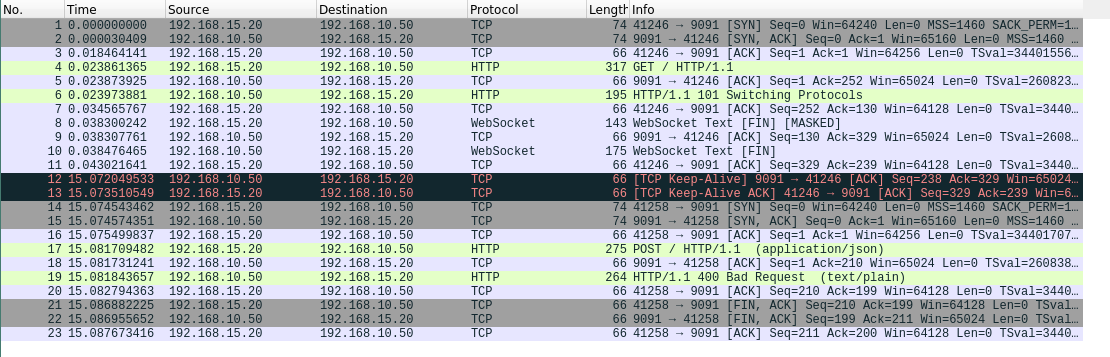
In the screenshot you can see that WebSocket stops after that reply, and then a new TCP connection is made and HTTP is used.
The HTTP 400 Bad Request is because turning on WebSocket in Turbo-Geth currently disables JSON RPC :laughing: I was told they'll fix it.
Kind of good news :) The main purpose to use WS for Dshackle is to subscribe to the new blocks (newHeads), hope they'll add it
I know there are other efficiency gains from using WebSocket, is it not worth using WebSocket even without the subscription?
You're right, it probably makes sense to use WebSocket for all requests. It relies on HTTP only because of the historical reasons, was easier to start/debug/etc. Hope to change it in one of the future releases, not sure when