
astrapy
 astrapy copied to clipboard
 datastax
AstraPy is a Pythonic interface for DataStax Astra DB and the Data API
AstraPy
A pythonic client for DataStax Astra DB.
This README targets AstraPy version 1.0.0+, which introduces a whole new API. Click here for the pre-existing API (fully compatible with newer versions).
Quickstart
Install with pip install astrapy.
Get the API Endpoint and the Token to your Astra DB instance at astra.datastax.com.
Try the following code after replacing the connection parameters:
import astrapy

ASTRA_DB_APPLICATION_TOKEN = "AstraCS:..."
ASTRA_DB_API_ENDPOINT = "https://01234567-....apps.astra.datastax.com"

my_client = astrapy.DataAPIClient()
my_database = my_client.get_database(
    ASTRA_DB_API_ENDPOINT,
    token=ASTRA_DB_APPLICATION_TOKEN,
)

my_collection = my_database.create_collection(
    "dreams",
    dimension=3,
    metric=astrapy.constants.VectorMetric.COSINE,
)

my_collection.insert_one({"summary": "I was flying", "$vector": [-0.4, 0.7, 0]})

my_collection.insert_many(
    [
        {
            "_id": astrapy.ids.UUID("018e65c9-e33d-749b-9386-e848739582f0"),
            "summary": "A dinner on the Moon",
            "$vector": [0.2, -0.3, -0.5],
        },
        {
            "summary": "Riding the waves",
            "tags": ["sport"],
            "$vector": [0, 0.2, 1],
        },
        {
            "summary": "Friendly aliens in town",
            "tags": ["scifi"],
            "$vector": [-0.3, 0, 0.8],
        },
        {
            "summary": "Meeting Beethoven at the dentist",
            "$vector": [0.2, 0.6, 0],
        },
    ],
)

my_collection.update_one(
    {"tags": "sport"},
    {"$set": {"summary": "Surfers' paradise"}},
)

cursor = my_collection.find(
    {},
    sort={"$vector": [0, 0.2, 0.4]},
    limit=2,
    include_similarity=True,
)

for result in cursor:
    print(f"{result['summary']}: {result['$similarity']}")

# This would print:
#   Surfers' paradise: 0.98238194
#   Friendly aliens in town: 0.91873914
Next steps:
- More info and usage patterns are given in the docstrings of classes and methods
- Data API reference
- AstraPy reference
- Package on PyPI
AstraPy's API
Abstraction diagram
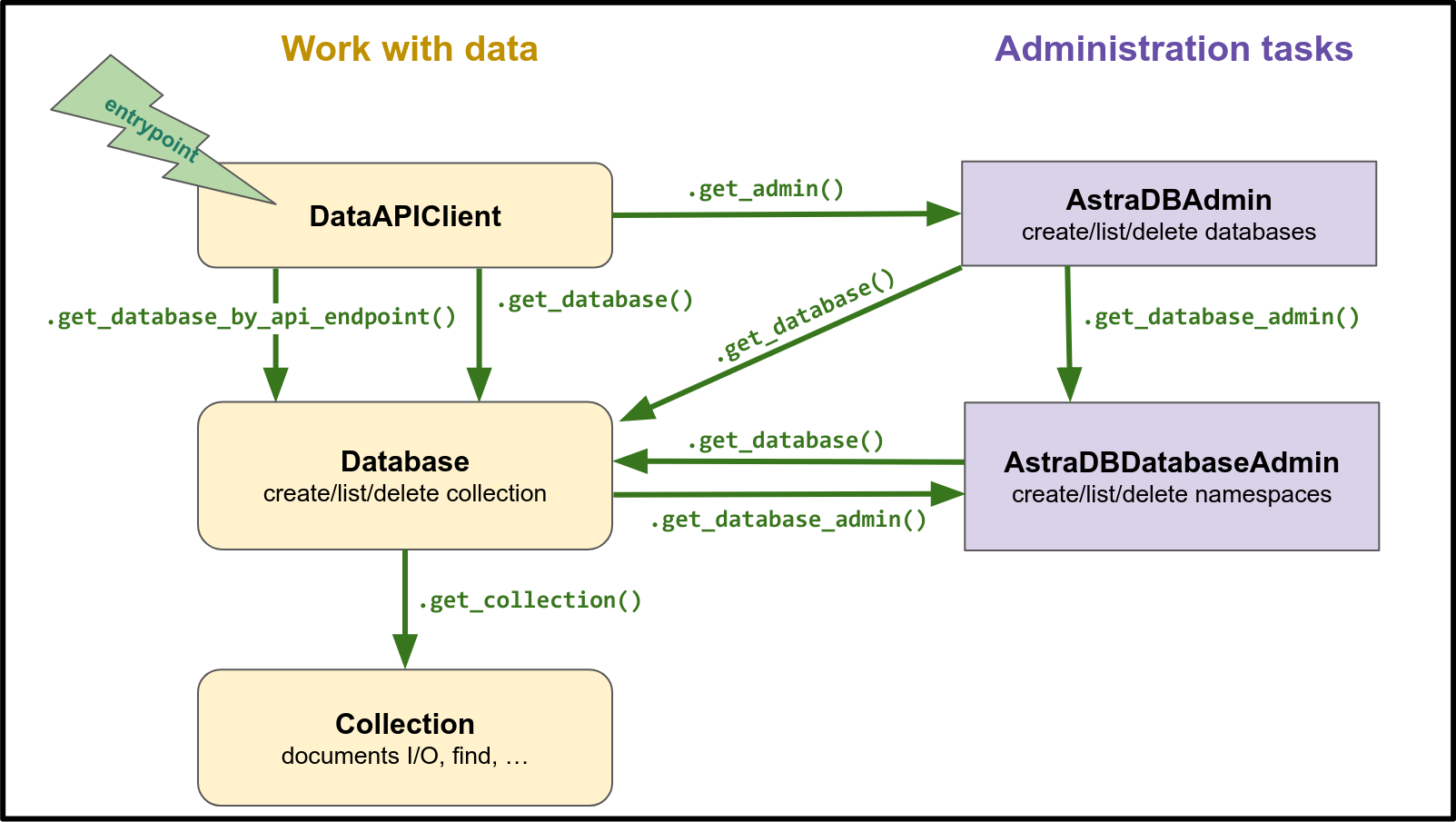
AstraPy's abstractions for working at the data and admin layers are structured as depicted by this diagram:
Here's a small admin-oriented example:
import astrapy


# this must have "Database Administrator" permissions:
ASTRA_DB_APPLICATION_TOKEN = "AstraCS:..."

my_client = astrapy.DataAPIClient(ASTRA_DB_APPLICATION_TOKEN)

my_astra_admin = my_client.get_admin()

database_list = list(my_astra_admin.list_databases())

db_info = database_list[0].info
print(db_info.name, db_info.id, db_info.region)

my_database_admin = my_astra_admin.get_database_admin(db_info.id)

my_database_admin.list_namespaces()
my_database_admin.create_namespace("my_dreamspace")
Exceptions
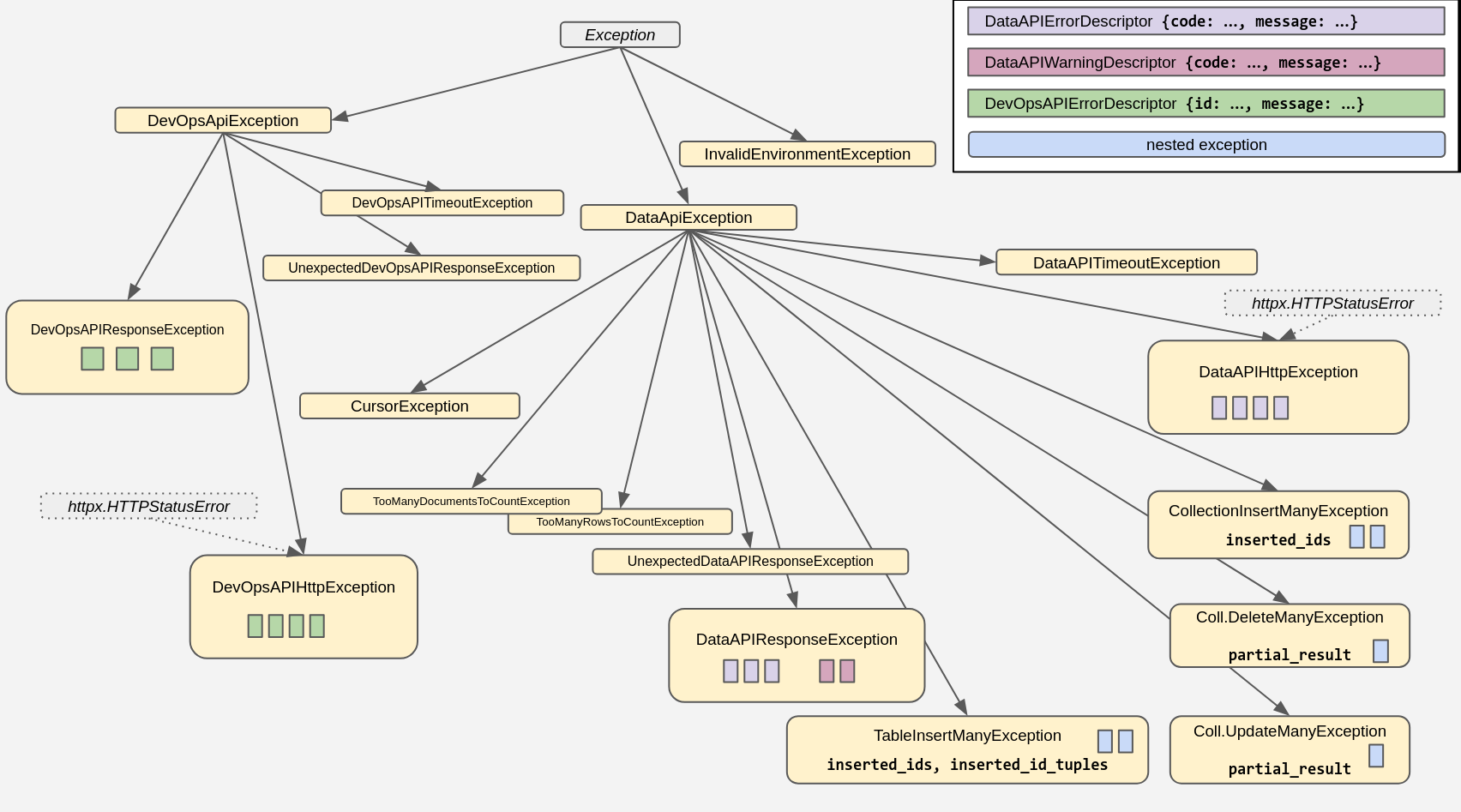
The package comes with its own set of exceptions, arranged in this hierarchy:
For more information, and code examples, check out the docstrings and consult the API reference linked above.
Working with dates
Date and datetime objects, i.e. instances of the standard library
datetime.datetime and datetime.date classes, can be used anywhere in documents:
import datetime
import astrapy


ASTRA_DB_APPLICATION_TOKEN = "AstraCS:..."
ASTRA_DB_API_ENDPOINT = "https://01234567-....apps.astra.datastax.com"

my_client = astrapy.DataAPIClient()
my_database = my_client.get_database(
    ASTRA_DB_API_ENDPOINT,
    token=ASTRA_DB_APPLICATION_TOKEN,
)
my_collection = my_database.dreams

my_collection.insert_one({"when": datetime.datetime.now()})
my_collection.insert_one({"date_of_birth": datetime.date(2000, 1, 1)})

my_collection.update_one(
    {"registered_at": datetime.date(1999, 11, 14)},
    {"$set": {"message": "happy Sunday!"}},
)

print(
    my_collection.find_one(
        {"date_of_birth": {"$lt": datetime.date(2001, 1, 1)}},
        projection={"_id": False},
    )
)
# This would print:
#    {'date_of_birth': datetime.datetime(2000, 1, 1, 0, 0)}
Note: reads from a collection will always
return the datetime class regardless of wheter a date or a datetime was provided
in the insertion.
Working with ObjectIds and UUIDs
Astrapy repackages the ObjectId from bson and the UUID class and utilities
from the uuid package and its uuidv6 extension. You can also use them directly.
Even when setting a default ID type for a collection, you still retain the freedom to use any ID type for any document:
import astrapy
import bson

ASTRA_DB_APPLICATION_TOKEN = "AstraCS:..."
ASTRA_DB_API_ENDPOINT = "https://01234567-....apps.astra.datastax.com"

my_client = astrapy.DataAPIClient()
my_database = my_client.get_database(
    ASTRA_DB_API_ENDPOINT,
    token=ASTRA_DB_APPLICATION_TOKEN,
)

my_collection = my_database.create_collection(
    "ecommerce",
    default_id_type=astrapy.constants.DefaultIdType.UUIDV6,
)

my_collection.insert_one({"_id": astrapy.ids.ObjectId("65fd9b52d7fabba03349d013")})
my_collection.find({
    "_id": astrapy.ids.UUID("018e65c9-e33d-749b-9386-e848739582f0"),
})

my_collection.update_one(
    {"tag": "in_stock"},
    {"$set": {"inventory_id": bson.objectid.ObjectId()}},
    upsert=True,
)

my_collection.insert_one({"_id": astrapy.ids.uuid8()})
For contributors
First install poetry with pip install poetry and then the project dependencies with poetry install --with dev.
Linter, style and typecheck should all pass for a PR:
make format
With make format-fix the style and imports are autofixed (by black and isort resp.)
Features must be thoroughly covered in tests (see tests/idiomatic/* for
naming convention and module structure).
Running tests
Tests are grouped in three blocks (in as many subdirs of tests/):
- core: pre-1.0 classes
- idiomatic: all 1.0+ classes and APIs, except...
- vectorize: ... everything making use of
$vectorize(within the idiomatic classes)
Actually, for convenience, sub-blocks of tests are considered:
- core regular: everything except DevOps interactions
- core ops: core DevOps operations
- idiomatic regular: everything except the admin parts
- idiomatic admin Astra: the Astra-specific admin operations
- idiomatic admin nonAstra: the nonAstra-specific admin operations
- vectorize in-depth: many Data API interactions for a single choice of provider/model. This is mostly test the client
- vectorize all-providers: a slightly more shallow test repeated for all providers, models, auth methods etc. This is mostly testing the API
Tests can be run on three types of Data API targets (with slight differences in what is applicable):
- DockerCompose: HCD started by the test initialization with
docker-compose. Note that in this case you will have to manually destroy the created containers. - nonAstra: a ready-to-use (user-supplied) local Data API
- Astra: an Astra DB target account (or two, as some tests are specific to dev environment)
Depending on the (sub-block, target) combination, some environment variables may be needed.
Templates for the environment variables are to be found in tests/env_templates.
The general expectation is that idiomatic non-Admin tests, and vectorize in-depth tests, are part of the main CI flow; conversely, core, admin and vectorize all-providers are kept as a manual task to run (locally in most cases) when circumstances require it (use your judgement).
Required environment variables
Below is a detail of the reference template files needed for the various types of testing:
- DockerCompose: generally no variables needed, except:
- vectorize in-depth: provide as in
env.vectorize-minimal.template - vectorize all-providers: provide as in
env.vectorize.template - (also note that core ops and idiomatic admin Astra amount to nothing in this case)
- vectorize in-depth: provide as in
- nonAstra: all tests require as in
env.local.template, plus:- vectorize in-depth: also provide as in
env.vectorize-minimal.template - vectorize all-providers: also provide as in
env.vectorize.template - (also note that core ops and idiomatic admin Astra amount to nothing in this case)
- vectorize in-depth: also provide as in
- Astra: all tests require as in
env.astra.template, plus:- core ops: the token must have at least "Database Administrator" role (possibly through definition of a separate
ASTRA_DB_OPS_APPLICATION_TOKEN), andASTRA_DB_IDmust also be defined - idiomatic admin Astra: also provide as in
env.astra.admin.template - vectorize in-depth: also provide as in
env.vectorize-minimal.template - vectorize all-providers: also provide as in
env.vectorize.template - (also note that idiomatic admin nonAstra amounts to nothing in this case)
- core ops: the token must have at least "Database Administrator" role (possibly through definition of a separate
Sample testing commands
For the DockerCompose case, prepend all of the following with DOCKER_COMPOSE_LOCAL_DATA_API="yes" .
All the usual pytest ways of restricting the test selection hold in addition
(e.g. poetry run pytest tests/idiomatic/unit or [...] -k <test_name_selector>).
core regular:
poetry run pytest tests/core
core ops:
Note the special variable needed to actually run this. You will have to manually clean up afterwards.
TEST_ASTRADBOPS="1" poetry run pytest tests/core/test_ops.py
idiomatic regular:
Warning: this will also trigger the very long-running idiomatic admin Astra if the vars as in env.astra.admin.template are also detected. Likewise, the idiomatic admin nonAstra may start (if DO_IDIOMATIC_ADMIN_TESTS is set), which however takes few seconds.
poetry run pytest tests/idiomatic
idiomatic admin Astra:
poetry run pytest tests/idiomatic/integration/test_admin.py
idiomatic admin nonAstra:
DO_IDIOMATIC_ADMIN_TESTS="1" poetry run pytest tests/idiomatic/integration/test_nonastra_admin.py
vectorize in-depth:
poetry run pytest tests/vectorize_idiomatic/integration/test_vectorize_methods*.py
or just:
poetry run pytest tests/vectorize_idiomatic/integration/test_vectorize_methods_sync.py
vectorize all-providers:
This generates all possible test cases and runs them:
poetry run pytest tests/vectorize_idiomatic
For a spot test, you may restrict to one case, e.g.
EMBEDDING_MODEL_TAGS="openai/text-embedding-3-large/HEADER/0" poetry run pytest tests/vectorize_idiomatic/integration/test_vectorize_providers.py -k test_vectorize_usage_auth_type_header_sync
Useful flags for testing
Remove logging noise with:
poetry run pytest [...] -o log_cli=0
Increase logging level to TRACE (i.e. level 5):
poetry run pytest [...] -o log_cli=1 --log-cli-level=5
Do not drop collections (valid for core):
TEST_SKIP_COLLECTION_DELETE=1 poetry run pytest [...]
Appendices
Appendix A: quick reference for imports
Client, data and admin abstractions:
from astrapy import (
    DataAPIClient,
    Database,
    AsyncDatabase,
    Collection,
    AsyncCollection,
    AstraDBAdmin,
    AstraDBDatabaseAdmin,
    DataAPIDatabaseAdmin,
)
Constants for data-related use:
from astrapy.constants import (
    ReturnDocument,
    SortDocuments,
    VectorMetric,
    DefaultIdType,
    Environment,
)
ObjectIds and UUIDs:
from astrapy.ids import (
    ObjectId,
    uuid1,
    uuid3,
    uuid4,
    uuid5,
    uuid6,
    uuid7,
    uuid8,
    UUID,
)
Operations (for bulk_write collection method):
from astrapy.operations import (
    BaseOperation,
    InsertOne,
    InsertMany,
    UpdateOne,
    UpdateMany,
    ReplaceOne,
    DeleteOne,
    DeleteMany,
    AsyncBaseOperation,
    AsyncInsertOne,
    AsyncInsertMany,
    AsyncUpdateOne,
    AsyncUpdateMany,
    AsyncReplaceOne,
    AsyncDeleteOne,
    AsyncDeleteMany,
)
Result classes:
from astrapy.results import (
    OperationResult,
    DeleteResult,
    InsertOneResult,
    InsertManyResult,
    UpdateResult,
    BulkWriteResult,
)
Exceptions:
from astrapy.exceptions import (
    DevOpsAPIException,
    DevOpsAPIResponseException,
    DevOpsAPIErrorDescriptor,
    DataAPIErrorDescriptor,
    DataAPIDetailedErrorDescriptor,
    DataAPIException,
    DataAPITimeoutException,
    CursorIsStartedException,
    CollectionNotFoundException,
    CollectionAlreadyExistsException,
    TooManyDocumentsToCountException,
    DataAPIFaultyResponseException,
    DataAPIResponseException,
    CumulativeOperationException,
    InsertManyException,
    DeleteManyException,
    UpdateManyException,
    BulkWriteException,
)
Info/metadata classes:
from astrapy.info import (
    AdminDatabaseInfo,
    DatabaseInfo,
    CollectionInfo,
    CollectionVectorServiceOptions,
    CollectionDefaultIDOptions,
    CollectionVectorOptions,
    CollectionOptions,
    CollectionDescriptor,
    EmbeddingProviderParameter,
    EmbeddingProviderModel,
    EmbeddingProviderToken,
    EmbeddingProviderAuthentication,
    EmbeddingProvider,
    FindEmbeddingProvidersResult,
)
Admin-related classes and constants:
from astrapy.admin import (
    ParsedAPIEndpoint,
)
Cursors:
from astrapy.cursors import (
    BaseCursor,
    Cursor,
    AsyncCursor,
    CommandCursor,
    AsyncCommandCursor,
)
Appendix B: compatibility with pre-1.0.0 library
If your code uses the pre-1.0.0 astrapy (i.e. from astrapy.db import Database, Collection and so on) you are strongly advised to migrate to the current API.
That being said, there are no known breakings of backward compatibility: legacy code would run with a newest astrapy version just as well. Here is a recap of the minor changes that came to the old API with 1.0.0:
- Added support for null tokens (with the effect of no authentication/token header in requests)
- Added Content-Type header to all HTTP requests to the API
- Added methods to
[Async]AstraDBCollection:delete_one_filter, - Paginated find methods (sync/async) type change from Iterable to Generator
- Bugfix: handling of the mutable caller identity in copy and convert (sync/async) methods
- Default value of
sortisNoneand not{}forfind(sync/async) - Introduction of
[Async]AstraDBCollection.chunked_delete_manymethod - Added
projectionparameter tofind_one_and[replace/update](sync/async) - Bugfix: projection was silently ignored in
vector_find_one_and_[replace/update](sync/async) - Added
optionstoupdate_many(sync/async) [Async]AstraDBDatabase.chunked_insert_manydoes not intercept generic exceptions anymore, onlyAPIRequestError- Bugfix:
AsyncAstraDBCollection.async chunked_insert_manystops at the first error whenordered=True - Added payload info to
DataAPIException - Added
find_one_and_deletemethod (sync/async) - Added
skip_error_checkparameter todelete_many(sync/async) - Timeout support throughout the library
- Added
sorttoupdate_one,delete_oneanddelete_one_by_predicatemethods (sync/async) - Full support for UUID v1,3,4,5,6,7,8 and ObjectID at the collection data I/O level
AstraDBOps.create_databaseraises errors in case of failuresAstraDBOps.create_database, return type corrected- Fixed behaviour and return type of
AstraDBOps.create_keyspaceandAstraDBOps.terminate_db - Added
AstraDBOps.delete_keyspacemethod - Method
create_collectionofAstraDBrelaxes checks on passingdimensionsfor vector collections - AstraDBOps core class acquired async methods:
async_get_databases,async_get_database,async_create_database,async_terminate_database,async_create_keyspace,async_delete_keyspace
Keep in mind that the pre-1.0.0 library, now dubbed "core", is what the current 1.0.0 API ("idiomatic") builds on.
 datastax