

 common-voice
LOCALIZATION REQUEST: Add Pomak language
Use this template to request a new localizable language that is currently not available on Pontoon.
Note: This issue only applies to the web interface language - in order to activate language contributions on Common Voice you will also need to ensure 5,000+ sentences are available to be read in that language. Please refer to the full Language documentation for more details.
Language name What language would you like to add?
- Pomak
Language code Please provide the ISO-639-1 code
- Pomak has not been assigned an ISO-code yet. Pomak is a language of the Slavic family. About its status as an identifiable language please see the attached text Pomak: An idiosyncratic East South Slavic language?. Pomak_traits.pdf
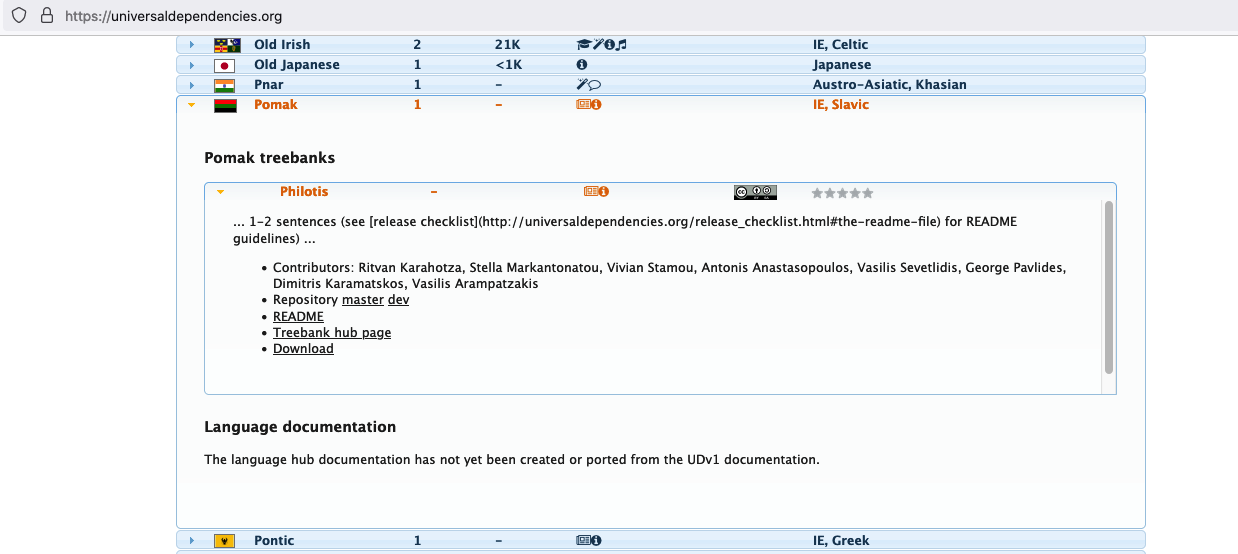
We would like to ask you to assign to Pomak the code qpm that has already been assigned to it in the Universal Dependencies framework.

Language size
- A very rough estimation is about 450000 people distributed in three countries, namely Bulgaria, Greece and Turkey. We refer to Adamou and Fanciullo (2018) for these numbers as explained below:
_… there are no official statistics on the number of Pomaks in Bulgaria. … According to this estimate, the number of Pomaks in Bulgaria would be roughly 100,000. (Adamou and Fanciullo, 2018: 6)
.. given the numbers in the 1965 census and what we know about the migration in the years 1980 and 1990, the numbers cited in Milliyet in 2008 remain particularly high. If these numbers were to be precise, this would mean that the majority of Pomaks is nowadays settled in Turkey (Adamou and Fanciullo, 2018: 7) (our note: about 300000)
The number of Pomaks in Greece is estimated to be approximately 36,000 according to the numbers cited in KOSTOPOULOS (2009, 290‒291). However, it is very difficult to evaluate the presence of Pomaks in Greece. (Adamou and Fanciullo, 2018: 7)._
Plural forms How would you translate the following in this language?
- 0 rocks 0 kámene
- 1 rock 1 kámen
- 2 rocks 2 kámenæ
- 3 rocks 3 kámenæ
- 4 rocks 4 kámenæ
- 5 rocks 5 kámenæ
- 10 rocks 10 kémenæ
- 20 rocks 20 kámenæ
- 100 rocks 100 kámenæ
- 1000 rocks 1000 kámenæ
- I see 0 rocks on the ground Vídem 0 kémene na zemǿno
- I see 1 rock on the ground Vídem 1 kámenæ na zemǿno
- I see 10 rocks on the ground Vídem 10 kámenæ na zemǿno
- I see rocks on the ground Vídem kámene / kámeņe na zemǿno
Pontoon manager Please link to the Pontoon account of the person who should be listed as the community manager of this language
- Pontoon account: [email protected]
Language Script What is the name of the language scripts used to write your language ? e.g latin, Devanagari
- Latin

Dear @kosmasK thank you for your interest. Have you looked at the process for requesting an ISO code for the language. If so, what stage of the process are you in?
Currently we are working on enabling language variants, with the first variants (for Portuguese, Welsh and Swahili) released this week. To speed up the process, could Pomak speakers benefit from the work already put into Bulgarian and Macedonian on Common Voice? Either in terms of being one among many variants of these languages?
Do you have representatives in your community from Bulgaria, Turkey and Greece? It would be good to get a wide consensus about the way forward. Note that Common Voice is a platform for collecting speech data for speech recognition systems, so categorisation of languages and variants is oriented towards these concerns.

Hey @kosmasK
Thanks for your request.
I'm messaging to follow up from Francis' message.
Do you need any support regarding the questions asked or would like a phone call ?
Many thanks,
Hillary

Dear @ftyers and @Heyhillary ,
Thank you for your patience and I apologize for our late response. We provide our answers on a question basis.
Have you looked at the process for requesting an ISO code for the language. If so, what stage of the process are you in?
- We have not requested an ISO code for the language. Our work on Pomak is carried out within the project “Philotis”, which is funded by the Greek State. Philotis is interested in providing easily accessible facilities for the development of language resources and uses Pomak of Greece as a case study (Greek is the second case study of Philotis for other types of resources). The assignment of an ISO code to Pomak is beyond Philotis’ goals.
This said, we have argued on linguistic grounds that Pomak is an independent language within the South East Slavic language group. Drawing on this argumentation, UDs assigned the code qpm to Pomak.
Currently we are working on enabling language variants, with the first variants (for Portuguese, Welsh and Swahili) released this week. To speed up the process, could Pomak speakers benefit from the work already put into Bulgarian and Macedonian on Common Voice? Either in terms of being one among many variants of these languages?
- As already said, Pomak is an independent language within the South East Slavic language group. Currently, we are training ASR models for speech drawing on Slovac. The criterion for this choice is the correspondence between the sounds and the alphabet of the language, and the Slovac correspondence is closest to the Pomak one among the languages of the Slavic group. We are working on Pomak as spoken in Greece and we would consider a variant such as POMAK-GR valid. Other variants could perhaps be POMAK-BR and POMAK-TR.
Do you have representatives in your community from Bulgaria, Turkey and Greece? It would be good to get a wide consensus about the way forward. Note that Common Voice is a platform for collecting speech data for speech recognition systems, so categorisation of languages and variants is oriented towards these concerns.
- As said, Philotis develops resources for Pomak as spoken in Greece, what we have called Pomak-GR. We are working in close cooperation with the Pomak community in Greece but we have no representatives of the Pomak communities in Bulgaria and Turkey.
We can also arrange a call to discuss any further inquiries. Best,
Kosmas