

 colin-kiegel
Print warning when we cannot print good diff
Ref #100
If left and right are not equal, but we cannot print any diff, then make sure to print warning instead.
example:
use pretty_assertions::assert_eq;

fn main() {
    assert_eq!("\n", "\r\n");
}
thread 'main' panicked at 'assertion failed: `(left == right)`

Diff < left / right > :
Warning: values were different, but no line diff was generated. Do your values have the same line endings?

', pretty_assertions/examples/pretty_assertion.rs:4:5
note: run with `RUST_BACKTRACE=1` environment variable to display a backtrace

@lemolatoon Oh, that's quite tricky - even if a diff is shown, these differences could be hidden in the output. :-/
No Diff Case
The warning is good, but let's try to offer more - why not at least fall back to the default presentation AFTER the warning? IMO we don't need to ask the user whether there are different line endings, if we can also tell him.
General Case
I wonder if we should try to detect "invisible" differences and implement more general fallbacks?

@colin-kiegel Thank you for replying. Let me comfirm what you suggested.
No Diff Case
So you mean Asking (Do your values have the same line endings?) is unnecessary. And Warning should be shown before.
In which case, example would be...
thread 'main' panicked at 'assertion failed: `(left == right)`

Warning: values were different, but no line diff was generated.
Diff < left / right > :

', pretty_assertions/examples/pretty_assertion.rs:4:5
note: run with `RUST_BACKTRACE=1` environment variable to display a backtrace
General Case
In another case, such as...
use pretty_assertions::assert_eq;

fn main() {
    assert_eq!("a\n", "ab\r\n");
}
As you pointed out, on current implementation, we cannot detect and print warning on this type.
What I am going to do
I am going to fix these points.
@lemolatoon That's only part of what I meant - first let's keep the second part, but not as a question:
- Warning: values were different, but no line diff was generated. It seems like these values only differ in line endings - falling back to debug output:
Then we could fallback to showing the debug-string of left and right, like the original "not pretty" assert_eq!() output´.
Warning: values were different, but no line diff was generated. It seems like these values only differ in line endings - falling back to debug output:
Diff < left / right > :
  left: `"Foo\n"`,
 right: `"Foo\r\n"`'
Now by the commit I just did. It should be ok. example:
use pretty_assertions::assert_eq;

fn main() {
    assert_eq!("Foo\n", "Foo\r\n")
}
thread 'main' panicked at 'assertion failed: `(left == right)`

Warning: values were different, but no line diff was generated. It seems like these values only differ in line endings - falling back to debug output:
Diff < left / right > :
 left: `"Foo\n"`,
right: `"Foo\r\n"`

', pretty_assertions/examples/pretty_assertion.rs:4:5
note: run with `RUST_BACKTRACE=1` environment variable to display a backtrace
You might want to steal some code from similar-asserts which renders sigils for newlines if they matter: https://github.com/mitsuhiko/similar-asserts/blob/63eef1b71d2d21648c3b8c992c616a7c4b74d747/src/lib.rs#L214

@mitsuhiko Nice, thank you!
You might want to steal some code from
similar-assertswhich renders sigils for newlines if they matter: https://github.com/mitsuhiko/similar-asserts/blob/63eef1b71d2d21648c3b8c992c616a7c4b74d747/src/lib.rs#L214
I also like the way you both print the original left / right output AND the difference. It seems worthwile to also copy this behaviour - so far rust-pretty-assertions only prints the difference...
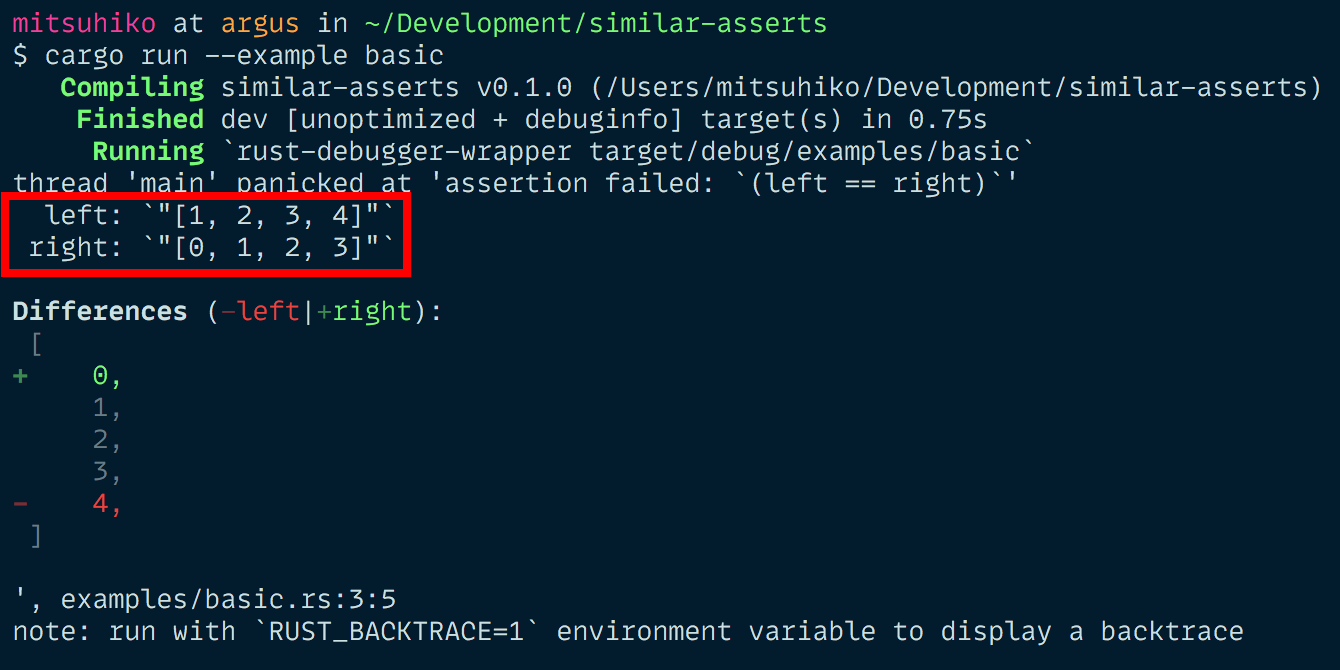
Off-Topic: Do you see any other areas where either rust-pretty-assertions or similar-asserts perform better and could learn from each other?
PS: @tommilligan What's your thought on all of this?
@colin-kiegel similar-asserts pretty much only exists because of the performance issues i with with this crate in the past on large diffs and I already had similar in my dependency tree for insta. But since pretty-assertions is used in a lot of places I am exposed to it :)
I personally believe that at this point similar-asserts is the better crate, but it has much lower adoption and in the most ideal of cases they would just become the same thing.