

 calcom
refactor: split up routers to separate lambdas
What does this PR do?
Splits up the all tRPC routers into their own API routes. (Edited by @keithwillcode)
New bundle sizes
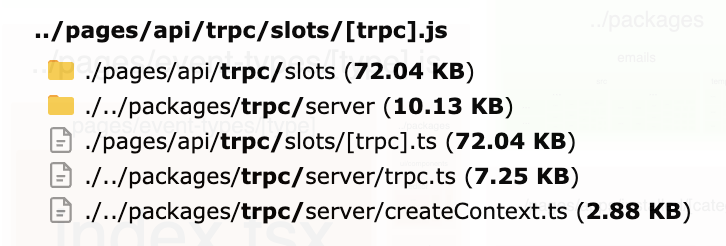
The slots router is massive compared to all the rest endpoints together...

Old bundle size
Seems like the analyzer doesn't really compare apples to apples here, as it states the previous bundle size is tiny. Not sure what's going on there, does it not take into account the size of the appRouter since it's just joining in others?

But, given that the entire appRouter is imported which comes in at 334kB, that should give an idea of the actual size:

Fixes # (issue)
Environment: Staging(main branch) / Production
Type of change
- Bug fix (non-breaking change which fixes an issue)
- Chore (refactoring code, technical debt, workflow improvements)
How should this be tested?
- [ ] Test the entire app basically to ensure no tRPC routes have been broken.

The latest updates on your projects. Learn more about Vercel for Git ↗︎
| Name | Status | Preview | Comments | Updated (UTC) |
|---|---|---|---|---|
| cal | ✅ Ready (Inspect) | Visit Preview | 💬 Add feedback | May 3, 2023 3:49pm |
| ui | ✅ Ready (Inspect) | Visit Preview | 💬 Add feedback | May 3, 2023 3:49pm |
| web | ✅ Ready (Inspect) | Visit Preview | 💬 Add feedback | May 3, 2023 3:49pm |
![vercel[bot] avatar](https://avatars.githubusercontent.com/in/8329?v=4 "Published by a pub.dev verified publisher")
@juliusmarminge is attempting to deploy a commit to the cal Team on Vercel.
A member of the Team first needs to authorize it.
📦 Next.js Bundle Analysis for @calcom/web
This analysis was generated by the Next.js Bundle Analysis action. 🤖
This PR introduced no changes to the JavaScript bundle! 🙌
![github-actions[bot] avatar](https://avatars.githubusercontent.com/in/15368?v=4 "Published by a pub.dev verified publisher")
Latest main changes to reduce the appStore size look to have been succesful:

📦 Next.js Bundle Analysis for @calcom/web
This analysis was generated by the Next.js Bundle Analysis action. 🤖
Two Pages Changed Size
The following pages changed size from the code in this PR compared to its base branch:
| Page | Size (compressed) | First Load | % of Budget (350 KB) |
|---|---|---|---|
/apps/[slug]/[...pages] |
387.08 KB |
620.2 KB | 177.20% (🟢 -0.15%) |
/auth/setup |
79.95 KB |
313.07 KB | 89.45% (🟢 -0.19%) |
Details
Only the gzipped size is provided here based on an expert tip.
First Load is the size of the global bundle plus the bundle for the individual page. If a user were to show up to your website and land on a given page, the first load size represents the amount of javascript that user would need to download. If next/link is used, subsequent page loads would only need to download that page's bundle (the number in the "Size" column), since the global bundle has already been downloaded.
Any third party scripts you have added directly to your app using the <script> tag are not accounted for in this analysis
The "Budget %" column shows what percentage of your performance budget the First Load total takes up. For example, if your budget was 100kb, and a given page's first load size was 10kb, it would be 10% of your budget. You can also see how much this has increased or decreased compared to the base branch of your PR. If this percentage has increased by 20% or more, there will be a red status indicator applied, indicating that special attention should be given to this. If you see "+/-
📦 Next.js Bundle Analysis for @calcom/web
This analysis was generated by the Next.js Bundle Analysis action. 🤖
Two Pages Changed Size
The following pages changed size from the code in this PR compared to its base branch:
| Page | Size (compressed) | First Load | % of Budget (350 KB) |
|---|---|---|---|
/apps/[slug]/[...pages] |
387.3 KB |
620.41 KB | 177.26% (🟢 -0.15%) |
/auth/setup |
80.16 KB |
313.28 KB | 89.51% (🟢 -0.19%) |
Details
Only the gzipped size is provided here based on an expert tip.
First Load is the size of the global bundle plus the bundle for the individual page. If a user were to show up to your website and land on a given page, the first load size represents the amount of javascript that user would need to download. If next/link is used, subsequent page loads would only need to download that page's bundle (the number in the "Size" column), since the global bundle has already been downloaded.
Any third party scripts you have added directly to your app using the <script> tag are not accounted for in this analysis
The "Budget %" column shows what percentage of your performance budget the First Load total takes up. For example, if your budget was 100kb, and a given page's first load size was 10kb, it would be 10% of your budget. You can also see how much this has increased or decreased compared to the base branch of your PR. If this percentage has increased by 20% or more, there will be a red status indicator applied, indicating that special attention should be given to this. If you see "+/-
📦 Next.js Bundle Analysis for @calcom/web
This analysis was generated by the Next.js Bundle Analysis action. 🤖
This PR introduced no changes to the JavaScript bundle! 🙌
I've gotten this branch up to date with main and have brought over my changes from #8551 to separate all tRPC routers into their own API routes.

Documenting here for clarity. There was a separate test done in #8551 that verified when accessing the route /api/trpc/viewer.public.i18n under a different API route of /api/trpc/public/i18n, the time difference in cold start load was down to 2 seconds from 15+. When I realized the full path forward was to separate all routers into their own API routes so we avoid a compounding effect of loading lots of routers into 1 core router, I brought those changes back over here to build upon the work @juliusmarminge had started.
The effect this will have is if you look at the network traffic for cold starts on pages in the app, you will now see multiple tRPC calls take upwards of 3 seconds to load but since they run concurrently, the effect is not compounded, which was what resulted in such long load times.
The way it’s written now, since the api routes are separated into different folders, Vercel already creates separate functions for each one. We don’t have to include this config to ensure those are created distinctly. We can if we want to change config of course though.