

 boostorg
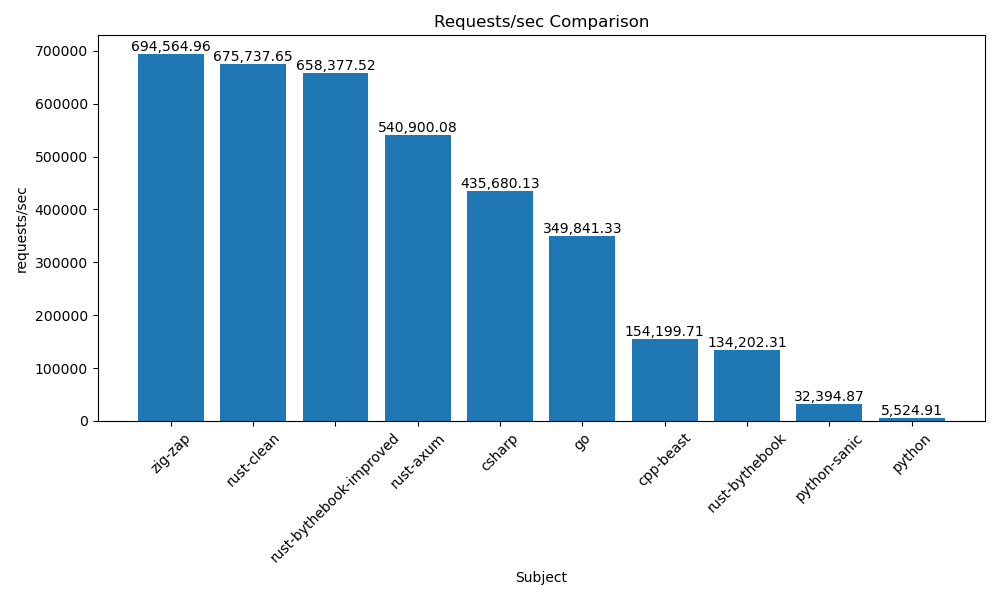
Performance issue: Beast's request per second (RPS) is half of C#'s
Version of Beast
347
Steps necessary to reproduce the problem
- Install dotnet https://learn.microsoft.com/en-us/dotnet/core/install/linux
- Install zig:
sudo snap install zig --beta --classic - check your
zigversion and it should be 0.12 now -
git clone https://github.com/zigzap/zap.git -
cd zap -
git checkout -b perf tags/v0.7.0 - In
wrk/csharp/Program.cs, change line 6 toapp.MapGet("/", () => "Hello from C#1234");, makes response body size (17 bytes ) the same between c# and c++ test code (little impact on result). -
./wrk/measure_all.sh "csharp cpp-beast" - the perf result displays in console, you can find the cpp-beast is really poor on perf compared to csharp
for more details, see https://github.com/zigzap/zap/blob/master/blazingly-fast.md#how
All relevant compiler information
Result
The perf test result: https://github.com/zigzap/zap/blob/master/blazingly-fast.md#the-computer-makes-the-difference
Beast's test code
https://github.com/zigzap/zap/blob/master/wrk/cpp/main.cpp
I like beast, it's hard to believe beast's performance is so poor, can anyone point out what's wrong or improve beast's test code? I tried to modify to beast's http server example to return a string-body response for the perf, but the result got worse. 😭

I'm mesuring approximately 300K requests per second using the http_server_async example and utilizing 4 threads (as stated in the provided link). However, if you create one io_context per core and use individual acceptors (using SO_REUSEPORT option), you can anticipate around 150K requests per second for each additional core you put into your setup (as they work independently).
Regardless, I doubt this benchmark accurately reflects the usage of these libraries in real-world scenarios:
So, what exactly are these benchmarks testing? Simple HTTP servers that respond to GET requests with a constant, 17-byte-long message.

This is comparing apples to pears.
- The Kestrel route is probably not creating a new response each time.
- The C++ version is not reading any requests AND closing the connection each time. The Kestrel server keeps the connection alive e.g. when probed with
curl. Even if you kept it alive, at some point the client might have filled the entire TCP receive buffer and will effectively block on sending the request. -> You need to properly process requests. - The C++ version used a synchronous accept loop
I compared with my own C++ version that fixes these. I have two conditional defines (TRUE_HTTP and CACHED_RESPONSE) that you can play around with. The code comments explain their (observed) effect.
#include <boost/asio.hpp>
#include <boost/asio/experimental/awaitable_operators.hpp>
#include <boost/beast.hpp>
#include <boost/lexical_cast.hpp>
#include <fstream>
#include <iostream>
#include <syncstream>

namespace beast = boost::beast;
namespace http  = beast::http;
namespace net   = boost::asio;
using tcp     = net::ip::tcp;
using namespace net::experimental::awaitable_operators;
using executor_t = net::thread_pool::executor_type;
using acceptor_t = net::deferred_t::as_default_on_t<net::basic_socket_acceptor<tcp, executor_t>>;
using socket_t   = net::deferred_t::as_default_on_t<net::basic_stream_socket<tcp, executor_t>>;

[[maybe_unused]] static std::string read_html_file(std::string const& file_path) {
    std::ifstream file(file_path, std::ios::binary);
    return {std::istreambuf_iterator<char>(file), {}};
}

static auto const make_response_message = [](bool keep_alive) {
    // Construct an HTTP response with the HTML content
    std::string_view msg = "Hello from C++!!!"; // or read_html_file("hello.html");

    http::response<http::span_body<char const>> res{http::status::ok, 11, msg};
    res.set(http::field::server, "C++ Server");
    res.set(http::field::content_type, "text/html");
    res.keep_alive(keep_alive);
    res.prepare_payload();
    return res;
};

static auto const s_cooked_response = [] {
    static auto const text = boost::lexical_cast<std::string>(make_response_message(true));
    return net::buffer(text);
}();

net::awaitable<void, executor_t> handle_client_async(socket_t socket) try {
    socket.set_option(tcp::no_delay(true)); // no difference observed in benchmark

#ifdef TRUE_HTTP // This affects throughput by only about -10%
    beast::flat_buffer buf;
    for (http::request<http::empty_body> req;; req.clear()) {
        auto [ec, _] = co_await async_read(socket, buf, req, as_tuple(net::deferred));
        if (ec)
            break;
    #ifdef CACHED_RESPONSE
        // emulate caching server
        co_await async_write(socket, s_cooked_response);
    #else
        // This is a more realistic way but probably NOT what Kestrel is doing for the static route
        // It affects throughput by about -25%
        co_await async_write(socket, make_response_message(req.keep_alive()));
    #endif
        if (!req.keep_alive())
            break;
    }
#else
    // Since we're ignoring the requests, we might as well assume they're correct. (INSECURE)
    for (beast::flat_buffer buf;;) {
        auto [ec, n] = co_await async_read_until(socket, buf, "\r\n\r\n", as_tuple(net::deferred));
        if (ec)
            break;
        buf.consume(n);
        co_await async_write(socket, s_cooked_response);
    }
#endif
} catch (beast::system_error const& e) {
    std::osyncstream(std::cerr) << "handle_client_async error: " << e.code().message() << std::endl;
}

net::awaitable<void, executor_t> server(uint16_t port) {
    auto ex = co_await net::this_coro::executor;

    for (acceptor_t acceptor(ex, {{}, port});;)
        co_spawn(ex,                                                    //
                 handle_client_async(co_await acceptor.async_accept()), //
                 net::detached);
}

int main() try {
    // Create a thread pool
    net::thread_pool pool(4);
    executor_t ex = pool.get_executor();

    // Create and bind the acceptor
    co_spawn(ex, server(8070), net::detached);

    std::cout << "Server listening on port 8070..." << std::endl;

    pool.join();
} catch (std::exception const& e) {
    std::cerr << "Main error: " << e.what() << std::endl;
}
On my system:
-
no defines, fast route:
-
TRUE_HTTPandCACHED_RESPONSE: -
TRUE_HTTPonly:
As you can see, I focused on throughput numbers (as with fixed response size it's colinear with req/s). As such, TCP_NODELAY has no tangible effect. You may want to play around to see what the latencies are like. You can see my work here: https://github.com/zigzap/zap/pull/110
Enabling
BOOST_ASIO_HAS_IO_URINGandBOOST_ASIO_DISABLE_EPOLLdid not result in improvements.

However, if you create one io_context per core and use individual acceptors (using
SO_REUSEPORToption)
Thanks @ashtum . I'll try that and comapare to c# again.
Thanks @sehe , I'll try your GREAT work and compare to other languages.
- related issue: https://github.com/zigzap/zap/issues/108