
Humanoid_Robot_Learning_To_Walk
 Humanoid_Robot_Learning_To_Walk copied to clipboard
 bnurbekov
This purpose of the project was to apply Central Pattern Generators (combined with a novel learning strategy) to compliant humanoid robots.
Synopsis
This purpose of the project was to apply Central Pattern Generators (combined with a novel learning algorithm) to compliant humanoid robots, such as Atlas.
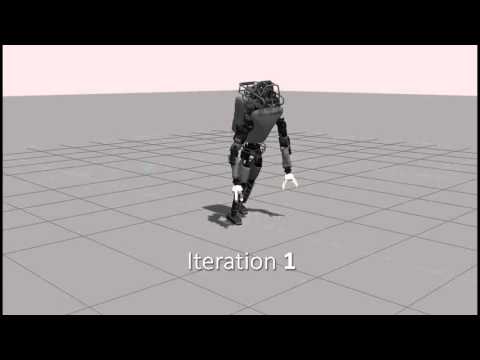
Atlas is shown below.

Demonstration
Please click to the image below to see video demonstration.
Motivation
The project was developed as Major Qualifying Project (senior year undergraduate project at WPI).
Creation
The project was completed on April 25, 2016 by myself. My advisor was Dr. Michael Gennert.
Simulink was chosen to implement the control module (please see included report or presentation) to keep connections organized. All learning functionality was implemented in Python.
The system was tested in Gazebo and on the real robot.
System Overview

Central Pattern Generator
The purpose of this module:
- reducing a state (parameter) space from 100 states to an average of 10 states;
- generating rhythmic patterns.
Consists of the following layers:
- Rhythmic generator layer generates synchronized oscillatory movements.
- Pattern formation and motor neuron layers incorporate afferent sensory feedback for movement modulation [1].
The high-level scheme of the Central Pattern Generator is shown below.

Please see the Wikipedia article (https://en.wikipedia.org/wiki/Central_pattern_generator) and the report (Documentation/MQP_final_report.docx) for more details.
Learning
Parameters for CPG are learnt by
- CMA-ES (learning);
- Kohonen self-organizing maps (memory) → Success, Failure Map.
Covariance Matrix Adaptation – Evolutionary Strategies
The purpose of this module:
- learn set of parameters for CPG that lead to stable walking gate initially
The high-level illustration of the algorithm is shown below.

Please see the Wikipedia article (https://en.wikipedia.org/wiki/CMA-ES) and the report (Documentation/MQP_final_report.docx) for more details.
Qualitative Adaptive Reward Learning
The purpose of this module:
- memorizing a particular region in parameter (state) space that leads to success/failure;
- finding global optimal set of parameters in success region after failure region is learnt.
The high-level illustration of the algorithm is shown below.

Please see the Wikipedia article (https://en.wikipedia.org/wiki/Self-organizing_map) and the report (Documentation/MQP_final_report.docx) for more details.
Installation
As this was a school project, it was not meant to be distributed and used. Nonetheless, it's certainly possible to recreate the environment used. The Simulink diagram and the Python modules will have to modified in that case to use proper ROS topics. Also, the .mex file for the custom ROS subscriber will have to be recompiled (the compilation command is included into the repo).
 bnurbekov