

 bigopon
deepComputedFrom breaks when object contains a reference loop
consider the following Node model, that represent a node in a Doubly linked list.
the combined getter should list all the values starting the root, to the last child.
export interface Node
{
  parent?: Node;
  child?: Node;
  value?: string;
}

export class App
{
  root: Node;
  constructor()
  {
    this.root = {};

    this.root.child = {
      parent: this.root
      }
  }

  @deepComputedFrom("root")
  get combined(): string
  {
    let root = this.root;
    let value = "";
    while(root)
    {
      value += `${root.value} =>`;
      root = root.child;
    }
    return value;
  }
}
but: we get an error - because there is a reference loop between the parent and the child.
Uncaught (in promise) RangeError: Maximum call stack size exceeded
    at Function.[Symbol.hasInstance] (<anonymous>)
    at getDependency (index.js?3ae2:309)
    at ObjectPropertyDependency.collect (index.js?3ae2:91)
    at eval (index.js?3ae2:59)
    at Array.forEach (<anonymous>)
    at ObjectDependency.collect (index.js?3ae2:56)
    at ObjectPropertyDependency.collect (index.js?3ae2:96)
    at eval (index.js?3ae2:59)
    at Array.forEach (<anonymous>)
    at ObjectDependency.collect (index.js?3ae2:56)
this can be fixed by marking the visited objects after they have been "patched".
or saving a Set with all "patched" objects.
that way: the process of deep traversing will not run into endless loops.

I'm trying to create a PR for this, but it turn-out to be more difficult than I initially thought.
at first I thought it's enough to fix the ObjectDependency.collect, but now I realize we need to fix all collect scenarios.
an object can be a part of the loop in many ways.
- the obvious way - (x => y => x) like in the issue above
- as part of an arbitrary length loop (a => b => c => ... => a)
- as part of an internal collection of some sort (a => b[7] => a) etc.
because I don't want to add a flag directly on the current observed object. (maybe we can use metadata API?), I need to keep track of all "items" that are already collected. - regardless of where they are in the actual object.
you already have an owner object that gets passed down the hirearchy.
can I add a Set there? to keep track of every visited item?
its sound simple, but I don't have the full picture of how things works in mind. would I need to sync this set when new objects gets added after initial collection? would I need to remove them from the set when they are disconnected from the original object? etc.
I'd like your input on that.
or even better - if you are already working on a fix for that. :) that will be great.
you already have an owner object that gets passed down the hirearchy.
This is what im thinking too. Can use a weakmap to associate the owner object with a set of tracked object.
And no, i havent worked on a PR yet, anyncontribution will be really welcomed 😃

From what you commented, I thi k you already got an idea of how it all shouls work together 👍
well, I've tried to implement that in a fork. it's seems to work only if I had all of the property that I was intending to change present in my VM beforehand.
for example: I had to explicitly set the value property:
constructor() {
  this.root = {value: undefined};
  this.root.child = {parent: this.root, value: undefined};
}
I think it it was always like that, and not because of my changes. (am I right?)
if I tried like that - the changes would not fire:
constructor() {
  this.root = {};
  this.root.child = {parent: this.root};
}
in a real case scenario - when you have bindings from the view to that non-existing property - aurelia will create a property for it, so this will be unnoticeable.
overall, introducing the WeakMap did not break any other test.. except: it lowered the amount of times values were being re-evaluted. I didn't fix those tests - because I wanted your opinion on the all solution beforehand.
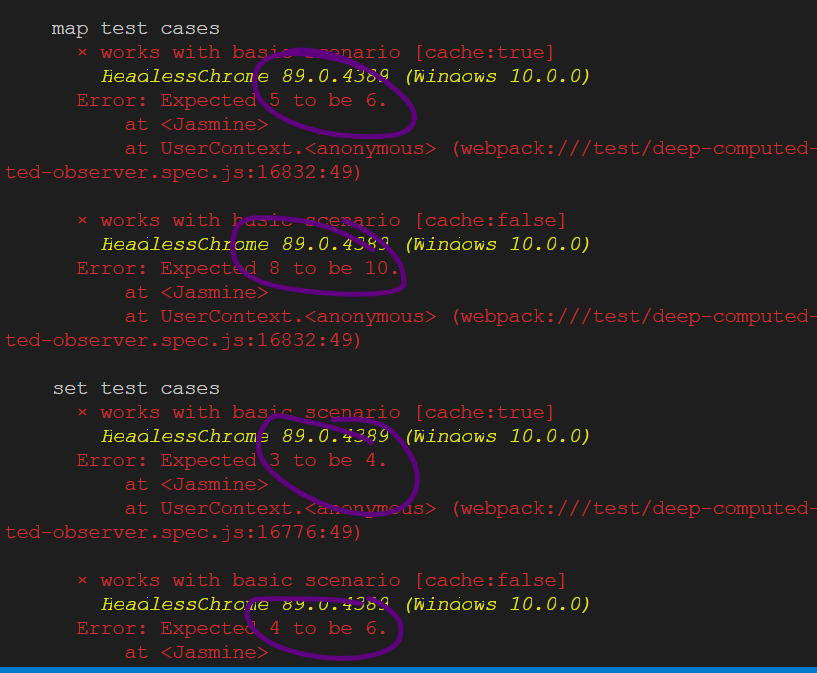
before inserrting things into the WeakMap, I had to make sure they are objects. I think that could have been done nicely with a helper function, instead of repeating the same code over and over. I'll do in the offical PR that if this a valid solution.
@avrahamcool that sounds cool, let's create a PR 🚀 For the predefined property issue, it's kind of a requirement, as it's impossible to do without it, unless we use proxy. I think it's ok to not involve proxy at all in v1, so that we can keep it compat to older JS environments.
the reop contains dist files,
what is the policy about the PR? should it update the dist? or just src?
I was wrong. my simple implementation doe's break some test. (I was able to see that only after I cleaned the json counts errors). although its sounds good, and should work in theory.
I'll try to dive in more deeply in the upcoming.