
elm-format
 elm-format copied to clipboard
 avh4
avh4
Rewrite `[ foo ] ++ bar` to `foo :: bar`?
elm-analyse gives a warning for this situation:
If you concatenate two lists, but the [left hand side is a single element list literal], then you should use the cons operator.
This seems like not only a stylistic concern, but a performance optimization!
I can't think of any situations where it would be better to write e.g. [ foo ] ++ anyOtherList than foo :: anyOtherList. Should elm-format automatically perform this rewrite?

What about the following line:
oneList ++ [ oneItem ] ++ anotherList
From a purely stylistic point of view I think it looks nicer than:
oneList ++ (oneItem :: anotherList)
I assumed the elm compiler would optimise the second append, but I guess if it doesn't, maybe style doesn't matter as much.
Now even if we do want the optimised version, is it really the role of elm-format to apply this change?

@basile-henry Actually, since (++) and (::) are both right associative and have the same precedence (source), the parentheses are superfluous and, if that feature sticks, will be automatically removed by elm-format, so the end code would be
oneList ++ oneItem :: anotherItem
I'm not sure whether that is stylistically better or worse than the first alternative. I do share your concern whether this is elm-format's area of responsibility though.

I'd vote against this. Symmetry in code is useful for readability, so having both [a] ++ b and b ++ [a] is more readable, symmetry-wise, than replacing it with ::. This optimisation should be trivial to add to the compiler if anyone wants to take a stab at it.

Not to dig up a very old issue, but elm-review-simplify now does this transformation.
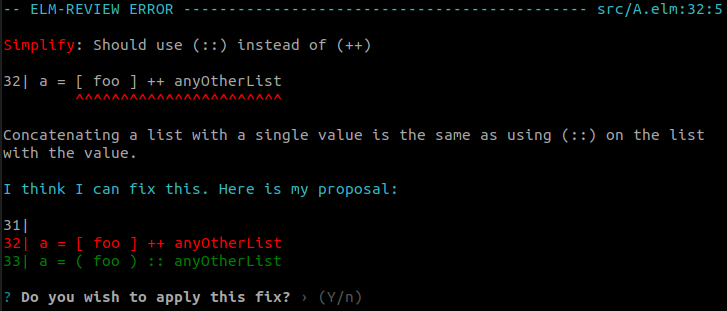
elm-review then applies elm-format so it removes the extra parens is they prove to not be needed.
I don't know if I would have liked elm-format to do this change, but at least it's available somewhere, and people can choose not to opt-in if they don't like it.
