
astillich

astillich
I managed to capture the command stream of some of the ES2 examples in grate, so that's working for me now. A newer version os es2_tri runs fine, so I...
According to Substance3D's [documentation](https://substance3d.adobe.com/documentation/bake/thickness-map-from-mesh-172818642.html) they can create a thickness map by tracing from the mesh surface through the mesh. I guess OG could map each color texture texel's position to...
Well yeah, but a leaf isn't very thick anyway. One could set a minimum depth value in this case. For solid parts of a tree it should work as expected,...
I decided to dig into this a little, here's what I have found: The frontier geometry is indeed stored as a MSH, initially they seemed to want to build the...
I tried to set up rendering, first using the resource system to load the .MSH, discovering it is not supported. Knowing that the world mesh is stored in .MSH format,...
According to what info I can find, the .MSH format is the "old" mesh format and looking at the phoenix code, geometry is read from there. Warping is just offsetting...
Here's what I'm trying to do: 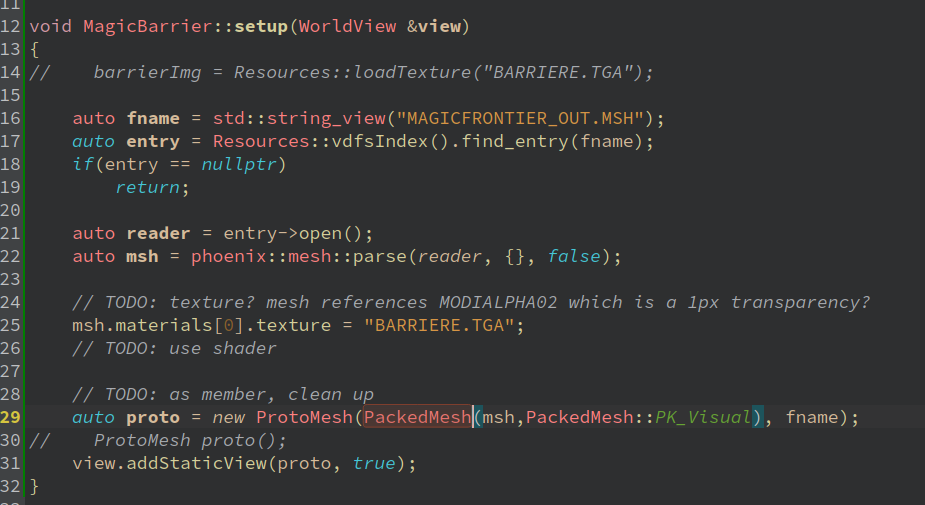 I'm not sure if that's the best way to get it to render. I can step through the code and see that meshlets...
Hi @lmichaelis, thanks for chiming in. I know that I can parse a mesh, I'm already using it in the snipped I posted. It's really only about how to set...
Okay, I'll drop the shader part for now, it makes the barrier too much of a special case. It's just a semi-transparent object after all. I have a basic version...
I'd like to second that inserting passes before the opaque pass is essential. A practical example: yesterday I developed a system for hiding walls obstructing the view on the player....