

 alibaba
microservices data - timestamp
 Hi! I am trying to understand "timestamp" in the microservice data. The paper mentioned that these traces were collected from a 7-day period. However, the timestamp is explained in the README as "Timestamp of recorded metrics. Range from 0 to 43200000 for twelve hours (12 * 60 * 60 * 1000). The recording interval is the 30s (30 * 1000). "
Dose this mean that the timestamp only reflects the time of a given day and the exact same timestamp could mean the same time on two different days? Also, what does the recording interval mean? In the README, you mentioned two different recording interval, could you clarify which data table used which interval?
Thank you very much!
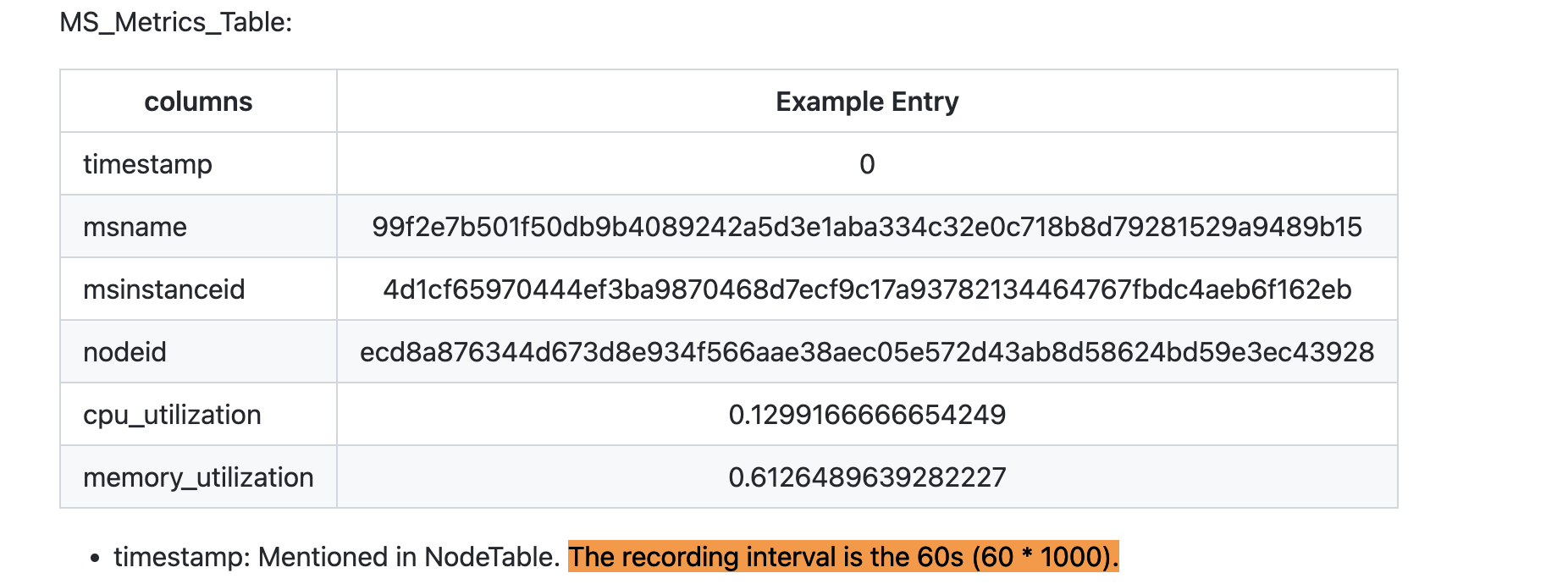


Thanks for your interest! The timestamp only reflects the time of a given day. We only release 12-hour traces, so the timestamp ranges from 0 to 43200000 (twelve hours: 12 * 60 * 60 * 1000). Recording interval means the time duration of collected metrics. For example, if CPU metric's interval is 30s for , the value of metrics is the average of CPU utilization from (timestamp - 30s) to timestamp. As described in the README, different metrics have different intervals.

Hi thank you for your response! I am still confused. The following is my current understanding and please help me to verify if it is correct.
The results in the paper (SoCC '21, Characterizing Microservice Dependency and Performance: Alibaba Trace Analysis) analyzed more than ten billion call graphs that were collected over 7 consecutive days (see the screenshot of the paper).

This github repo released only more than twenty million call graphs that were collected from 12 connective hours (see the screenshot of the README). The released call graphs are a strict subset of the call graphs that were actually used for analysis in the paper.

Lastly, in MS_CallGraph_Table, there is no metrics value that needs to be averaged, so recording interval does not impact the interpretation of the data from MS_CallGraph_Table, right?
Thank you again for clarifications.