

 Vandermode
Possibility to estimate scale parameter directly from probability plot?

 Hi,
For the normal distribution, the intercept of the line in the Quantile-quantile plot is the mean, while the slope is the std of the distribution. However, the Tukey lambda is a prox distribution with a specific lambda and doesn't have a variance parameter as the closed-form like the normal distribution has. Thus, how can we derive the scale mathematically??
Hi,
For the normal distribution, the intercept of the line in the Quantile-quantile plot is the mean, while the slope is the std of the distribution. However, the Tukey lambda is a prox distribution with a specific lambda and doesn't have a variance parameter as the closed-form like the normal distribution has. Thus, how can we derive the scale mathematically??

Ok, I just simply answer this question without touching any implementation details.
The probability plot can be used to estimate the location and scale parameters of a given distribution. For distributions with shape parameters (e.g. TL distribution), the shape parameters must be known (or estimated by PPCC plot) in order to generate the probability plot.

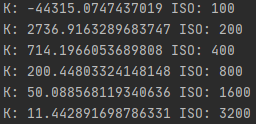
Hi, I am trying to calibrate the overall gain K myself, but found that K is not stationary at a fixed ISO. I am not sure if my understanding of the K is identical to yours or I did miss some parameter here.

 According to the paper[32], the unit of K here is electrons/DN, which is reciprocal to the equation from your paper: D=KI+N. Thus, I will use K as electrons/DN here to be consistent with the paper[32]
I took 10 flat-field frames and bias frames per ISO under two LUX, and then calculated the average variance to get K.
LUX = 15
 LUX = 100
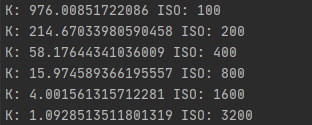
Please ignore the negative K in LUX=15, ISO=100. As I see, the K fairly following a 1/4 times linear decrement with ISO doubles. However, the K varies under different LUXs which is not the fact you mentioned in your paper. Did I miss some scalar or parameters?
PS: I really appreciate your work and thanks for your help here. I definitely understand the confidentiality and I am not requesting the implementation detail. All we discuss on Github are about sharing the scientific idea and knowledge.
Hi, which camera you used? how did you control the LUX?
Btw, pls send me an email with self-introduction (see readme) for further discussion of K calibration
Firstly, great thanks for the amazing work of @Vandermode !
And, Hi @ProNoobLi , I'm trying to reimplement the proposed noise-model for my camera as well, and getting stuck in estimating the overall system gain K as well. Can we discuss more about how do we approach this problem of estimating K, and share do and do-not to have a better understanding of it?

Firstly, great thanks for the amazing work of @Vandermode !
And, Hi @ProNoobLi , I'm trying to reimplement the proposed noise-model for my camera as well, and getting stuck in estimating the overall system gain K as well. Can we discuss more about how do we approach this problem of estimating K, and share do and do-not to have a better understanding of it?
Hi, Kaixuan shared this link with me, and I have done the calibration of both flat-field frames, and bias frames successfully.https://www.photonstophotos.net/GeneralTopics/Sensors_&_Raw/Sensor_Analysis_Primer/Gain.htm
Great! I'm using an industrial camera and the controllable settings are a bit difference. I will give it a try with this, Thanks.
I'm using an industrial camera
From my experience, the only settings you need to control are exposure time and ISO. While the difficulty is actually how to shot the bias frame and flat field frame
hi, will you release noise estimation code? or the training aug code which add noisy on clean image so that we can know the exact key details.
