

 SeisSol
Different behaviors when nucleating by s_xy and nuc_xy after the merge of the two linear slip-weakening regimes (FL=2 & FL=16)
Describe the bug Hi, I used to use the FL=2 option for my simulation, nucleating by increasing the s_xy value inside a weak nucleation patch. However, after the update in SeisSol, FL=2 is merged with FL=16, and seems like it requires defining either nucleation stresses or tractions (nuc/Tnuc). I was not sure how they work, so I tested them as follows:
| s_xx | s_yy | s_zz | s_xy | s_yz | s_xz | nuc_xx | nuc_yy | nuc_zz | nuc_xy | nuc_yz | nuc_xz | |
|---|---|---|---|---|---|---|---|---|---|---|---|---|
| Case 1 | -120e6 | -120e6 | -120e6 | -70e6 (elsewhere) -81.6e6 (nuc. zone) |
0 | 0 | 0 | 0 | 0 | 0 | 0 | 0 |
| Case 2 | -120e6 | -120e6 | -120e6 | -70e6 | 0 | 0 | 0 | 0 | 0 | -81.6e6 (nuc. zone) | 0 | 0 |
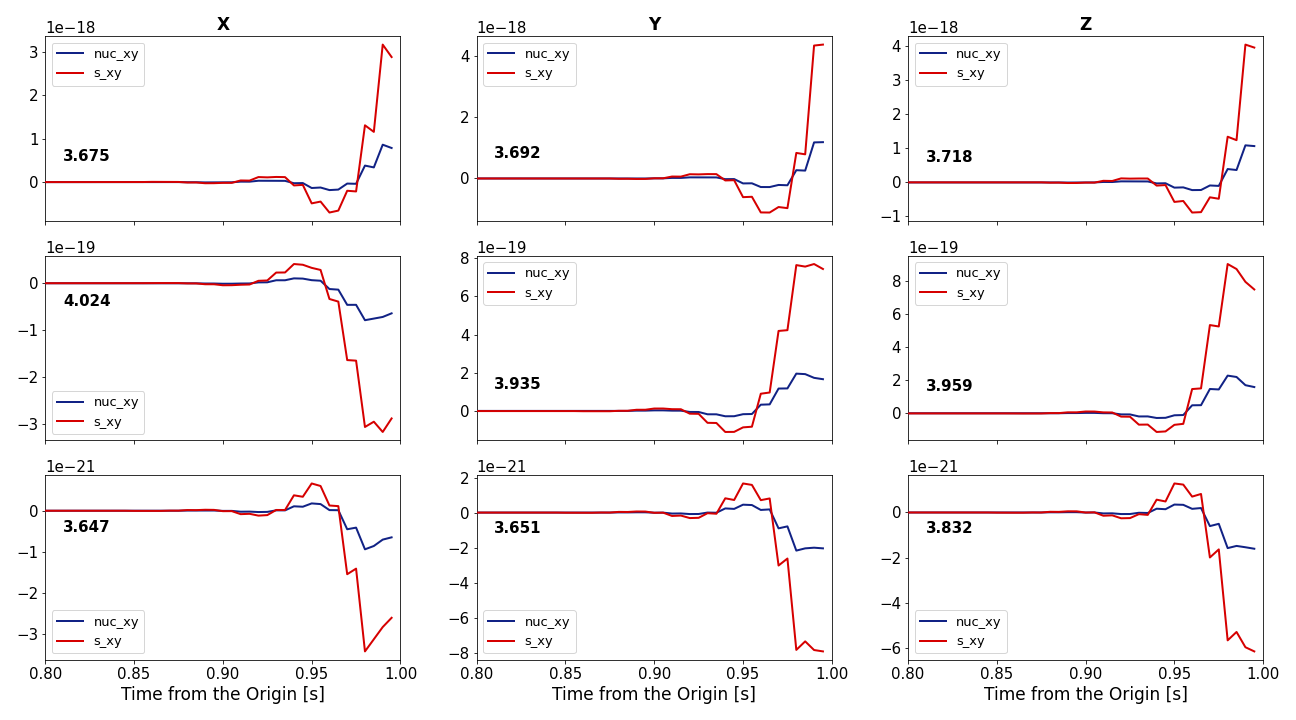
I feel like these two cases should give the same result. However, when I run the simulation for 1 s and compare the waveform output for three stations, the amplitudes from cases 1 and 2 differ by a factor of ~ 3 - 4.
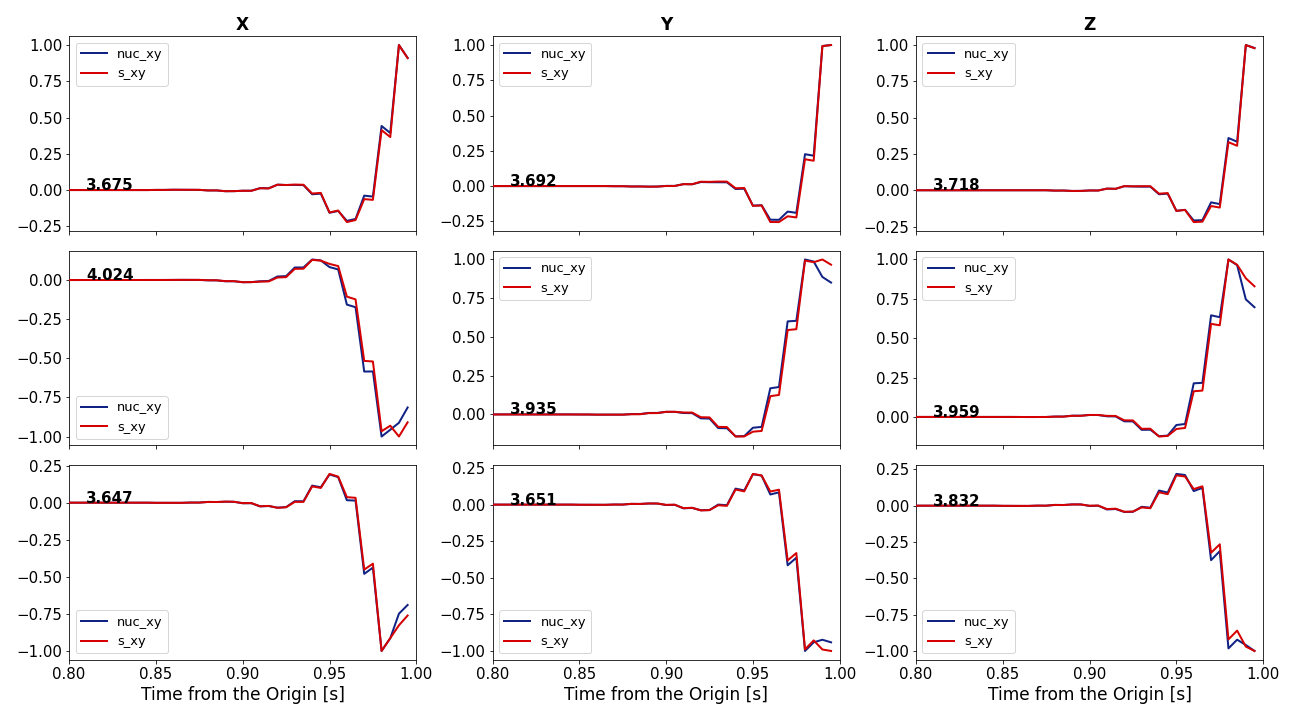
 When normalized, their behavior seems consistent.
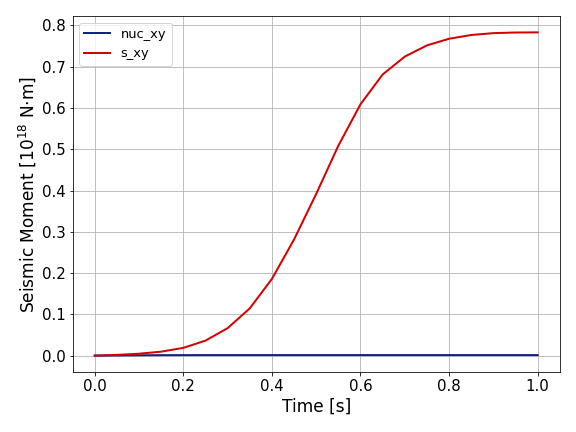
 Also, the seismic moment from the two cases are significantly deviating from each other.
Expected behavior The two cases are expected to give the same result.
To Reproduce Steps to reproduce the behavior:
- Which version do you use? Provide branch and commit id. [master] Merge pull request #665 from SeisSol/thomas/document_more_backward_incompatibility
- Which build settings do you use? Which compiler version do you use? mpi compiler
- On which machine does your problem occur? If on a cluster: Which modules are loaded? SuperMUC
- Provide parameter/material files. case1.tar.gz case2.tar.gz All the files required for SeisSol running are zipped in each file. Need to create a directory named 'output' in your working directory. run_SeisSol.txt SuperMUC job submission script. Make sure to convert run_SeisSol.txt to run_SeisSol.sh before running.
Screenshots/Console output
Additional context

Nuc_xy is added over t_0 (defined in main parameter) to S_xy. So nuc_xy should be -11.6e6 and t_0 set to 0.
Le 8 octobre 2022 02:18:42 GMT+02:00, Jeena Yun @.***> a écrit :
Describe the bug Hi, I used to use the FL=2 option for my simulation, nucleating by increasing the s_xy value inside a weak nucleation patch. However, after the update in SeisSol, FL=2 is merged with FL=16, and seems like it requires defining either nucleation stresses or tractions (nuc/Tnuc). I was not sure how they work, so I tested them as follows:
s_xx s_yy s_zz s_xy s_yz s_xz nuc_xx nuc_yy nuc_zz nuc_xy nuc_yz nuc_xz Case 1 -120e6 -120e6 -120e6 -70e6 (elsewhere)
-81.6e6 (nuc. zone)0 0 0 0 0 0 0 0 Case 2 -120e6 -120e6 -120e6 -70e6 0 0 0 0 0 -81.6e6 (nuc. zone) 0 0 I feel like these two cases should give the same result. However, when I run the simulation for 1 s and compare the waveform output for three stations, the amplitudes from cases 1 and 2 differ by a factor of ~ 3 - 4.
Expected behavior The two cases are expected to give the same result.
To Reproduce Steps to reproduce the behavior:
- Which version do you use? Provide branch and commit id. [master] Merge pull request #665 from SeisSol/thomas/document_more_backward_incompatibility
- Which build settings do you use? Which compiler version do you use? mpi compiler
- On which machine does your problem occur? If on a cluster: Which modules are loaded? SuperMUC
- Provide parameter/material files. case1.tar.gz case2.tar.gz All the files required for SeisSol running are zipped in each file. Need to create a directory named 'output' in your working directory. run_SeisSol.txt SuperMUC job submission script. Make sure to convert run_SeisSol.txt to run_SeisSol.sh before running.
Screenshots/Console output
Additional context
-- Reply to this email directly or view it on GitHub: https://github.com/SeisSol/SeisSol/issues/688 You are receiving this because you are subscribed to this thread.
Message ID: @.***>

I suppose, @Thomas-Ulrich's answer solved the issue. If not, please reopen.

Edit: I can reproduce your issue. On the other hand, your fault in the nucleation is critically stressed at t=0 (without nucleation stress contribution, that is 70/120=0.583>0.54). So I guess, adding nucleation stress at idt=1 or idt=0 makes a difference if some stress is already released at idt=0. When locking the fault with cohesion=-1e10, both methods give the same stress.