

 RobinSchmidt
How do you know when delay is finished?
Need to bypass FX... well more specifically, the oscilloscope takes 1.6% cpu idle (in debug mode, but still...). Is there a way to tell when the ping pong delay's buffer is basically silent/empty, maybe below 1.e-6 amplitude?

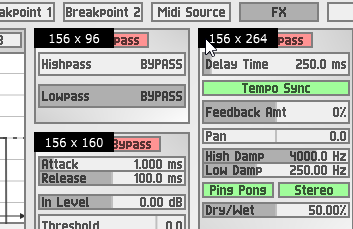
strictly speaking, it will have finished only when the signal falls soo low that it will be flushed to zero (by our denormal flush-to-zero code) - which can take a really long time. for practical matters, i'd probably use a threshold of something like -100dB - but obviously, the choice of that number is a matter of judgement. 1.e-6 - one part in a million - i think that's -60 dB - it's a value typically used to define reverb time (RT60 is a common measure for the length of f reverb tail). . soo - yeah - pick something in that ballpark

oh - these pixel values is in ColourSchemeComponent.cpp - you must set a boolean value to false in paintOverChildren. i use that in debug mode to figure out optimal editor sizes (there are certain values for which the grid lines look homogenous, for example - see comment in the constructor of EngineersFilterEditor)
unfortunately, when the grid-lines look homogenous, they are two pixels wide (and have half the brightness). maybe i should offset all pixel coordinates by 0.5. must be something about what you consider the pixel coodinates to be - top-left or center of the pixel - and my drawing code makes a wrong assumption of the convention used by juce
...i think, the rule is: if there are N grid-lines, your pixel-width (or height) of the plot should be divisible by N+1 (because there are N+1 sections...or something...just some gut math and trial and error, i didn't consult pencil and paper)
what are you talking about? grid lines? offset by .5? your drawing code makes wrong assumption?
1.e-6 is -120db .001 amplitude is -60dB
the issue is how: do I know the amplitude of the delay without scanning the entire buffer? How do i get an amplitude value?
yes, you are right. -60dB is 0.001. so, yes, -120dB seems appropriate to me. if you don't want to scan the entire buffer, you could use a formula based on the delaytime and the feedback gain to compute the time, after which the output signal has decayed to -120dB and switch to bypass after that time has passed (after the delay's input went silent). then you would need to count samples, though
what are you talking about? grid lines? offset by .5? your drawing code makes wrong assumption?
yes, try a pixel size for a eq-plot for which the grid lines of the plot appear homogenous (for example, the default size in ToolChain). then, they are 2 pixels thick with a multiplier of 0.5 for the brightness. better would be 1 pixel thick at full brightness. and i think, it's because i'm making the wrong assumptions about where juce deems the pixel's coordinates to be (center or corner - that's a matter of convention) ...i'll probably rewrite my coordinate-system drawing code anyway. it's a huge mess with lots of code duplication (very old code)
use a formula
...i think, you need to start with a(t) = k^(t/d) where t: time (after input went silent,) a(t): amplitude at time t, k: feedback gain, d: delaytime, so the formula for the time t should be t = d * log(a)/log(k), if i'm not mistaken. ...where you put "a" to be your target amplitude, i.e. a=1.e-6