

 OBOFoundry
OBO Core population
Issue to document the history and usage of terms for population in the OBO foundry and library.

Early discussion: https://code.google.com/archive/p/popcomm-ontology/issues/2. A key consideration was distinguishing between a population in the biological sense and a population in the statistical sense.
What many people think of as a population is http://purl.obolibrary.org/obo/PCO_0000001, 'population of organisms'.
Current hierarchy in PCO:
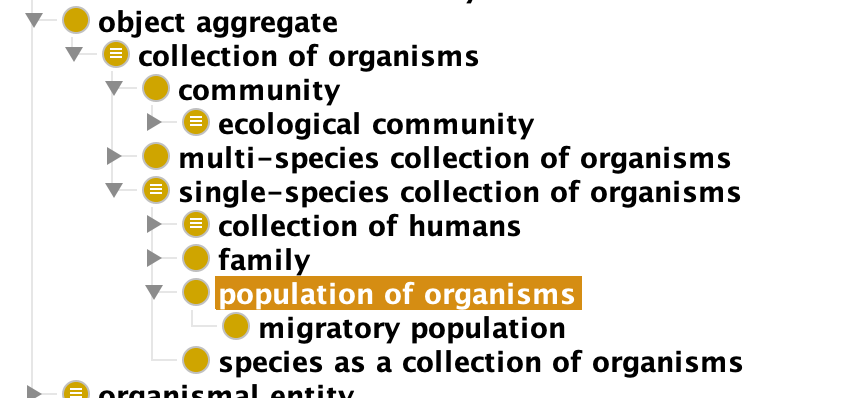
Population classes in OBO ontologies (from an Ontobee search):
http://purl.obolibrary.org/obo/PCO_0000001: A collection of organisms, all of the same species, that live in the same place.
http://purl.obolibrary.org/obo/OBI_0000181: A population is a collection of individuals from the same taxonomic class living, counted or sampled at a particular site or in a particular area
http://semanticscience.org/resource/SIO_001061: A population is all the organisms that both belong to the same group or species and live in the same geographical area.
http://purl.obolibrary.org/obo/IDOMAL_0001254: A population is a collection of individuals from the same taxonomic class living, counted or sampled at a particular site or in a particular area. [database_cross_reference: OBI:0000181]
http://purl.obolibrary.org/obo/OMIT_0012119: (no definition)
http://purl.obolibrary.org/obo/NCIT_C17005: A group of individuals united by a common factor (e.g., geographic location, ethnicity, disease, age, gender)
I tend to favor the NCIT definition best I think. For example, in population health contexts, such as the 'population of rare disease patients" , which are in the same geographical area so much as you might say the country or the world, so that doesn't seem a very useful distinction.

@mellybelly While I agree that geographic area is vague, it is the way that most ecology and evolutionary textbooks define a population. The NCIT definition is very human focused and doesn't seem relevant to most population biology outside biomedicine.
http://purl.obolibrary.org/obo/PCO_0000001 is intentionally very general, so that more specific subclasses can be defined for use cases like human population studies. The comment helps to clarify:
"It is sometimes difficult to define the physical boundaries of a population. In the case of sexually reproducing organisms, the individuals within a population have the potential to reproduce with one another during the course of their lifetimes. 'Community', as often used to describe a group of humans, is a type of population."
Perhaps it should be included in the definition.
Note that when a decision is made on how to define organism (see OBOFoundry/Experimental-OBO-Core#6), the PCO logical definition of collection of organisms (http://purl.obolibrary.org/obo/PCO_0000000) will be updated if needed.
+1 to broad definition of population that encompasses population biology. This definition of population by PCO is the one we re-use in Apollo-SV, and that is how we understand it. Going too narrow with 'population' to cover only human types of things would cause us a fair amount of trouble.
On Sun, Jul 28, 2019 at 6:35 PM Ramona Walls [email protected] wrote:
@mellybelly https://github.com/mellybelly While I agree that geographic area is vague, it is the way that most ecology and evolutionary textbooks define a population. The NCIT definition is very human focused and doesn't seem relevant to most population biology outside biomedicine.
PCO_000001 is intentionally very general, so that more specific subclasses can be defined for use cases like human population studies. The comment helps to clarify:
"It is sometimes difficult to define the physical boundaries of a population. In the case of sexually reproducing organisms, the individuals within a population have the potential to reproduce with one another during the course of their lifetimes. 'Community', as often used to describe a group of humans, is a type of population."
Perhaps it should be included in the definition.
— You are receiving this because you are subscribed to this thread. Reply to this email directly, view it on GitHub https://github.com/OBOFoundry/Experimental-OBO-Core/issues/20?email_source=notifications&email_token=AAJR55W7BCMBAMKRHZQUGRLQBYNMXA5CNFSM4HH65HH2YY3PNVWWK3TUL52HS4DFVREXG43VMVBW63LNMVXHJKTDN5WW2ZLOORPWSZGOD27H7OI#issuecomment-515801017, or mute the thread https://github.com/notifications/unsubscribe-auth/AAJR55SQUHBWGE26MO3UFP3QBYNMXANCNFSM4HH65HHQ .

My intuitive understanding of population is that it is always individuals of the same species. In general, we should err on the side of broadening terms for the core. Geographic limitations seem too restrictive. How about taking the PCO parent class instead as population of organisms?
On Sun, Jul 28, 2019, 6:08 PM Bill Hogan [email protected] wrote:
+1 to broad definition of population that encompasses population biology. This definition of population by PCO is the one we re-use in Apollo-SV, and that is how we understand it. Going too narrow with 'population' to cover only human types of things would cause us a fair amount of trouble.
On Sun, Jul 28, 2019 at 6:35 PM Ramona Walls [email protected] wrote:
@mellybelly https://github.com/mellybelly While I agree that geographic area is vague, it is the way that most ecology and evolutionary textbooks define a population. The NCIT definition is very human focused and doesn't seem relevant to most population biology outside biomedicine.
PCO_000001 is intentionally very general, so that more specific subclasses can be defined for use cases like human population studies. The comment helps to clarify:
"It is sometimes difficult to define the physical boundaries of a population. In the case of sexually reproducing organisms, the individuals within a population have the potential to reproduce with one another during the course of their lifetimes. 'Community', as often used to describe a group of humans, is a type of population."
Perhaps it should be included in the definition.
— You are receiving this because you are subscribed to this thread. Reply to this email directly, view it on GitHub < https://github.com/OBOFoundry/Experimental-OBO-Core/issues/20?email_source=notifications&email_token=AAJR55W7BCMBAMKRHZQUGRLQBYNMXA5CNFSM4HH65HH2YY3PNVWWK3TUL52HS4DFVREXG43VMVBW63LNMVXHJKTDN5WW2ZLOORPWSZGOD27H7OI#issuecomment-515801017 , or mute the thread < https://github.com/notifications/unsubscribe-auth/AAJR55SQUHBWGE26MO3UFP3QBYNMXANCNFSM4HH65HHQ
.
— You are receiving this because you are subscribed to this thread. Reply to this email directly, view it on GitHub https://github.com/OBOFoundry/Experimental-OBO-Core/issues/20?email_source=notifications&email_token=ADJX2IQLB4QQBV5NECY3M2LQBYRGLA5CNFSM4HH65HH2YY3PNVWWK3TUL52HS4DFVREXG43VMVBW63LNMVXHJKTDN5WW2ZLOORPWSZGOD27IOPI#issuecomment-515802941, or mute the thread https://github.com/notifications/unsubscribe-auth/ADJX2IS45SBQT5LA7ZO57A3QBYRGLANCNFSM4HH65HHQ .

No one is advocating for a human-specific definition, obviously.
Melissa suggested the NCIT definition as base: "A group of individuals united by a common factor"
Ramona objected as being human-centric, perhaps the term "individuals"? But I think the point of Melissa's suggestion was to avoid the vaguesness of "same geopgraphic area", and to avoid making it inapplicable to some human populations
On Sun, Jul 28, 2019 at 4:08 PM Bill Hogan [email protected] wrote:
+1 to broad definition of population that encompasses population biology. This definition of population by PCO is the one we re-use in Apollo-SV, and that is how we understand it. Going too narrow with 'population' to cover only human types of things would cause us a fair amount of trouble.
On Sun, Jul 28, 2019 at 6:35 PM Ramona Walls [email protected] wrote:
@mellybelly https://github.com/mellybelly While I agree that geographic area is vague, it is the way that most ecology and evolutionary textbooks define a population. The NCIT definition is very human focused and doesn't seem relevant to most population biology outside biomedicine.
PCO_000001 is intentionally very general, so that more specific subclasses can be defined for use cases like human population studies. The comment helps to clarify:
"It is sometimes difficult to define the physical boundaries of a population. In the case of sexually reproducing organisms, the individuals within a population have the potential to reproduce with one another during the course of their lifetimes. 'Community', as often used to describe a group of humans, is a type of population."
Perhaps it should be included in the definition.
— You are receiving this because you are subscribed to this thread. Reply to this email directly, view it on GitHub < https://github.com/OBOFoundry/Experimental-OBO-Core/issues/20?email_source=notifications&email_token=AAJR55W7BCMBAMKRHZQUGRLQBYNMXA5CNFSM4HH65HH2YY3PNVWWK3TUL52HS4DFVREXG43VMVBW63LNMVXHJKTDN5WW2ZLOORPWSZGOD27H7OI#issuecomment-515801017 , or mute the thread < https://github.com/notifications/unsubscribe-auth/AAJR55SQUHBWGE26MO3UFP3QBYNMXANCNFSM4HH65HHQ
.
— You are receiving this because you are subscribed to this thread. Reply to this email directly, view it on GitHub https://github.com/OBOFoundry/Experimental-OBO-Core/issues/20?email_source=notifications&email_token=AAAMMONNCZRMLIU3RJ3ORXLQBYRGHA5CNFSM4HH65HH2YY3PNVWWK3TUL52HS4DFVREXG43VMVBW63LNMVXHJKTDN5WW2ZLOORPWSZGOD27IOPI#issuecomment-515802941, or mute the thread https://github.com/notifications/unsubscribe-auth/AAAMMOO7S2AUAS5JH63Z7ODQBYRGHANCNFSM4HH65HHQ .

Yes that is exactly correct @cmungall. Not all populations are defined by a geographical location by some definitions (though this could be a subclass). I don't see that "individual" is human centric, but if it feels that way and to be more specific, we could write:
"A group of individual organisms united by a common factor (e.g., geographic location, ethnicity, disease, age, gender, etc.)
or simply:
"A group of organisms united by a common factor (e.g., geographic location, ethnicity, disease, age, gender, etc.)"
factor could also be attribute or feature, both of which I might prefer.
I like Melissa's proposal. Modifying it a bit in the light of Chris recent blog post on how to write definitions
"A group of organisms that share a common feature. Shared features can be a quality, location, disease, etc."
On Sun, Jul 28, 2019 at 9:37 PM Melissa Haendel [email protected] wrote:
Yes that is exactly correct @cmungall https://github.com/cmungall. Not all populations are defined by a geographical location by some definitions (though this could be a subclass). I don't see that "individual" is human centric, but if it feels that way and to be more specific, we could write:
"A group of individual organisms united by a common factor (e.g., geographic location, ethnicity, disease, age, gender, etc.)
or simply:
"A group of organisms united by a common factor (e.g., geographic location, ethnicity, disease, age, gender, etc.)"
factor could also be attribute or feature, both of which I might prefer.
— You are receiving this because you commented. Reply to this email directly, view it on GitHub https://github.com/OBOFoundry/Experimental-OBO-Core/issues/20?email_source=notifications&email_token=ADJX2ISYWKA77E6YJIPL3I3QBZCXDA5CNFSM4HH65HH2YY3PNVWWK3TUL52HS4DFVREXG43VMVBW63LNMVXHJKTDN5WW2ZLOORPWSZGOD27LQBQ#issuecomment-515815430, or mute the thread https://github.com/notifications/unsubscribe-auth/ADJX2IXVAJGP6WEN3N35R53QBZCXDANCNFSM4HH65HHQ .
-- Bjoern Peters Professor La Jolla Institute for Allergy and Immunology 9420 Athena Circle La Jolla, CA 92037, USA Tel: 858/752-6914 Fax: 858/752-6987 http://www.liai.org/pages/faculty-peters
We have had all of this discussion already. See references to the older notes documents earlier in this thread. Some of it is explained in https://environmentalmicrobiome.biomedcentral.com/articles/10.1186/1944-3277-9-17.
The conclusion was to have a very general class called collection of organisms, which places no constraints on what makes up that collection. Below that is single species collection of organisms. The only common feature required for a single species collection of organisms is that they belong to the same species. Single species collection of organisms currently has multiple subclasses, including population of organisms. That class is very useful to many biologists, and I don't see any reason to get rid of it or its current definition.
If you want to define "A group of organisms that share a common feature. Shared features can be a
quality, location, disease, etc." then you are essentially defining either collection of organisms or single species collection of organisms but with the added constraint that the group must have some feature in common, which I think we can assume anyway, because why else would you make a class for it in the ontology. So why not reuse collection of organisms or single species collection of organisms as the OBO Core class? Please, please don't reuse one of those classes and call is "population" because that would be rehashing several years of discussion and reintroduce all of the ambiguity associated with the word population to no semantic gain. Individuals and communities can continue to use the word population in whatever way they want, by defining new subclasses of collection of organisms or single species collection of organisms.
But I would urge them to not use the label "population" for those subclasses. Instead, use a more specific label that describes their use of the word.
Sorry Ramona, I had blanked on those previous discussions. You are right that we should re-use these hard-fought-over labels and definitions.
Per discussion on the OBO ops call on 8/27, there was general agreement to add collection of organisms as the root term for this branch, plus single- and multi-species collection of organisms. Terms like population of organisms, community, and ecological community may also end up in CORE as well. I'll try to do a PR with new terms some time soon.