
windows-powershell-docs
 windows-powershell-docs copied to clipboard
 MicrosoftDocs
Set-RDCertificate.md: examples 1 and 2, "Securing" certificate?
All emphasized instances of "secure" in the documentation are used incorrectly. Seems this page was largely copied/pasted from New-RDCertificate
Description
[...]You can use this cmdlet to **_secure_** an existing certificate by using a secure string supplied by the user.
The cmdlet is used to provide the password needed to unencrypt the existing, previously “secured” (encrypted) certificate
Example 1
[...]The cmdlet uses the secure string stored in the $Password variable to **_help secure_** the certificate.
see above
Example 2
Example 2: apply a secure string to a certificate

[...]The second part of the example uses the secure string stored in the $Password variable to **_secure_** the certificate used for the redirector role for the RD Connection Broker named RDCB.Contoso.com.
no clue what this example does - I don't believe it is possible to apply a secure string (encrypt) a certificate unless exporting it. Can't figure out what this example accomplishes
Document Details
⚠ Do not edit this section. It is required for docs.microsoft.com ➟ GitHub issue linking.
- ID: 6f1eb39a-ca8b-03d2-5646-1522a11e579b
- Version Independent ID: 890788c8-1cf0-b6f6-0291-39fd4a047e11
- Content: Set-RDCertificate (remotedesktop)
- Content Source: docset/windows/remotedesktop/Set-RDCertificate.md
- Product: w10
- Technology: powershell-windows
- GitHub Login: @andreabarr
- Microsoft Alias: v-anbarr

Perhaps example 2 is related to the GUI method: Select Existing Certificate > Apply the certificate that is stored on the RD connection Broker Server (password entry). This confuses me as well. Where does it find the certificate that is "stored on the RD Connection Broker Server"? In the certificate store? What is the purpose of the password field? Can certificates be "stored" (as opposed to exported) with passwords?
To make it easier for you to submit feedback on articles on learn.microsoft.com, we're transitioning our feedback system from GitHub Issues to a new experience.
As part of the transition, this GitHub Issue will be moved to a private repository. We're moving Issues to another repository so we can continue working on Issues that were open at the time of the transition. When this Issue is moved, you'll no longer be able to access it.
If you want to provide additional information before this Issue is moved, please update this Issue before December 15th, 2023.
With the new experience, you no longer need to sign in to GitHub to enter and submit your feedback. Instead, you can choose directly on each article's page whether the article was helpful. Then you can then choose one or more reasons for your feedback and optionally provide additional context before you select Submit.
Here's what the new experience looks like.
Note: The new experience is being rolled out across learn.microsoft.com in phases. If you don't see the new experience on an article, please check back later.
First, select whether the article was helpful:
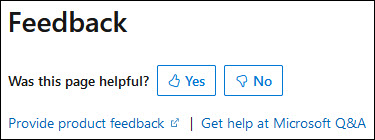
Then, choose at least one reason for your feedback and optionally provide additional details about your feedback:
| Article was helpful | Article was unhelpful |
|---|---|
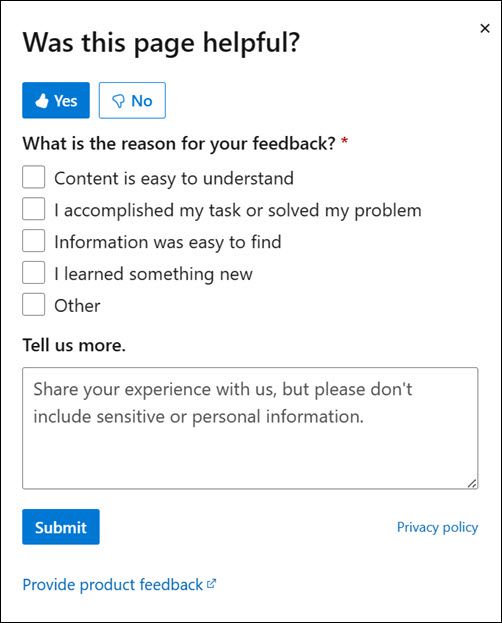 |
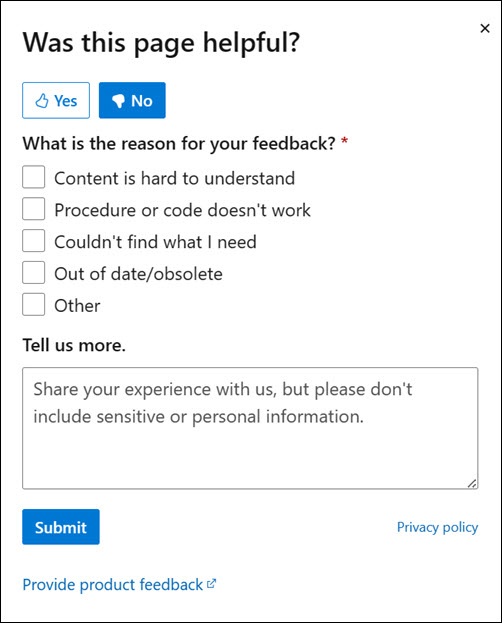 |
Finally, select Submit and you're done!
