
MartinGC94
MartinGC94
I hadn't heard about inlay hints before. They seem neat, though I'd still prefer the hover tooltips but maybe I'll change my mind if I try to use those hints....
> Further, we agree that we should not have a new attribute which suppresses the common parameters (as you can just avoid using the cmdlet binding attribute). This is not...
@TobiasPSP Thanks for reviewing this again, though I can't say I agree with this conclusion either. As we've already established, common parameters only show up when either the `cmdletbinding` attribute...
> If you do want to improve the user experience and feel that common parameters may distract some users, then why should this apply to some cmdlets and exclude others?...
> Can you redirect the output to various data streams while executing and then restore on exit? Sure, I could do something like this: ``` Resolve-Path $Path 2>&1 | ForEach-Object...
You are right that `ConciseView` presents this differently when you have an actual module file, but it's still not quite the same as `$pscmdlet.WriteError()`. It reports that the error came...
The problem with type accelerators is that they are global. If 2 module authors decide to make a `[Utility]` type accelerator and you import both modules there will be a...
This is only a problem with partial input. If you write: `Get-ChildItem -LiteralPath $PSHOME -` it shows the filesystem parameters as you would expect. I think I know where the...
Looks like the PID. It doesn't happen for me: 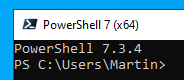 and I haven't seen any other complaints about this so I guess it's a problem specific to your machine. Since...
I am working on adding options to control this behavior (see: https://github.com/PowerShell/PowerShell/pull/19518 ). Assuming it will get merged with my current ideas, you'll be able to choose between the following...