

 JuliaPlots
call trace graphs?
@JackDevine does this repo want a recipe for call trace graphs? Based on https://gist.github.com/mkborregaard/81825c3d370bb4d8dbfe59c3b2ae4b33 but I don't really have the best interface yet. Probably a @userplot like tracegraph(modules, call, args...), allowing names to take value true.
It would involve a dep on JuliaInterpreter. Which I think of as not problematic.

That looks quite cool! here is my go at making a trace graph. I removed the module names to make the graph a little more manageable:
using GraphRecipes
using Plots

g, v = tracecall((Base,), sin, 3)
graphplot(g, nodeshape=:rect, names=getnames(v), nodesize=0.15, method=:buchheim, root=:left, size=(1000,1000))
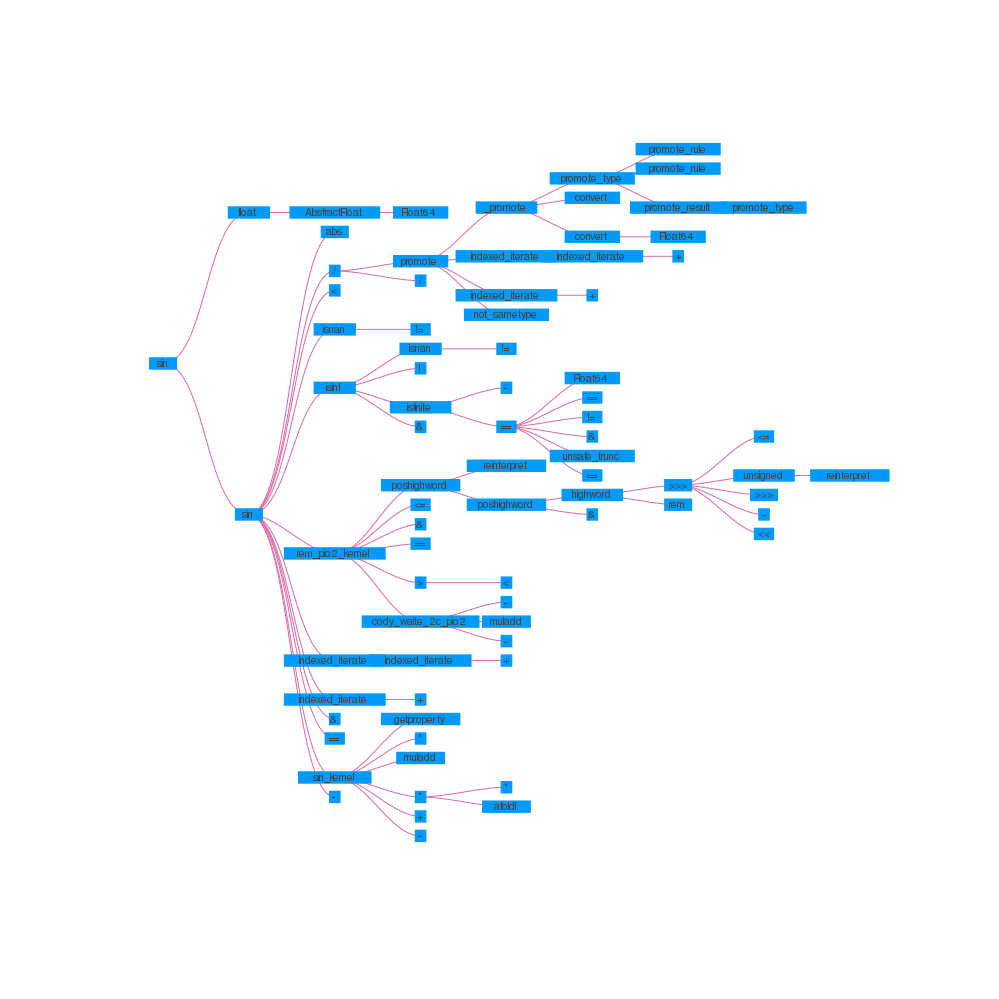
I think that we should include this into src/misc.jl. Right now it seems that tracecall can only handle one argument, which wouldn't block merging, but it would be nice to have a variable number of args.
I also wonder about the API, we could have a function tracegraph, but looking at the call signature, I think that we could just use multiple dispatch to add the same functionality to graphplot

I agree on the api. This should be a @tracegraph macro that takes a full expression (variable args) and returns a TraceGraph object, which GraphPlot should dispatch on.
I think :circle works better than :rect by the way.
I'll prep the PR. I also want to fix the dependency graph functionality in misc and add it to the docs.
I've been having some issues with the code recently though - not sure what changed. Did you see my complaints here? : https://julialang.slack.com/archives/C6E4SU1D3/p1583931179239700
https://julialang.slack.com/archives/C6E4SU1D3/p1583937388240600?thread_ts=1583931179.239700&cid=C6E4SU1D3
@mkborregaard sorry that I didn't notice your slack posts. I find slack a little inundating sometimes, so I tend not to check it. I should probably change my settings so that I get an email if someone tags me.
I do not understand your markershape/markersize problems, they do not occur for me. Also, the canonical names for those are nodehape/nodesize, marker* are just aliases in GraphRecipes.
The problem that I do notice is that graphplot doesn't perform well at all when the size is not square or close to square. That is probably some sort of scaling issue. I was able to get a semi-decent result with this:
using .TraceCalls2, GraphRecipes, Plots
a = rand(10);
d = scatter(a);
g, v = TraceCalls2.tracecall((Plots,), scatter, a)

graphplot(g, method=:buchheim, root=:left, names=getnames(v), size=(4000,4000),
          nodeshape=:rect, nodesize=0.15)
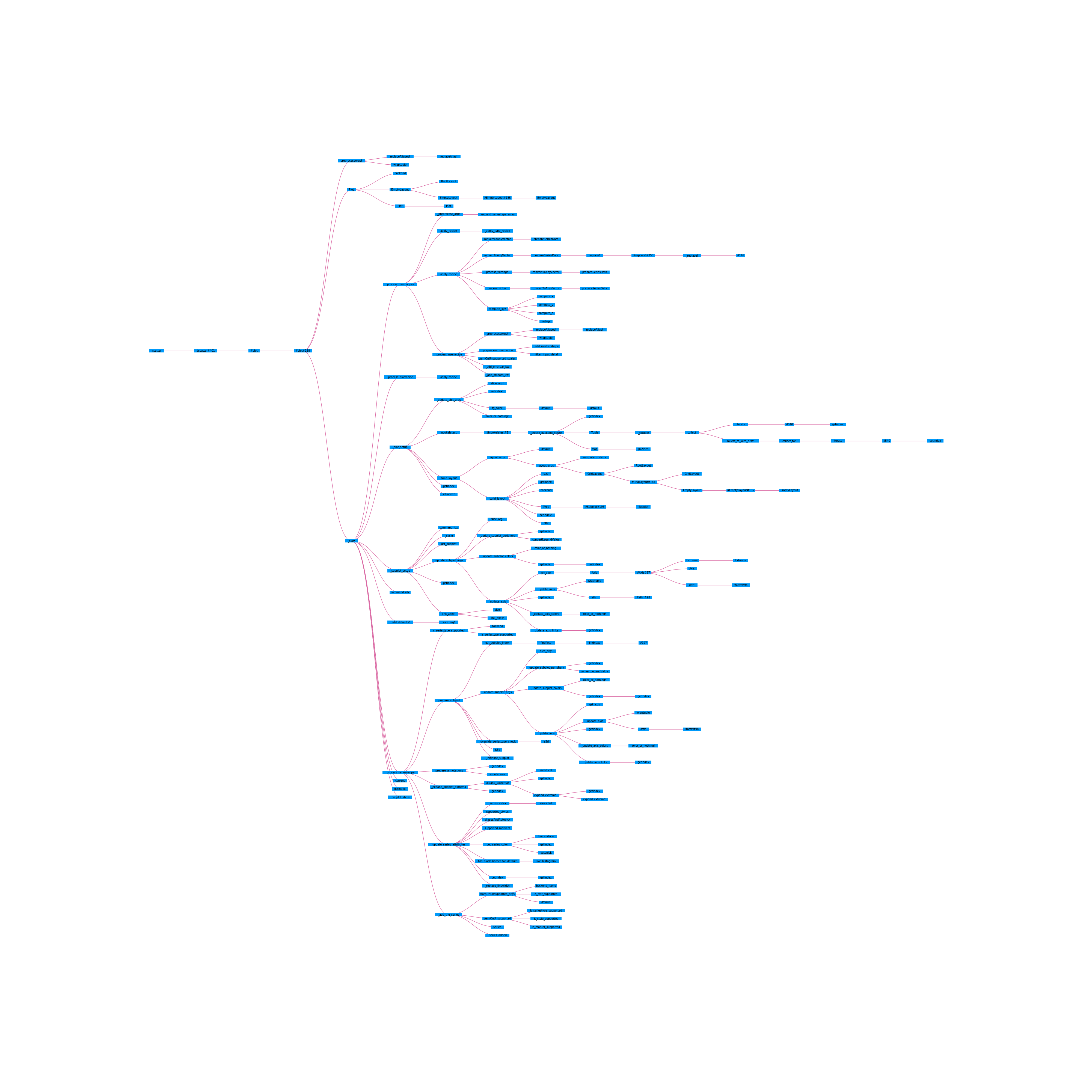
It seems that these trace graphs really push our current tree methods to the breaking point. Which is good, because I will be able to use them to stress test those layout methods.
I also noticed that it is possible to pass :buchheim a layers_scalar, but it will do nothing. See here:
https://github.com/JuliaPlots/GraphRecipes.jl/blob/34b1f7592ebe9ef6e17080fd7f6ab576a13aa95e/src/graph_layouts.jl#L227
Fixing that and the scaling issue will probably help a lot.
Back when we set aspect_ratio to 1 - could we instead query the aspect ratio from the data limits and use that in the equation? That would make it more generic
could we instead query the aspect ratio from the data limits and use that in the equation?
The node shape functionality that I created is rather basic, so setting aspect_ratio != 1 would make the nodes look a little wonky. It is not impossible to fix, but it is not trivial.
yes because it's hard to discern the size of the plotted area from the total plot size I guess.