

 Financial-Times
Proposal: Use Variable Fonts
Proposal: Use Variable Fonts
Motivation
- Allow the design team to use more variations of Financier Display and Metric on ft.com, weight/style.
- Enable the design team to use Financier Text on ft.com (pending further work).
- Replace unreliable, complicated font loading strategy.
Explanation
Overview
The design team are limited to a small number of weights and styles for our custom fonts due to performance. Variable fonts combine variants into one, smaller file and would allow the design team to make greater use of typography within Financial Times products without degrading current performance.
Not all browsers and operating systems support variable fonts. For example macOS prior to 10.13 or, notably for us, Internet Explorer 11 (~6% of desktop requests). Users with browsers which do not support variable fonts will fallback to the limited set of custom fonts we use currently.
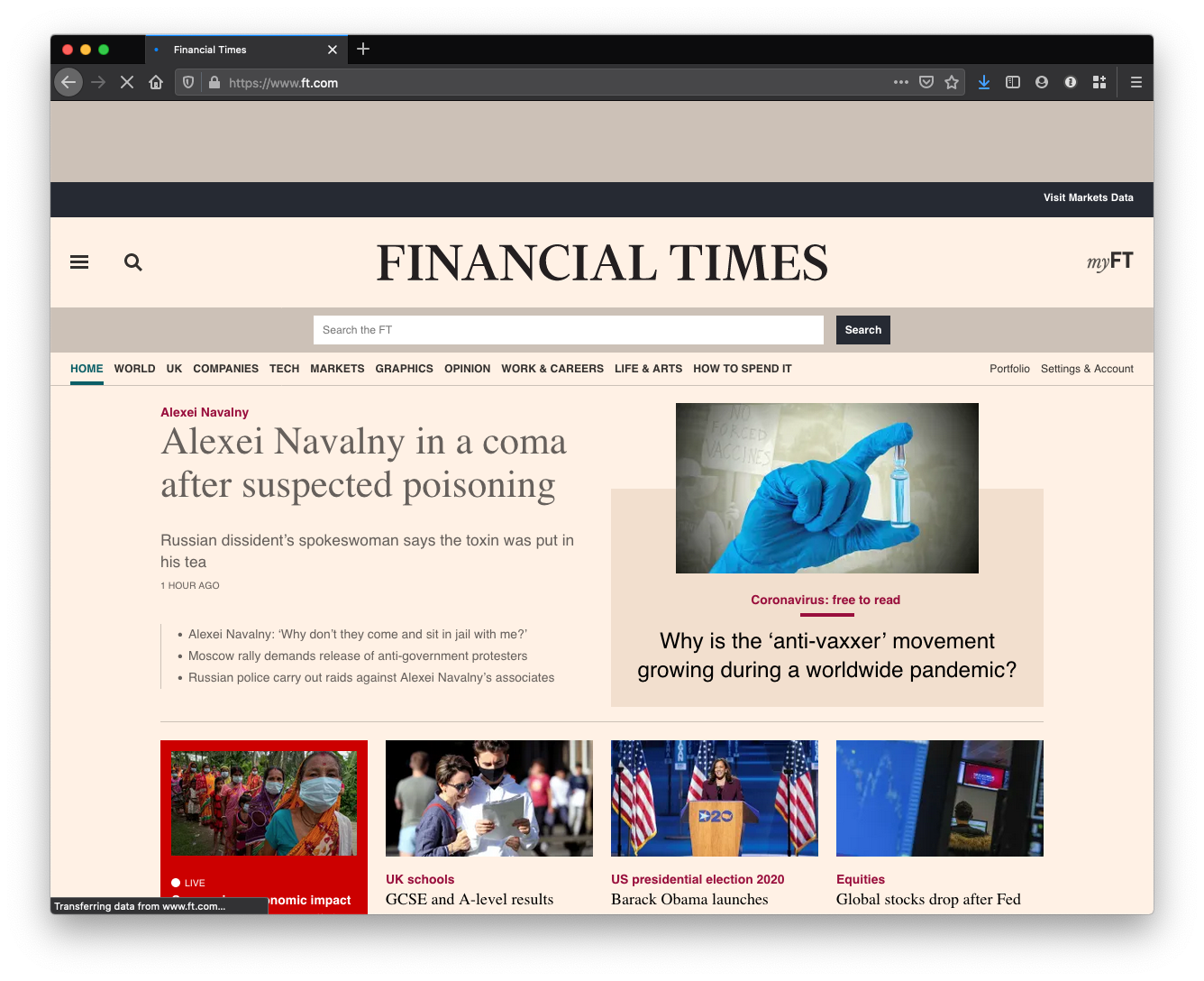
Where custom fonts fail to load or fail to load quickly, we will fall back to system fonts. Currently our font loading strategy resizes fallback fonts so they appear more like our custom fonts visually. Our custom font MetricWeb is particularly small compared to its fallback font. The type foundry, Klim, has therefore resized MetricWeb and will only provide a variable font for the resized version. Therefore we must update our font scale and loading strategy to remove fallback font resizing.
As our fallbacks have a limited set of weights and styles the design team must keep these experiences in mind.
Font Loading Strategy Background
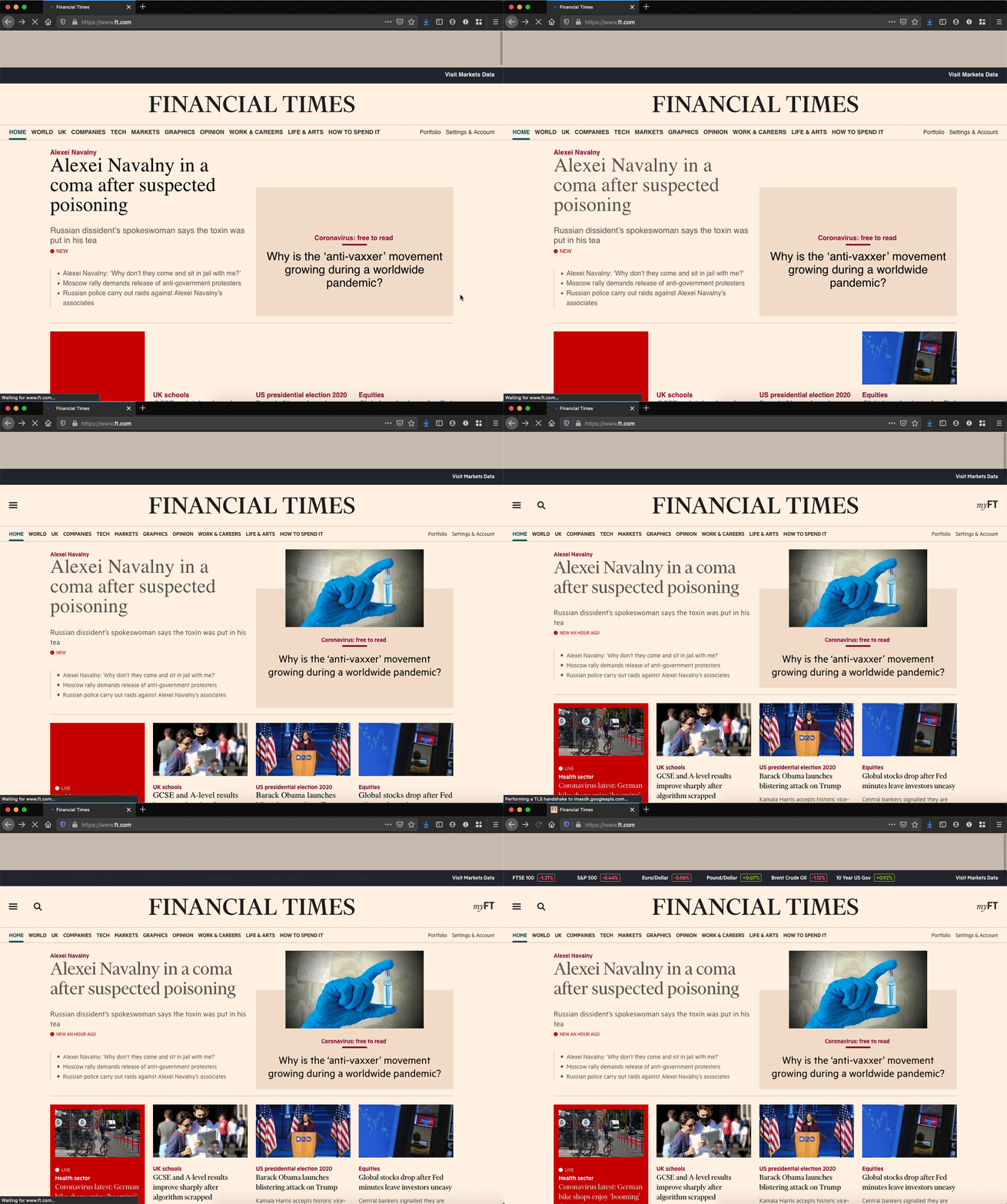
Browsers may layout and paint the page before custom fonts are downloaded. This causes a Flash of Invisible Text (FOIT) whilst the page loads. Some browsers, for example some versions of Safari, hide text until the font is downloaded which could mean users are unable to access any content for a long time. Other browsers use a fallback system font either immediately or if the custom font hasn't loaded within 3 seconds. When the custom font is loaded these browsers swaps the fallback font for the custom font. Swapping fonts can be jarring visually, its sometimes refereed to as a Flash of Unstyled Text (FOUT). This has user experience and performance implications due to the browser needing to layout and paint the page again.
Current Font Loading Strategy
We preload fonts on ft.com so they may start downloading before CSS has been downloaded and parsed, etc. Prioritising the download of custom fonts means we can reduce the Flash of Invisible Text (FOIT) and Flash of Unstyled Text (FOUT).
In addition o-typography currently aims to improve the experience by:
- Normalising the size of fallback fonts so they are closer to our custom fonts, reducing the impact of switching from fallback fonts both visually and minimising page layout changes.
- Using the fallback font immediately in all browsers and swapping for the custom font when its downloaded; unless the download takes longer than 3 seconds in which case the fallback font remains in use.
gif: current o-typography progressive font loading, 3g connection
screenshot: core experience fallback fonts, with o-typography fallback font resizing
Since Klim have resized MetricWeb we can remove custom font loading JavaScript/Sass from o-typography. This would solve a number of issues with our current font loading strategy:
- It requires JavaScript, which means core experience users never see custom fonts.
- Its not reliable.
o-typographyremembers fonts have loaded with a cookie which may persist after the browser cache has removed fonts; in which case the browsers default fallback behaviour is used and fallback fonts aren't resized. - It doesn't always resize well, depending on the font variant in use.
- In the context of Customer Products its a bit complicated, breaks, and can be difficult to debug.
- Though minor given the overall size it increases the bundle size of projects, see the
next-front-pageexample below.
Next Front Page CSS size comparison with and without our current fallback font resizing
next-front-page asset |
o-typography progressive font loading |
uncompressed | gzip | brotli |
|---|---|---|---|---|
| css | yes | 428 | 60 | 52 |
| css | no | 412 | 56 | 48 |
| reduction | 16 (3.6%) | 4 (6.7%) | 4 (7.7%) | |
| js | yes | 636 | 276 | 248 |
| js | no | 628 | 272 | 240 |
| reduction | 8 (1.3%) | 4 (1.4%) | 8 (3.2%) |
To use the resized MetricWeb we will need to update our typographic scale, so when MetricWeb is output it visually looks unchanged. That means we would need two scales, one for MetricWeb and one for Financier. The design team would have to use the resized font and remember the scale has changed. Products which use o-typography mixins to set font size would not need to make any changes, however anywhere an engineer has used font-size directly would need to be updated, else render smaller than it should. This could arguably be a minor release but practically should be a major release to allow users to replace font-size/line-height declarations with o-typography mixin calls.
Font Variant Performance Cost
The file size of fonts is not the only performance indicator, font loading strategy places a large part for example, but is one of the main reasons why we haven't been able to include more non-variable font files. This section evaluates how this proposal would change the download size of our custom fonts:
The font variants currently used on ft.com are:
| family | weight | style | size (bytes) |
|---|---|---|---|
| financier display | normal | regular | 47176 |
| financier display | bold | regular | 47092 |
| financier display | medium | regular | 38692 |
| total financier display size | 132960 | ||
| metric | normal | regular | 29120 |
| metric | semibold | regular | 31148 |
| total metric size | 60268 | ||
| Georgia (system font) | n/a | n/a | n/a |
The variable fonts which we have are as follows (we do not have a Metric variable font yet):
| family | weight | style | size (bytes) |
|---|---|---|---|
| financier display | n/a | regular | 64380 |
| financier display | n/a | italic | 69628 |
| total variable financier display size | 134008 | ||
| financier text | n/a | regular | 52336 |
| financier text | n/a | italic | 54112 |
| total financier text size | 106448 |
- The Financier Display variable font totals 134kb; only ~1kb larger than the variants currently used.
- We don't have a Metric variable font yet but its likely to be slightly larger than the two currently used.
- The financier text variable font would replace a system font adding an extra 106kb to download.
From a font download perspective we can expect a small increase to enable all variants of the font families we currently use. There is a ~100kb increase if we also introduce Financier Text. Financier Text will therefore not be included in this proposal.
Benefits
- The design team can make greater use of typography; to strengthen the brand and explore new design possibilities using typography, such as to provide a clear link between story 'genre' (news/opinion).
- An improved, simpler font loading strategy which is easier to implement in new projects and more reliable.
Drawbacks
- There's an additional experience to consider in design for a total of 3 (no custom fonts, limited custom fonts, variable fonts)
- A major release of a low level component can be complicated for Customer Products to coordinate (arguably this could be a minor release, but realistically Origami users sometimes set
font-sizeoutside ofo-typographymixins).
Work Required
Required:
- Communicate the plan to other groups, Customer Products in particular, get feedback and support. Plan for a major cascade (perhaps this should come before or after the move to npm). In the meantime;
- Commission a MetricWeb variable font to trial in Origami.
- Work with the design team to define a new font scale and which font variants should be allowed, to limit the variable font set sensibly. Update the readme of
o-fonts/o-typographyaccordingly and throw an error ino-typographyif a non-recommended variant is used. - Add variable font files to
o-font-assets(draft/beta). - Update
o-fontsfont faces with variable fonts and functions such asoFontsVariantExists. Use@supportsto load variable fonts conditionally (draft/beta). - Update
o-typographyto remove font fallback resizing (draft/beta).
- Ask the Platforms team to benchmark performance before release to compare performance metrics before and after.
- Release & support the rollout:
- Help users update
font-sizeproperties which effect MetricWeb, or replace witho-typographymixins. - Update dotcom-page-kit font preloads to preload the variable fonts given
woff2support and the fallback fonts ifwoff2is not supported. _Note some browsers supportwoff2but not variable fonts and will preload the font unnecessarily. The group seems small, and is not supported by PageKit.
- Help users update
Follow up:
- Work with the design team to validate
Financier Textand swap the serif font ino-typography.
Alternatives
Do Nothing
Accept the drawbacks of our current approach, continue to serve a limited set of custom fonts.
No Limited Set Fallback
We could fallback straight to system fonts, instead of falling back first to a limited set of custom fonts. There would be one fewer experiences to consider from a design perspective and slightly reduced technical complexity but we weaken the brand/design for a significant group of users.
Avoid Resized Variable Fonts
We could introduce the Financier Display variable font without creating a new font scale or requiring users to migrate. This might not be very helpful for the design team, who would still have a limited set of MetricWeb variants. We also would keep our font loading strategy which is unreliable.
Questions:
- We don't use many Metric font variants. How much bigger in file size will the variable font be?

update on this: we got funding for the variable font work that is required by Klim and it's gone through procurement 👍

We have the fonts. Work was started to rollout then abandoned due to team changes and capacity issues: https://github.com/Financial-Times/origami/pull/227