Nabla
 Nabla copied to clipboard
 Devsh-Graphics-Programming
Investigation into window resizing
Description
What do we need to change for window resizing, how do the different surface implementations report & deal with resizing.
Programatic Resizing APIs
Resize the window to a given size (not the same as the OS telling us the user has resized).
Windows
For Windows, SetWindowPos with SWP_NOMOVE and SWP_NOREPOSITION may be used. By default, this will also "activate" the window, which can be disabled with SWP_NOACTIVATE, and it will change the Z order of the window, which can be controlled with hWndInsertAfter or disabled with SWP_NOZORDER.
Normally this has to be called from the window thread, but the SWP_ASYNCWINDOWPOS flag makes it thread safe.
SetWindowPos(
    hwnd,
    // Unused due to flags
    nullptr, 0, 0,
    width, height,
    SWP_NOMOVE | SWP_NOREPOSITION | SWP_NOACTIVATE | SWP_NOZORDER | SWP_ASYNCWINDOWPOS
);
X11
For X11, XResizeWindow may be used.
x11.pXResizeWindow(m_dpy, m_native, width, height);
Normally X11 requires XInitThreads to be the first call to xlib in order for its usage to be thread safe. This comment, however, indicates that EGL handles the per-display locking & unlocking for us (?).
- Locking and unlocking with the X11 API (XLockDisplay & XUnlockDisplay) requires having called XInitThreads.
- Will EGL cover for us in the resize case?
Wayland
It appears the intended function is wl_egl_window_resize, under Wayland EGL. It appears this function is not thread safe. According to this, the last two arguments are related to moving floating top-level windows (?). We can leave them as 0.
wl_egl_window_resize(m_native, width, height, 0, 0);
Mac OS
For Mac, setContentSize within NSWindow may be used. This function does not appear to be thread safe, and needs to be called from the window thread.
ui::IWindow API
- Provide programatic set window size function:
virtual void setWindowSize(uint32_t width, uint32_t height) = 0;
- Handling thread safety
- We need to able to communicate with the window thread for setting the window size.
- Using a mutex is not enough in the case of Mac OS or Wayland, it needs to be done from the window thread.
- Workaround for Wayland used in egl-wayland: https://github.com/NVIDIA/egl-wayland/pull/53/files
- (Not needed on Win32 with
SWP_ASYNCWINDOWPOSor X11 withXInitThreadsor EGL locking (?) )
- We need to able to communicate with the window thread for setting the window size.
Resizing in Vulkan
Resizing plan:
- Create new swapchain providing oldSwapchain in VkSwapchainCreateInfoKHR.
- Use a mutex to have locks within the swapchain recreation and swapchain image acquisition on render loop.
ISwapchainshould keep track of an "iteration" value that increases each time the swapchain is re-created.- Implementation keeps track of the last swapchain iteration used for each frame in flight.
- Get the image, re-create the image view and FBO for current frame in flight if the swapchain superceeds it.
- This takes advantage that old swapchain images remain valid until a new view is created with the new swapchain. So we can avoid waiting for idle and still render to the old swapchain for all the frames in flight, only creating a new one for the current
m_resourceIx.
- This takes advantage that old swapchain images remain valid until a new view is created with the new swapchain. So we can avoid waiting for idle and still render to the old swapchain for all the frames in flight, only creating a new one for the current
- Get the image, re-create the image view and FBO for current frame in flight if the swapchain superceeds it.
- With the current API for createSwapchain, vkGetSwapchainImagesKHR is called right away, meaning all of the old images get invalidated.
- Would need something like
getImage(uint32_t index)onISwapchain.
- Would need something like
- Implementation keeps track of the last swapchain iteration used for each frame in flight.
Platform specific notes
VK_KHR_win32_surface
- Interesting note here:
Creating a VkSwapchainKHR over a window object can alter the object for its remaining lifetime. Either of the above alterations may occur as a side effect of vkCreateSwapchainKHR.
Old Experiment
- Makeshift solution for resizing:
WIN_W = window->getWidth();
WIN_H = window->getHeight();

// Destroy old swapchain
const video::CVulkanLogicalDevice* vkDevice = static_cast<const video::CVulkanLogicalDevice*>(device.get());
const video::CVulkanSwapchain* vkSwapchain = static_cast<const video::CVulkanSwapchain*>(swapchain.get());

VkDevice vk_device = vkDevice->getInternalObject();
auto* vk = vkDevice->getFunctionTable();

vk->vk.vkDestroySwapchainKHR(vk_device, vkSwapchain->getInternalObject(), nullptr);

// Create new swapchain
createSwapchain();
-
Resizing on the resize event
- In format of the examples, the render loop continues as the resize event is being handled, causing a segfault on the present function.
-
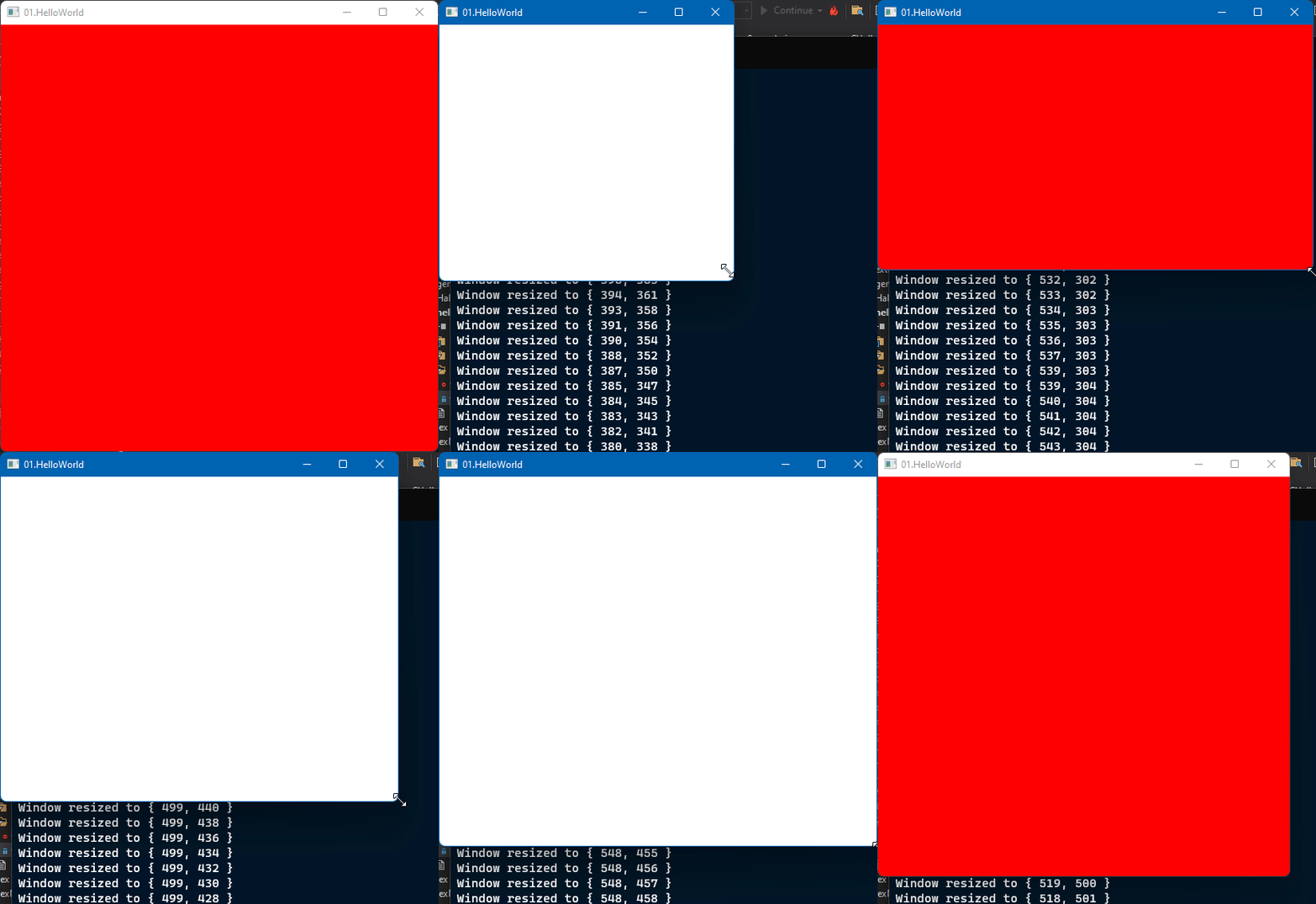
Resizing on the main render loop shows a white screen for a few frames after resizing (flickering).
- Device wait for idle doesn't fix this.
- This also tells us that the old swapchain turns white and stops presenting after the resize event, at least on Windows, so we can't use the old swapchain during a resize or something similar.
API for handling resizing
- Resizing the swapchain
- Provide oldSwapchain in VkSwapchainCreateInfoKHR.
- Old images acquired from the old swapchain may still be used until the new swapchain's images are acquired.
- Use a mutex/other lock to ensure presenting/acquiring the image doesn't run at the same time as the recreation.
~~- The biggest issue is the render loop running concurrently with the window events, not allowing us to resize within the window event
- We could have the rendering be done within the event handler, something like a redraw callback.
- Make the event loop non-blocking, if there is no event, redraw
- Redraw events? Seems to be WM_PAINT on Windows
- Current event loop doesn't trigger this
-
Recreate & handle automatically on swapchain->acquireNextImage?
- acquireNextImage returns "suboptimal" when the sizes don't match
- A simple check for the sizes could also suffice, but would need to be an input into acquireNextImage
- As tested above, this causes flicker.~~
-
Views to the swapchain images & their FBOs
- These need to be replaced with the new swapchain images before we use them again