
convex
 convex copied to clipboard
 Convex-Dev
On fixing expanders
This is a place for documenting failing cases related to expanders.
Taken from the docstring of defexpander:
(defexpander expand-once [x e] (e x (fn [x e] x)))

(expand 42 expand-once)

;; Cast error: Can't convert *initial-expander* of class convex.core.lang.Compiler$1 to type interface convex.core.lang.IFn.
Or a variant with a cryptic error:
(defexpander expand-once [x e] (expand x e))

(expand 42 expand-once)

;; Cast error: Can't convert :CAST of class convex.core.data.Keyword to type class convex.core.lang.expanders.AExpander.

@johnmn3 @Engelberg @pbaille you may also be interested in this one.
I am considering:
- Remove the dedicated
Expandertype and have macros / expanders just be regular functions. - Have symbol metadata like
{:expander true}used in the environment to define what should be used as an expander vs. a regular function (when found in the first position of a list form). - I believe this is more consistent with how Clojure does macro expansion
- This would simplify the CVM somewhat and reduce risk of error confusing expanders with functions.
Any thoughts?


I do not understand this expansion:
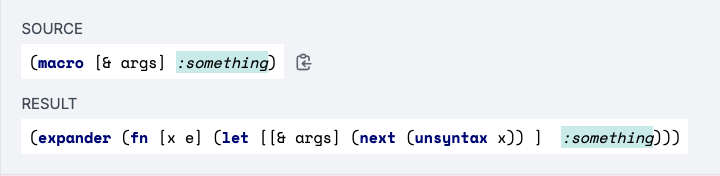
I must be missing something here but it seems that it should be this instead :

Why the received expander is not used ? How sub-expressions could be expanded this way ?
OK so I've pushed some changes that convert all expanders to regular functions
expander is no longer necessary (since it would just be the identity function). macro now produces something closer to what @pbaille suggested above.
Still testing, but comments and input welcome!
I've just done some tests and trying to understand:
;; define an expander that do nothing
;; it should receive the form as-is and stop the expansion (by not using the provided expander)
(defexpander stop [x _] x)


;; here two example of usages, that should (if I understand well) return the given form as-is
(expand '(stop (if true 1 2) (defn id [x] x))
         *initial-expander*)

;=> (stop (cond true 1 2) (def id (fn [x] x)))


(expand '(stop (if true 1 2) (defn id [x] x))
         (fn [x _] x))

;=> (stop (cond true 1 2) (def id (fn [x] x)))
;; apparently the previously suspicious *initial-expander* is not guilty
The stop expander seems to receive 'if and 'defn forms already expanded
but it does not happen with user defined expanders
(defexpander postfix [x e] (e (into () (next (unsyntax x))) e))

(expand '(stop (if true 1 2) (postfix 1 2 +))
         *initial-expander*)

;; => (stop (cond true 1 2) (postfix 1 2 +)) ;; postfix is not expanded
Any ideas ?
I was suspecting expand to do extra stuff but if I use stop directly it do not change anything
(stop  '(stop (if true 1 2) (defn id [x] x))
        (fn [x _] x))
;;=> (stop (cond true 1 2) (def id (fn [x] x)))
same with:
(expand '(stop (if true 1 2) (defn id [x] x))
         stop)
I also try to understand how nested quotation works in convex: here some documentation and examples according to the scheme R5rs standard.
see some results (Racket)
(define x 1)
;; some quasiquote examples
`(a b c).
`(a b ,x)
`(a `(b ,x))
`(a `(b ,',x))
`(a `(b ,,'x))
;; respectively evaluates to
(a b c)
(a b 1)
(a `(b ,x))
(a `(b ,'1))
(a `(b ,x))
in convex we are good for the two firsts (no nesting) but the three others do not match:
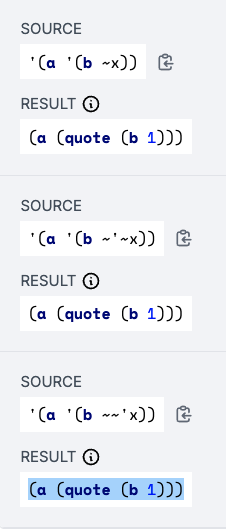
It will be a problem to support macros that emits macros and even if we want to deploy a simple macro (we need to quote the code that we are deploying)
So you can let go of Expander? Currently a function can be used as an expander but not the opposite:
($.eval/result ($.ctx/create-fake)
               '(expand [1 2]
                        (fn [f e]
                          (e f))))

;; Throws because `e` cannot be converted to a function, but will be resolve once we remove the expander type
the expander takes two arguments (e f) should be (e f e) I believe. But this is not the source of the error.
So I think I've managed to replicate the Racket examples (modulo the fact that everything is effectively a quasiquote in Convex at the moment). Following is passing:
@Test
public void testQuoteCases() {
  Context<?> ctx=step("(def x 1)");
  assertEquals(read("(a b c)"),eval(ctx,"`(a b c)"));
  assertEquals(read("(a b 1)"),eval(ctx,"`(a b ~x)"));
  assertEquals(read("(a '(b ~x))"),eval(ctx,"'(a '(b ~x))"));
  assertEquals(read("(a '(b ~1))"),eval(ctx,"'(a '(b ~~x))"));
  assertEquals(read("(a '(b ~1))"),eval(ctx,"'(a '(b ~~'~x))"));
  assertEquals(read("(a '(b ~x))"),eval(ctx,"'(a '(b ~~'x))"));
}
I haven't played enough yet with the new implementation but it looks rather good, doesn't it? @pbaille Did you manage to break something? :p
I think we are now good, but will leave open a bit longer for any comments or issues.