

 Chocobozzz
Monetization | A list of ethical and privacy-respecting ways Peertubers can make money
If someone chooses to monetize their videos, what ethical options do they have? Let's suggest ways (technical and non technical) for Peertubers to earn money.
First lets include the official suggestion from joinpeertube.org:
the solution proposed to people who upload videos is to use the "support" button under the video. This button displays a frame in which people who upload videos can display text, images, and links freely. For example, it’s possible to put a link to Patreon, Tipeee, Paypal, Liberapay (or any other solution) there.
A suggestion I could think of:
- Find a website/platform where advertisers meet directly with content creators (Peertubers). Next offer them to promote their product in videos you make and see how much they can pay you (per video).
What's yours? Let's expand the list.
:warning: What we probably want to avoid, is a monetization system that favors the users of big instances. This will kill decentralization. A PeerTuber should never have to think like: "If I join this big xyz instance I will make much more money as opposed to joining a recently created instance."

Another option would be Bitcoin or another cryptocurrency. The good thing about that is that all the software is open source, and easy to automate. The simplest way to implement this would be just show an address where users can send money to. Ideally it would create a new address for each donation for privacy reasons (so it is harder to tell how much money someone received, or who they received money from).
Another option would be to integrate Liberapay support.

I think cleanly integrating things such as Liberapay, Patreon and the likes, and actually working with those entities to make sure it works well, could make a huge difference.
Peertube as a global platform will only be as successful as it is successful with content creators. Without content creators wanting to use it, it will essentially be a backup solution for Youtube videos and the playground for a few convinced video makers.
Cryptocurrency integration, while interesting on paper, is not likely to be useful anytime soon, given most people have no idea how to use Bitcoin, Ether or anything else.
I agree encouraging ads would be counter-productive, as this is not the Internet PeerTube is pushing for. However, Read the Docs explanation about "ethical ads" might still be worth the read and consideration.

Patreon has an API that can be integrated with, but liberapay and open collective do not. Nor does kofi. Liberapay explains that they are not a 'paywall' service like they imply Patreon is, but a donation platform(you're not supossed to be giving perks to people when they donate as that can be seen as selling a service instead).
For someone to self-host a paywall service, they'd proly have to implement a customer relation manager(like civicrm) to keep track of their contacts, implement a payment provider to get money, and finally get peertube to give access to content depending on the state of a contact in the CRM...
So, to be able to implement a paywall like system peertube by itself would need to have both the ability to set permission to view on certain videos(or at the very least have a list of people to notify for certain videos), as well as API to control that programmatically(or for all videos of a certain type in a channel). I suspect this is also necessary for Patreon integration or any other such service.
You could extend this to little medals/ribbons etc for commenters who are supporting the show financially.
Of course, looking at this I feel the instinct wriggle that better moderation needs to be done first, especially things like a channel giving other people the ability to moderate a channel's community, as this is really the biggest time-sink for any moderately popular artist on social media, but this is a completely different topic.

https://github.com/Chocobozzz/PeerTube/issues/1521#issuecomment-451401571

Given the recent weird thing youtube is doing where it is demonitising channels because they might be advertiser unfriendly, I think it might be worth it to think about how an alternative approach to this can be handled.
First things first, marketting people are people too. They want to do work and tell their boss they did work good. So there is a market for making things easy on marketting people. The youtube issues right now is that youtube is not able to garantuee that adverts appear on wholesome channels so that people will not associate the brand with horrible things(horrible videos, horrible people in the comments) happening on the channel.
One of the main things about the fediverse is that moderation is human. Decentralization makes this feasible. So, technically speaking, a peertube instance can actually make a promise towards advertisers saying 'this is an instance only for children's videos', 'this is an instance only for technology', 'this is an instance only for art' and that the terms of service are followed very very closely. The ability to say this is super prestigious, and I think peertube instances could ask more money than the equivelant youtube video due this.
It is also important that peertube instances ask for more money, because there's a reason youtube doesn't do proper human moderation: it is expensive.
So, then, thinking in terms what is technically needed for this:
- Integration with Matomo(#1385 ). Statistics are necessary for the advertisers to understand how useful it will be to advertise on these channels.
- The ability to have short videos before/between/after the main video.
- The ability for users to define 'commercial breaks'
- The ability to get some anonymous statistics for these. (Views, how long it was played, etc)
Now, for the ads themselves, they might either... come from a 3rd party, or come from an instance pool of ads.
3rd party adverts would be more in line with peertube's current stance towards advertisement("er, make a plugin"). There would need to be some kind of service that allows receiving info about videos and sending statistics towards such a service.
An instance pool on the other hand would be closer full integration, but there is a very good argument to be made for this: The less middlemen between the advertiser and the video creator, the more the video creator has power to negotiate a fair price. If you have a 3rd party system, the 3rd party could turn out to be something big like google, who'd benefit from having super low prices for everyone and for hiding to advertisers where their videos are going to end up. But not every video creator is equal, advertisers want the channels which are popular and are well moderated.
I think we should keep a sharp eye on what is possible to ensure that these super valuable channels(where people work hard to output quality content and keep a civil atmosphere) have a strong position when negotiating versus advertisers, because advertisers want to be able to share in the cultural and social capital these channels have accumulated, and I think channels should be rewarded for that.
Sorry if this comes across as a bit rambly, but I really wanted to get that last paragraph across. It is not in the favor of advert giants to let this negotiation be possible, and I would like video creators to not have to advertise for a pittance, much like I wouldn't want to see illustrators work for 'exposure'.
I would prefer to avoid totally any form of advertisement. I think this encourage the marketing and I think it's a terrible thing.
Enabling any form of advertisement would inevitably lead to derives, I think. Where channels would just upload a lot of shorts videos just to get as much as money as they can. We saw that with YouTube. I don't want to have the same schema with PeerTube.
I think the more ethical approach is something already said on this topic: Having the possibility to directly give money to instances owner and video creators. Having something integrated (with addons) would be the best scenario. With the possibility for instances owner to display publicly how much they need and to automatically give them fees when paying creators.

an who will judge if a channel, video or comment is horrible or not? the minister of conscience? YT started already an Owelian insanity, so now you want peertube doing the same? well, sad times....

You could use Duniter Libre Currency! Each Peertube Node would have 2 Ḡ1 wallet filled with an initial amount. Then each actions in Peertube could initiate 0,01 Ḡ1 transfer +/- beetween wallets with Metadata as Comment.
There is python API like https://git.duniter.org/clients/python/duniterpy
If you want to know more about "Monnaie Libre" project? https://monnaie-libre.fr

You could use Duniter Libre Currency! Each Peertube Node would have 2 Ḡ1 wallet filled with an initial amount. Then each actions in Peertube could initiate 0,01 Ḡ1 transfer +/- beetween wallets with Metadata as Comment.
There is python API like https://git.duniter.org/clients/python/duniterpy
If you want to know more about "Monnaie Libre" project? https://monnaie-libre.fr
I am not an expert about cryptocurrencies but does it work in the same way as Bitcoin? Needing miners calculate things to generate money?
Because it seems to be extremely polluting (because it asks a lot of energy) and I don't think PeerTube should be associated with this kind of practices.
But if it's energy-friendly why not!
I am not an expert about cryptocurrencies but does it work in the same way as Bitcoin? Needing miners calculate things to generate money?
Because it seems to be extremely polluting (because it asks a lot of energy) and I don't think PeerTube should be associated with this kind of practices.
But if it's energy-friendly why not!
This is energy efficient, because there is no competition for mining blocks (and no token reward), members are forging new blocks in a peaceful equivalent way and generate an equal part of Libre Currency every day as everyone. See details http://duniter.org/
I totally agree with @Booteille
I don't think advertisements are good for Peertube's ecosystem. Instead, I prefer the patreon/librepay method of supporting your favourite channels via monthly, one time and yearly subscriptions will go a long way! Advertisements can easily mess up the whole ecosystem and push the whole peertube ecosystem towards youtube's hell of attention craving ecosystem. I also fear that advertisements will inevitably also hit the roots of Peertube's development & will likely effect the course of Peertube over time.
Coming back to this again:
Thinking about paywalls, what might also be interesting, and needs a bit of work on peertube's side:
Instead of accessing the latest video over a paywall, rather, access the archives. A video maker would just upload their videos, and the latest video would be watchable for free, but archive access requires subscription.
This is similar to how broadcast tv has worked for years, and we know that fans of a show will want access to previous versions.
This will require Peertube to be able to limit access to a once public video reliably, which is tricky with federation.
@therahedwig I am attracted to the inverted version of this model. Think paid latest sessions, and eventually they become cheaper, and then free. So content which is in demand is at a higher cost and if you want to watch something for free you'll have to wait for the demand to go down?
@therahedwig I am attracted to the inverted version of this model. Think paid latest sessions, and eventually they become cheaper, and then free. So content which is in demand is at a higher cost and if you want to watch something for free you'll have to wait for the demand to go down?
I think in the end it'll be a per-channel type of thing. A narrative driven show might paywall the latest episode, but a video essayist might want to make their last video public and paywall the previous ones, as in the case of the show, viewers will want to know how it continues, while in the case of the video essayist, it is important to them to have the videos that are part of the current discourse to be public. A cooking channel could do great with either method, I think.
I've been thinking about the ethical payments side of PeerTube for about a day now, and have got a collection of ideas that I'd be interested in hearing feedback on.
Just to get this out of the way first, I agree with keeping advertising support to an absolute minimum, partly because it gives advertisers influence that they need not have and partly because it often has a detrimental effect on creative content.
However, if PeerTube is going to grow, we should be honest with ourselves that file storage and Internet bandwidth doesn't come for free, and it will almost certainly be tricky for PeerTube to provide a healthy alternative to YouTube if purely relying on the altruism of early adopters.
What I had in mind was a service that is very similar to Flattr, which pays creators based on splitting a recurring fee that users pay to support them.
https://flattr.com/
https://en.wikipedia.org/wiki/Flattr
On some level, using the standard Flattr service would be a good step forward (if Flattr chose to support PeerTube), but I think we have the potential to offer something even better.
Something that struck me is that IPFS and PeerTube could work very well together.
https://ipfs.io/
For those that are unfamiliar with IPFS, the simplest explanation I can think of is that it's a decentralised peer-to-peer file system. Users that host content on IPFS will have the option of being paid in a currency called Filecoin (I think it's still under development, not quite ready for widespread use yet), which helps to ensure they're not left out of pocket for the service they provide. Two nice features of Filecoin compared to many cryptocurrencies are that the currency is earned by producing a tangible good (file storage) and that earning currency does not involve highly energy intensive processes (from my limited knowledge, earning Filecoin seems to be based on providing proof that the storage you have indicated is available for IPFS to use is truly available).
So how does this link to PeerTube? Firstly, considering that it's possible to run torrent sites on IPFS, in principal it's possible to run a PeerTube instance on IPFS. As an example, there's a torrent site called Torrent Paradise that runs on top of IPFS:
https://medium.com/chainrift-research/ipfs-powered-torrent-paradise-is-decentralized-and-invulnerable-fde51a0bc4d6
By running a PeerTube instance on IPFS, aside from enabling a PeerTube instance to make use of the extra storage capacity that IPFS could provide, it also means we can make use of Filecoin to help keep this PeerTube instance alive.
Now that I've set the scene, hopefully the rest of this idea is easier to explain. Imagine a Flattr-like service for PeerTube where users buy Filecoin, which is then split between file hosts and content creators. File hosts would be paid off first to keep the service going, and all remaining funds would be split amongst content creators (based on the same approach used by Flattr).
One potential downside I can currently see with this plan is that I'm not 100% sure how fast it is to access content on IPFS, but it should be possible to test out whether the performance would be adequate. Another potential downside is that it may end up limiting the hosting options available for paid PeerTube instances, which is something to guard against. Also, there may be simpler ways of achieving the main benefits of what I've set out, I'm open to suggestions.
Any thoughts?

Any thoughts?
Flattr is a wonderful idea (but centralized, unfortunately). Integration with Peertube should be studied along the one with patreon, tipeee and liberapay, ASAP and KISS.
Filecoin is interesting. For creators, it would be a simple way to have their videos somewhere in exchange of some price. It enables any creator with some money to have their videos online, and the price is an incentive to become host themselves.
IPFS is a very good tech ; but it's just starting to grow. I'm not sure Peertube should do anything for it now, but in the long run those two may work together. Like having Peertube be able to serve as an IPFS gateway for videos (which could be in turn plugged with the Filecoin system).
-
For the moment, the easy thing is to allow channels to show buttons toward arbitrary websites with an icon next to each video. This way, creators can easily reference their patreon and alike. (interface-wise: an horizontal list of "buttons", populated using two widgets : a drop-down list of icons (taken from font-awesome + icons of some big providers like patreon + the "upload icon" enabling arbitrary image), and an url to fill. Hit enter: the button is added to the video)
-
Next step would be to provide a more integrated interface for some website (e.g. patreon may provide statistics about money raised and goals, youtube could provide number of view, etc).
-
Then, sometime, the time for IPFS integration will come.
To me, the Fediverse on IPFS sounds like the next humanity goal, after the moon landing and internet invention. I may be biased.

I'm so glad I've stumbled upon this discussion. I've been thinking about monetization on the platform, and I want to share some thoughts of my own and commenting on a lot of the ones mentioned here.
Adverts: My feelings about advertising (As we know it on say youtube with prerolls and banners) on the platform/network is a bit mixed. I'm not against it but I'm also wary of it. On one hand, I agree that with instances have greater control of their target audience where they can have it as niche as they like could be an advantage for creators and advertisers. Remember, the problem with ads on youtube has a bit of two-way street when it comes to all of the ad controversies on youtube. There are things that advertisers don't want their money supporting, and creators don't want certain ads appearing on their videos. In a decentralized system like Peertube, the advertisers and Peertube instance admins/creators have a bit more control of who's advertising to what like in the instance pool idea.
On the other hand, there is a number of problems with ads on the platform. I can see this splitting the network as some instances have both viewers and creators coming to Peertube instances to get away from advertisers trying to sell them stuff. I'm also skeptical of how cleanly the plugins would federate across the network, and if it can I would imagine the more grassroots instances that sync with an advertising instance would be alienated by that.
If anything, I see a lot of ads on Peertube (if it gets bigger in the future) coming from sponsors for creators or instances from what I see is currently possible. Of course, this is all theoretical.
Flattr I actually really like the idea of Flattr or Flattr-like product being used for the platform. From day one I wanted to see if Peertube might implement something like youtube red/Premium where the sub is split across the creators you watch, and instances you are one, and Flattr comes close to that vision.
If we could implement integration Flattr or make something similar to that on Peertube, that would make my day.
Though speaking of Flattr this is this other idea I've seen floating around that I like:
Retribute This is an interesting project I found on the Fediverse. While a lot for crowdfunding services are centralized, Retribute tries to aggregate all support options for a user/creator with the goal being eventually similar to Flattr/BAT: more interaction means more payment to the creator. It's only at the start of development and needs some work, but I love this idea. I hope it gains some traction in the future. https://eliotberriot.com/2019/06/09/introducing-retribute-a-decentralized-open-effort-to-support-creators.html https://eliotberriot.com/2019/06/16/retribute-technical-architecture.html
Coil/interledger (EDIT NEW EDITION)
Recently I just found out about https://coil.com/ this seems like a similar idea to flattr but sends a micropayment for users browsing the content. It uses a protocol called "Interledger Protocol RFC" for how it mediates the payment. I think having a plugin based on coil or from Interledger to make a peertube integrated version could be another micropayment option akin to youtube premium or flattr.
IPFS While I'm skeptical of cryptocurrencies, File Coin interests me for as file hosting solutions. I know Lbry is trying its hand at something similar in trying to rent out storage through their currency. The only thing that I would consider is that Peertube viewers don't necessarily come from Peertube itself. either coming from other parts of the Fediverse or accountless (probably using RSS to follow WOO!). I think those type of users needs to be considered as well for file coin exchanges. Voluntary of course.
Users Paying For Storage I can see this being an unpopular method for instances, but I can see it happening. Storage and bandwidth can be expensive so having users pay to be hosted is one method of doing this without a paywall if this something an instance is trying to avoid. With proper scaling, I can see it useful from people who occasionally upload something for the hell of it to those who are more interested in being self-employed through fan support one way or the other.
Cooperative Platform Method When I first came to the Fediverse, one of the mastodon instances I came across was Social.coop. It uses a cooperative style structure in its management. This instance is democratically run with users having some decision making power.
I feel it would be interesting to see instances that are governed by creators. After all, many creators have stated in the past a platform should be for the creators. How it would work is that members pay a membership fee that would cover the cost of operation. Depending on the governance structure, the creators would have a say in any decision on the instance or elect a board of members. Otherwise, the creators would be largely independent and using fan support and other methods for monetization.
In fact I found a french coop, p2p.legal, trying to do implement coop platforms with one being a peertube instance, tube.p2p.legal/. Though it seems that it plans to pay members through Duniter's ğ1 from what I've seen from a translation. Definitely and interesting way of going about this.
And those are all of my thoughts. I know some of the last ideas were more instance-centric than a creator, but are still ideas on how to keep them afloat. I definitely felt the need to contribute.

The primary reason I built a PeerTube instance was to experiment and determine how to best integrate it into my existing project that is all about people exchanging values and making a profit when they add value to others. I'm interested in your comments and ideas for integration as ethics and privacy are key aspects driving my project.

In my opinion you don't need to integrate a payment system into PeerTube. There are plenty of external services content creators can use to monetize their content. PeerTube should focus on improving the UI/UX for content creators and users, to attract them to the platform. Much of the bullshit content on youtube is specifically people looking to make a living out of it. What made youtube grow was the organic content people wanted to make because they wanted to make it. Then the flock of wannabe like, favourite, share, subscribe, follow my twitter and insta started happening.
In case you want to proceed, an integration with donorbox [1] would be non-intrusive and seamless.
[1] https://donorbox.org/
Donorbox seems like it could be a good platform for content creators, but we also need to think about how to fund content hosters. Relying on the spare bandwidth of personal internet connections is fine when PeerTube is small, but at some point (if PeerTube continues to grow) there's probably going to be a need for seedboxes, and they cost money. Content creators are free to choose whatever monetisation platform suits them best, but bandwidth doesn't come for free, and if we want to move away from the ad-supported model of sites like YouTube we need to tackle this head on.
About monetization, maybe Peertube could use G1Tag associated to its media and nodes. https://www.g1sms.fr/fr/blog/g1tag
And use it to build a "file economy" between Nodes (readers) & Files (storage) as for CopyLaRadio Jukebox: https://www.copylaradio.com/blog/blog-1/post/jukebox-interplanetaire-9
I don't speak French, but from what I can see from the translated pages the Interplanetary Jukebox model seems interesting.
Not to come across like the super capitalist asshole, but what exactly is the problem of having the option to plug-in a regular payment system which uses a standard money exchange (PayPal, Creditcard, maybe Bitcoin et Al.) and enable people to offer Video On Demand via Peertube as a platform?

@tilllt please read our note in the FAQ. TLDR': it is better to write plugins (since we have a plugin API that allows such things).

Absolutely no offense intended here, but I think you have a limited understanding of who might be interested in an independent video Streaming platform. The classical means in which YouTube is used (and in which creators that want to monetize) is similar to how commercial Free to View Television is financed. Which is advertisements or sponsorship.
Well and then there is a whole different tradition of monetization, which probably had its roots in Cinema and theater. You pay, then you can see the content. I studied filmmaking, I know a lot of indipendent filmmakers: the demands of presenting their work is different than a YouTube channel. There are a plethora of VoD platforms to accommodate that, recently even Vimeo and YouTube jumped that pay per view bandwagon. Then you have a difference between subscription based vod (Netflix, Mubi etc.) and pay per view (Amazon Video does that, realeyz, DocAlliance etc.pp.usually branded and / or curated to s subject i.e. only docs, only short films etc) ... This type of pay per view VoD is not at all discussed here, although I personally find it to be one of the most honest methods of accessing content. You wanna see something, you pay for it.
In any case I think it would be good to have this potential user group in mind as well, since there is nothing which gives filmmakers a really fair share of the VoD fee. Obviously, in a Peertube network, the ones that provide storage and bandwidth for this type of streaming would have to be paid somehow for their contribution, as well as a fee to the Peertube team itself. Still I bet it would be a much better deal than anything commercially offered. Another problematic issue would be that it would be necessary / desirable to have stats over the maximum amount of possible streams and at which bandwidth. Filmmakers are usually very concerned that their film is played in a decent quality, something which the average YouTuber doesn't care about at all.
Peertube should make its own advertising platform were ads can me managed on a peertube instance or we can have peertube advertising instances that can connect to peertube instances. No third party needed, and ads can be privacy respecting.
Another option is a cryptocurreny and if that is the case I would suggest making a peertube token on the Tari blockchain platform with unlimited supply, Tari is a sidechain of Moneor and that way PeerTube token can have privacy built in by default.

Peertube should make its own advertising platform were ads can me managed on a peertube instance or we can have peertube advertising instances that can connect to peertube instances. No third party needed, and ads can be privacy respecting.
Relying on advertising to keep a platform afloat is like pissing on yourself to keep yourself warm, it works but it's messy and something that should only be done if you're desperate. Privacy concerns are just one of the downsides, the caustic effect it has on culture is arguably a much bigger issue.
Another option is a cryptocurreny and if that is the case I would suggest making a peertube token on the Tari blockchain platform with unlimited supply, Tari is a sidechain of Moneor and that way PeerTube token can have privacy built in by default.
Whether cryptocurrency or standard currency is used is up for debate, but it's not really the main issue. The main issue is how monetisation is integrated in the platform. If privacy is your main focus I can see why you'd be in favour of cryptocurrency, but we need to look at how the currency is distributed. Either we have something which requires manual work from users to manage (i.e. one off donations), in which case there's basically no limit on the type of funding platforms that can be used, or we look at building something more automated (such as paid subscriptions, to give one example), in which case it needs to be something more closely aligned with the platform.
To give an example of the latter, Twitch streamers get money for subscriptions, and this allows (some of) them to make a living just producing content. It doesn't matter if they're being paid in cryptocurrency or in dollars, what matters is that they're being paid.
Interledger would allow users to pay in the currency of their choice and sellers to receive in the currency of their choice. Coil puts a nice interface and prefunded wallet in front of Interledger.
Creators should have options for how they want to monetize their content. Ads for users that don't want to pay, single payment, streamed payment, subscription. More options are better.

Interledger would allow users to pay in the currency of their choice and sellers to receive in the currency of their choice. Coil puts a nice interface and prefunded wallet in front of Interledger.
Creators should have options for how they want to monetize their content. Ads for users that don't want to pay, single payment, streamed payment, subscription. More options are better.
Generally choice is good, but ads have a damaging effect on a platform, at multiple levels. Online advertisers are used to being able to track the effectiveness of their ads, and run targetted ads based on demographics they have deemed to be most likely to buy their product. Start introducing ads and you've introduced a slippery slope towards greater tracking of users. For this reason (and others, like the damage that advertising has on public discourse), I would suggest ads should be strongly resisted. Aside from that, I have no issue with offering multiple payment options.
In my personal opinion a system to manage the Adverts is not the way to go for several reasons: 1 - Adverts usually ruin the experience ( in my case at least ). 2 - Adverts monetize with very high number of views ( not Peertube videos case for now ) 3 - Adverts works better as targeted advertising and therefore with privacy limitation.
But Peertube Creators, even with lower views, have stronger connection with viewers so in my opinion a direct support would work better like direct donations, recurring donations, crowdfunding.
Another way is to simple use the sponsors inside the video so it would be a part of the video production.

I am myself comparing various "donation" websites at the moment. I recommend this very detailed comparative guide on the subject of Crowdfunding / Fundraising services : https://wiki.snowdrift.coop/market-research/other-crowdfunding

From: https://github.com/Chocobozzz/PeerTube/issues/3131
After spending some time on PeerTube instances and other federated social media, I can't help but shake the feeling that they might benefit from Web Monetization support. For those who don't know, Web Monetization is an open standard and JavaScript API that allows users to automatically send a small amount of money continuously to a site while the user is on a page. It's been proposed as a W3C web standard and is already used by sites like Imgur, Twitch, Hackernoon, and others. I can't help but feel PeerTube is the most natural fit for this.
I think it has a number of key benefits:
Decentralized: anyone can create a Web Monetization provider or wallet. Automatic: doesn't require that users actively support each individual. Monetization is based solely on engagement from Web Monetization-enabled users. Easy integration: all that is needed to start monetizing is a meta tag on a webpage. And it has no effect on users not using the standard. Support for Instances and Users: payment pointers can be added for content creators on their videos and pages, and for the instance as a whole in discovery pages and unmonetized videos. Multiplexing options also exist, to support multiple payment pointers at the same time. Not Cryptocurrency: doesn't requires users or creators to buy into a new crypto or ecosystem. It's real money moving from users to creators, and it's not tied to any one corner of the internet. No Tracking, No Ads: has a similar passive support mechanism to ad-based monetization, without the icky surveillance capitalism.
If this is something people think is worthwhile, I'd love to start working on it. If they think it fits better as a plugin, I'd be happy to develop that as well once the new plugin system is unveiled.

Sorry for my stupid question about monetization, but from the start, WHO pays?
@ROBERT-MCDOWELL well, that depends. From the "start", instance admins and content creators, paying to create and host content. Monetization is a mechanism for compensating those individuals, who are taking on costs in the first place, for the time/effort/resources etc. Most monetization setups involve users paying through some means, whether by regular micro-payments or through one time macro-payments or recurring subscriptions. Some others involve Proof-of-Work style crypto, where no one pays, per se, so much as "money" is created through the act of consuming the content. There is, of course, also advertising, where advertisers pay to get those sweet, sweet viewers.
Also, thanks for linking me to this thread @Chocobozzz, this is exactly the issue I was searching for but couldn't find myself. I'm going to write a Web Monetization plugin, will report back once I get 'round to it.

@LuckierDodge I've just received funding from Grant for the Web to implement this. Sorry I didn't say something earlier, I applied back in June and forgot about it until they selected the projects just now.
So far I've just setup a plugin which adds a meta tag with a hard-coded payee and starts sending money when someone visits a video. Next week I'll add the settings for an uploader to set their payment pointer and have it take affect. At that point I'll also publish updates to npm as there will be basic functionality.
As a general summary of what the current ecosystem supports, one can sign up with Coil for $5/mo and install their extension. When a site with Web Monetization support is visited, they pay a fixed amount per time through a stream of very small payments to the address specified by the site. The site can stop the payments and change the recipient at any time. The site gets a different random identifier for each payment stream, so the user cannot be identified. To receive payments, an account is needed that can receive Interledger payments for which there is currently GateHub and Uphold. Then a payment pointer, a url with invalid syntax for aesthetics, can be generated.
I will post more updates here and to this issue when I publish to npm.

@samlich congrats on the funding, that's terrific! Good thing too, since grad school hit me hard and I haven't gotten around to working on this yet. No wasted effort, at least. If you need an extra set of eyes/hands during development, feel free to ping me, I'd be more than happy to help out.
Long overdue, but here is a plugin https://www.npmjs.com/package/peertube-plugin-web-monetization (although you'll have to wait for v0.1.4 to be indexed by PeerTube as v0.1.3 doesn't have the dist folder). It provides a payment pointer associated with a video to the browser, and monitors payments. Sponsor segments can be specified using the chapters plugin, and they will be skipped if the user is paying. The uploader can set a minimum rate to skip sponsors, and a minimum rate to view the video at all. This is currently only enforced client-side.
It keeps track of which parts of the video have been paid for, and does not double pay. This information is lost at the next page navigation, but the intent is to optionally store this for the user and optionally also for aggregate statistics for the uploader.
I've uploaded several test videos. This one will only play if at least 1e-5 XRP/s is paid, where Coil seems to pay around 2.4e-4 XRP/s (you may need to scroll the page for the modal to appear after the video pauses).
The format of the payment pointer is validated in the video update page, but not in the publish page. I'm not sure why yet.
Fast-forward to the end of 2021, donations are getting more popular and widely adopted - most major social platforms have an implementation. And PeerTube is in the best position to make use of the trend.
A good solution that meets PeerTube requirements and values apparently needs to be decentralized both technically and financially - it wouldn't help much if your donations are routed via a crypto exchange that forces you to KYC and is prone to leaks. Besides, there's no point in replacing the arbitrage of centralized donation processors with crypto holders and miners - donations can be more efficiently decentralized without middlemen.
I develop a free nonprofit micro-donation processor with a focus on privacy and freedom. Thumb-up triggered or recurring micro-donations: transparent and optionally anonymous with no service fees, possibly connected to PeerTube keys so that spontaneous donations don’t require additional clicks for checkout. Instance domain owners can choose to receive a share to make hosting sustainable and scalable.
https://blog.smartlike.org/about What do you think?

Fast-forward to the end of 2021, donations are getting more popular and widely adopted - most major social platforms have an implementation. And PeerTube is in the best position to make use of the trend.
A good solution that meets PeerTube requirements and values apparently needs to be decentralized both technically and financially - it wouldn't help much if your donations are routed via a crypto exchange that forces you to KYC and is prone to leaks. Besides, there's no point in replacing the arbitrage of centralized donation processors with crypto holders and miners - donations can be more efficiently decentralized without middlemen.
I develop a free nonprofit micro-donation processor with a focus on privacy and freedom. Thumb-up triggered or recurring micro-donations: transparent and optionally anonymous with no service fees, possibly connected to PeerTube keys so that spontaneous donations don’t require additional clicks for checkout. Instance domain owners can choose to receive a share to make hosting sustainable and scalable.
https://blog.smartlike.org/about What do you think?
How does this compare to the Web Monetization plugin that has already been developed?
I think that both can coexist and find their users. Whichever works best for PeerTube.
The Web3 approach of Web Monetization W3C standard proposal is trendy, but is it really a universal fit to shape human relationships between authors and their fans by money, make it a marketplace, impose paywalls or taximeters that tick while you watch videos?
I believe some might rather prefer to have:
- more freedom to determine the value of what they see
- more privacy they can control
- peace of mind to know that from 1 dollar they donate the author receives 100 cent no matter what game crypto holders and investors play at the moment, or whether app owners decide to sell their stakes (Steem/Tron case)
- or enjoy the very process to forward emotions (basic to human species and confirmed by the current rise of micro-donations and numerous thumb-ups under videos)...
I prototyped an integration for micro-donations. Dear community, @Chocobozzz , could you please take a look to verify if it meets your ethical and privacy requirements?
-
Outside PeerTube Anonymous micro-donations (aka smartlikes) are accumulated per video and shared between PeerTube channels and instances. Example. To get paid out, users need to connect their PeerTube to Smartlike accounts by adding a "Smartlike: account number" signature to their profile description on PeerTube. Instance admins can add the signature as a TXT DNS entry and choose what share they would like to receive (0-100%).
-
Inside PeerTube When users connect their accounts, they can opt to have their PeerTube keys trusted on Smartlike in order to make one-click micro-donations without leaving PeerTube sites. The non-invasive relay prototype subscribes to PeerTube instances and transparently forwards signed thumb-up/comment transactions from connected users to Smartlike where they are turned into micro-donations. (Donating can be made more explicit with amount selection in the future.)
-
Collected data Smartlike data can be relayed back to PeerTube to improve user experience. All anonymous collected data (donation and comment vote counters, moderation and topic tags) is stored on a public ledger. Competing content viewers can use it to implement high quality moderated subscription feeds, charts, search and recommendations without robbing users of their freedom and privacy or building platform-dependent walls between them. We implement a decentralized crowdsourced moderation where users choose what moderators to trust.
Thank you!
TL;DR I think Web Monetization can be an ethical replacement for ad revenue and should be implemented to behave similar to ad revenue.
Looking through some monetization options on Wikipedia, I found that there are basically the following options for paying content creators:
- Advertisements: Show ads on your site. The content creator gets paid when the add is clicked (pay-per-click or PPC) or shown (cost-per-mille or CPM).
- Affiliate marketing: Provide an affiliate link to your users. The content creator gets paid when the user buys something through that link (pay-per-sale or PPS). The linked site can also require the user to do something other than a purchase (pay-per-action or PPA). PPC and CPM are also possible but are almost never used.
- Data monetization: The content creator can sell your user data. Though it is more likely that that the platform that the content creator uses sells the user data.
- Subscriptions: The user pays the content creator a specifc amount periodically for access to the content.
- Donations: The user pays the content creator periodically (or sporadically or just once). The period and amount are determined by the user and the user has access to the content regardless of payment.
Not all of these options are ethical and privacy-respecting. Advertisements and data monetization are tied into unethical surveillance capitalism. While advertisements can be done ethically, they are often still annoying for users to see and take up bandwidth to download. Of course, any content creator may still choose to use advertising within their content directly. Sponsors and product placement are reasonable monetization options, if used correctly. They are already supported, as they are just part of the content, and it doesn't make sense to try and discourage this option, as it is entirely up to the content creator.
Affiliate marketing can be done by the content creators already, as it only requires them providing their affiliate link somewhere. Perhaps some special section could be provided in Peertube for showing such links. Maybe together with some other options like donation links.
Donations could also be supported ethically. Like with affiliate marketing, this is usually just a matter of sharing donation links. This could be supported by providing a dedicated section for such links. The biggest problem with this (and affiliate marketing) would be to design a good user experience for it, that increases the likelihood of users supporting the content creator through those links.
If you want to go beyond just supporting donation links, it may be possible to incorporate some donor incentives in Peertube. Something like a "Donor" tag next to their user name maybe. These incentives should be entirely secondary to the content itself as you do not want this to become a way to pay for the content. I think it may be quite difficult to do something like this in a good way. You don't want this to become gimmicky.
While subscriptions can be done ethically, I think this will likely have a negative impact on content creators. This is just not how people are used to interacting with content creators anymore. Nowadays, people tend to find the content first, and then choose whether or not to support the creator.
Web Monetization, which already has a plugin in Peertube now, uses streaming micropayments which seems to be somewhere in between subscriptions and donations. However, from the user's perspective (at least when using Coil), this is just a monthly subscription ($5 per month, to be exact). Though from the content creator's perspective, this doesn't really work like a subscription due to how Coil works. Coil has a fixed rate at which it will stream payment to content creators ($0.0001 per second or $0.36 per hour). And it will never exceed the $5 amount per month, which it does by reducing the rate after $4.50 has been spent in that month. Since neither the user nor the content creator can influence this payment rate, it seems better to think of this as a donation rather than a subscription. In fact, from the content creator's perspective this concept does not seem that different from CPM advertisements (without the unethical mess).
Based on how I understand web monetization and Coil to work, I think there may be a bit of a problem with the web monetization plugin. I haven't used the plugin or Coil myself, I only read the documentation. So feel free to correct me if I misunderstood something. I think the problem with the plugin is in its approach to monetization. It seems to focus on "paying for content" instead of "supporting the content creator". This resulted in features like a minimum rate, which is something the user actually cannot influence in Coil. Or tracking whether a video was paid to avoid paying multiple times, even though the content creator created content that was apparently good enough for you to watch multiple times. Keep in mind that the user will always pay $5 per month with Coil, so this only reduces the amount that the content creator receives.
With the idea of "supporting the content creator" in mind, I think the monetization options of affiliate links and donations are the most obvious. These can already be provided alongside the content though but these options are also available in any other platform.
What is missing, is something that can replace the ad revenue that other platforms can provide, in an ethical and privacy-preserving way. To me, web monetization does seem like a suitable option for this, given how Coil seems to work quite similar to ad revenue. So I think it makes to make this work with Peertube similar to how ad revenue would work. So Peertube should allow a Peertube channel to fill in their payment pointer. This would enable monetization for all content on that channel (which would need to be implemented in Peertube and should be similar to what the plugin already allows for). Optionally, there could be a per-video override to allow the content creator to make it entirely free. Perhaps they have content that they would choose not to monetize. The viewer could then decide to support the creator by paying to be a Coil Member and having the Coil extension enabled in their browser. While not everyone will choose to be a Coil Member, this could still be comparable to ad revenue. Since people can use ad blockers to avoid ad revenue as well, there are plenty of people that consume content without triggering ad revenue.
I hope this helps with choosing a direction on how to allow for monetization in Peertube to make it a viable platform for content creators.

With the idea of "supporting the content creator" in mind, I think the monetization options of affiliate links and donations are the most obvious.
Why? Donations are fine, but why are affiliate links amongst the "most obvious" ways to support creators? Affiliate links have similar conflicts of interest as other advertising methods.
Aside from this, I don't think there's a need to replace services like Patreon, Tipeee and Liberapay that already offer the ability to sponsor your favourite creators, what is more important in my opinion is supporting the entire PeerTube ecosystem. Monetisation efforts that only target content creators are missing the bigger picture.
Fair points. I meant it in the sense that they are easiest to support. I agree with your point about affiliate links but they seemed similar enough to donation links that it seemed fine to support them. Though I don't really have a strong opinion about affiliate links in particular.
I was definitely not suggesting to replace services like Patreon and the likes. I was suggesting that we could tie into those kinds of services. So a link to those services would make the most sense. Going beyond that, like providing donor incentives, may not even be a good idea. I thought it might be too gimmicky but your point about leaving that to services that specialize in it is an even stronger argument for me.
Monetisation efforts that only target content creators are missing the bigger picture.
I'm not sure what you mean by this. I focused on content creators because this issue is about "... ways Peertubers can make money". I think Peertubers are content creators but I'm curious to hear what I'm missing.
I meant it in the sense that they are easiest to support.
Easiest to implement doesn't necessarily mean best. If there's a better option that's slightly harder to implement, it still remains better overall.
I'm not sure what you mean by this. I focused on content creators because this issue is about "... ways Peertubers can make money". I think Peertubers are content creators but I'm curious to hear what I'm missing.
The conversation started with supporting content creators, but other ideas have emerged since. Think about it, do you think it's enough just to support content creators and not support the platform itself? For example, scaling a PeerTube instance to YouTube-like levels would take a lot more than just being able to support content creators.
While subscriptions can be done ethically, I think this will likely have a negative impact on content creators. This is just not how people are used to interacting with content creators anymore. Nowadays, people tend to find the content first, and then choose whether or not to support the creator.
Subscriptions don't need to work in a binary way, I think there are several tones of how subscriptions can be done. For simplicity, I'll also treat recurring donations as subscriptions in the following:
- everyone has access to any content of the creator*
- some content is only accessible to subscribers
- some content is only accessible to subscribers except in a defined timeframe
- if the content creator does live streams
- everyone can view the live stream, but only subscribers can view it later
- everyone can view it later, but only subscribers can view the live stream
- only subscribers have access to any of the content
Donations/subscription can be incentivized by things like these:
- subscription age counter
- sub-only emoticons (in my experience (only as a viewer) people love this)
- access to off-platform goods
- possibly others These are even more useful if the creator prefers to allow anyone to access everything.
Affiliate links have similar conflicts of interest as other advertising methods
Other advertising methods are usually based on individual data harvesting and profiling, while affiliate links are usually only tied to the name of the content creator. You're right that it is similar, but I don't think it's the same. It is a different level, I think.
For example, scaling a PeerTube instance to YouTube-like levels would take a lot more than just being able to support content creators.
@arucard21 they mean that there should also be a way to support the PeerTube instance that hosts the content creator. A very basic way of doing that is that the content creators could manually support the instance on Liberapay, but of course that is not a stable option. It might be worth coordinating with the Liberapay devs to design a feature that would mean the platform takes x% of the amount of donations going to the creators it hosts, and this could be "enforced" by the donor button that appears on the creator's channel. For example there would be a minimum rate defined by the instance, which would go purely for maintenance, and the user could raise that to further support the creator or the instance. At that point it could also be considered to not only channel some mones to the instance, but to the developers of PeerTube too.. Some kind of a "dependency" system: content creator depends on the instance, but the instance depends on PeerTube devs, so by supporting the creator by default you also support the entities on who the creator depends. I think other kinds of distributed services could also benefit from something like this.
So in the end, I think a good approach could be integrating payment platforms like Liberapay into Peertube and building functionality around that. Of course, that functionality could be also used without being a subscriber, when it makes sense.

Those are some interesting suggestions for the incentives. I didn't really know much about that but they seem pretty cool.
As for monetization for platform, I think that would indeed be necessary. My first guess is that content creators would donate periodically to the platform they are on. Just like how users of open-source software tend to donate to the open-source software projects that they use. So perhaps something can be done to simplify this within Peertube. Though the problem with integrating any specific payment platform (like Liberapay) is that is effectively reduces all the others to second-class citizens for your platform. Though if we can support a decent selection of ethical payment platforms, this might actually be a good thing.
There may also be something that is possible with web monetization. It has the possibility to configure weighted revenue sharing. So you could configure it to have the Peertube instance take, let's say, 10% of the revenue for the content on its platform. The way this would work is that for 10% of the viewers, the payments get streamed to the wallet of the instance owner instead of the content creator. This could be made configurable by the instance owner and I think this should also be clearly made visible to all the content creators on that instance. You don't want the instance owner to hide how much of the revenue they actually take (probably).
An interesting (ethical) question with this approach is what to do when the instance owner has their web monetization set up but the content creator has not. Do you still enable monetization for that creator's content but send all the money to the instance owner? You don't have the necessary information for sending this money to the content creator and this doesn't the content creator or the viewer. The content creator would not get paid, regardless of whether the instance owner monetizes the content. And it doesn't make the viewer pay more since they have a fixed rate subscription. But the instance owner does make money off of someone else's content. And in theory, more money from that viewer could have gone to another content creator that did set up web monetization (if they end up going into the lower rate due to running out of money for that month). The practical implications are almost negligible but the question is still whether it is ethical for the instance owner to make money off of someone else's content, on which its creator doesn't even make any money. I would lean towards just having the instance owner take that money though, since the practical impact seems small. But I wouldn't necessarily say that that was ethical since I don't think I am qualified to judge that :smile:
I also found that Coil keeps any remainder from the $5 monthly subscription but also shares it with their affiliates that referred their members to them. I'm not sure what it actually takes to become a Coil affiliate but perhaps this is another way for the instance to get some revenue. Though I can't really think of ways that Peertube can help make this process any simpler. But in all fairness, I couldn't find anything about how to actually become a Coil affiliate.
These kinds of methods could benefit both content creators and instance owners so they seem quite promising to me. I think that people will generally use some combination of these methods so it makes sense to support many of them.
I thought it might be useful to think of these monetization options in terms of the available revenue streams for the parties involved. So I tried to list them all to get an overview of them. For each, I tried to describe how the money flows for that revenue stream, whether it is ethical or not and what can be done in Peertube for that revenue stream.
- Sponsors
- Money goes from sponsor company to content creator
- This can be done ethically or non-ethically, it is entirely up to the content creator
- What can be done
- Nothing. This is in-content which is entirely up to content creator
- Affiliates
- Money goes from affiliate company to content creator
- It not clear to me whether this is considered ethical.
- What can be done
- The user experience of how affiliates (and the corresponding links) are presented in Peertube can be improved.
- Merchandising
- Money goes from content consumer to content creator, through a merchandise shop (Redbubble, TopatoCo, etc.)
- While this is essentially not that different from affiliates, with the affiliate here being the content creator themselves, this is more likely to be an ethical and privacy-respecting option (though that still depends on the content creator).
- What can be done
- The user experience of how merchandising options are presented in Peertube can be improved.
- Advertising
- Money goes from advertiser to content creator and instance/platform owner, through an advertising company/platform
- This is neither ethical nor privacy-respecting since this is what fuels surveillance capitalism
- What can be done
- Do not support this in Peertube
- Discourage the use of advertising (of this type) in Peertube instances (not sure how)
- Data monetization
- Money goes from data buyer to instance owner
- This is neither ethical nor privacy-respecting since this is what fuels surveillance capitalism
- What can be done
- Nothing. The instance owners do have the data from their users and could sell it if they want to. The decentralized nature of Peertube already makes this less appealing though
- Provide a mechanism for users to remove their data from the Peertube instance completely and reliably
- Allow the instance owner to somehow show that they can be trusted with the data (not sure how)
- Donations
- Money goes from content consumer to content creator or instance owner or Peertube project, through payment provider (PayPal, Patreon, etc.)
- This should most likely be ethical and privacy-respecting, depending on the payment provider that is used
- What can be done
- For recurring donations: the user experience of starting a recurring donation can be simplified, possibly through integrations with a selection of ethical and privacy-respecting payment providers.
- For one-time donations: the user experience could probably be simplified even further for one-time donations (relative to recurring donations). This can allow viewers to make quick-and-easy donations, e.g. it could be made as easy as writing a comment by allowing the user to specify their one-time donation in the comment section directly.
- Peertube could provide some features that can serve as donor incentives for either the content creator or the instance owner (subscription age, donor-only emoticons, etc.). These features should always be secondary and have no influence on the content.
- Peertube could also provide features that are not secondary, like controlling access to the content based on donations which would then be more like subscriptions. While this is likely ethical and privacy-respecting, this option needs to be considered quite carefully as it impacts the core functionality of Peertube. Having paywalls going up on most Peertube instances may not be a desirable outcome.
- Streaming micropayments
- Money goes from content consumer to content creator or instance owner or Peertube project, through a web monetization provider (only Coil right now)
- This should be ethical and privacy-respecting, depending on the web monetization provider. Currently, only Coil is available and this provider has a strong focus on respecting privacy.
- What can be done
- Peertube can implement support for streaming micropayments to the content creator through the web monetization standard
- Peertube can implement support for revenue sharing so the streaming micropayments get shared by content creator, instance owner and Peertube project, with configurable share amounts
This entire list is basically a summary of what has been discussed already, except for the Merchandising part which I added. But hopefully looking at it from this perspective can be helpful in getting an idea about what can be done.
Though the problem with integrating any specific payment platform (like Liberapay) is that is effectively reduces all the others to second-class citizens for your platform. Though if we can support a decent selection of ethical payment platforms, this might actually be a good thing.
That's a good point. I think though that if native support is not included by default for any single platform, but instead there is a plugin for it which the admin can install if they want it, then it might have less of such of a meaning. Also, the first such plugin could serve as an example on how to implement it for other payment services.
The way this would work is that for 10% of the viewers, the payments get streamed to the wallet of the instance owner instead of the content creator.
Hmm, this can work, but it can only work fairly if it is set in stone that every subscription costs the same amount of money. Not just across viewers of a creator, but across all viewers of the instance.
The reason I felt to point this out is because there might be viewers who want to donate more for their favorite content creator from the interface of PeerTube. Twitch allows 3 tiers, each with a higher price and more rewards (latter depends on the creator). I don't say we should copy Twitch on this, but this might worth considering.
Also, I think generally it might be better if a payment provider handles the money distribution. My reason is that this way I think the cash flow is more transparent: if the instance admin secretly sets up a higher share, or intentionally changes the page where their income is shown to display a different amount of how much money they got, then this can be seen by looking at the payment provider's statistics. But then the instance admin could run their own Liberapay (or other) instance too, which is ok by itself, but they could modify that too..
Maybe I'm overthinking this part, and the simplest is the best.
Do you still enable monetization for that creator's content but send all the money to the instance owner?
Possibly, but in that case it should look different, and it might be best if the button is then at a different place on the page, or if somehow it works differently. And even then, the amount transferred to the instance admin shouldn't be that of a full subscription, but only an amount that is determined necessary for maintenance, possibly with some kind of an upper limit. This might be determined per channel (by resource usage) or for the entire instance.
The practical implications are almost negligible but the question is still whether it is ethical for the instance owner to make money off of someone else's content, on which its creator doesn't even make any money.
I would say it's fine until the amount is only used for necessary maintenance, but this is a thing hard to define or prove.
Affiliates
It not clear to me whether this is considered ethical.
It depends. If we look at ethics as a scale, I think this can be done fairly ethically. I mean, a custom link for the creator, possibly tracking what sites are the visitors coming from, and not anymore tracking beyond that is fair I think.
Advertising
This is neither ethical nor privacy-respecting since this is what fuels surveillance capitalism
I also hate advertising, but I don't think this is necessarily true. Advertising doesn't need to be based on surveillance. Context based advertising works. By default, any (except blacklisted) kind of ads would be shown (if the creator has enabled ads on their content). Then if the creator has selected the topic(s) of their channel, the category of ads would be narrowed to that, and in case of gaming channels, for example, where the creator could set for each stream what kind of games did they play in the stream/video, the ads could be even furhter narrowed to that. Probably this can be done with other topics too. Steam already has a game recommendation rating system (1, 2, 3) based on how much did you play with certain games on their platform. Of course this ad category selection wouldn't be based on data from the viewer, but data about the channel that is already there.
Data monetization
What can be done
Nothing. The instance owners do have the data from their users and could sell it if they want to. The decentralized nature of Peertube already makes this less appealing though
I think regular, non-web clients for viewing the content lessens the data that can be collected by orders of magnitude. So encouraging the making and use of these is what can be done here.
Provide a mechanism for users to remove their data from the Peertube instance completely and reliably
I don't think this is realistic. A rouge instance owner can undo all efforts made by PeerTube devs.
Allow the instance owner to somehow show that they can be trusted with the data (not sure how)
For the web frontend, which I think is the most useful for data mining, there could be some kind of verification mehcanism. I don't think anyone on the internet uses such a technique today, though. Probably there doesn't even exist one.
PS: oh god, with every comment our walls of text are becoming larger and larger
That's a good point. I think though that if native support is not included by default for any single platform, but instead there is a plugin for it which the admin can install if they want it, then it might have less of such of a meaning.
Agreed, a plugin per donation payment provider seems to make sense.
Hmm, this can work, but it can only work fairly if it is set in stone that every subscription costs the same amount of money. Not just across viewers of a creator, but across all viewers of the instance.
For now, this should indeed be the case for streaming micropayments (using the web monetization standard). With Coil (currently the only web monetization provider), the payment rate is fixed (to $0.0001 per second). Though it might drop to a lower rate sometimes. So on average, I think this should be fair enough. This does mean that it is not suitable for using tiers and rewards.
Keep in mind that this is not a subscription, the streaming micropayments are intended as donation. So what is considered "fair" is slightly different. There should be no expectation that you're paying some predetermined amount for the content you're consuming. For donations, the amount that is given is determined by the one giving the money, not the one receiving it. This is why it makes sense for Coil to just use a fixed rate.
Also, I think generally it might be better if a payment provider handles the money distribution. My reason is that this way I think the cash flow is more transparent: if the instance admin secretly sets up a higher share, or intentionally changes the page where their income is shown to display a different amount of how much money they got, then this can be seen by looking at the payment provider's statistics.
For streaming micropayments using web monetization, the provider cannot split up the money between different parties. This is because of the focus on respecting privacy. They only send the money where it needs to go, directly from one party to the other. So it never gets pooled into a single pot that can be split up, as you would normally do with revenue sharing. So with web monetization you can only do something that is very similar to normal revenue sharing, since you can never pool the money together. They call this probabilistic revenue sharing.
But you can avoid this problem. Consider that the payment streams are donations from the viewers to the content creator. So for revenue sharing, it should be up to the content creator who they want to share it with. So you give them the options to share with the instance owner or the Peertube project or even some other party (perhaps a charity or other creators they collaborated with). Then you only have to provide the instance owner with the option to configure their payment pointer (the address to which the payment stream can be sent). Again, this works because it's a way to send donations, not a subscription. The recipient of the money has no say in how much they get.
I would say it's fine until the amount is only used for necessary maintenance, but this is a thing hard to define or prove.
Yeah, that does not seem feasible.
It depends. If we look at ethics as a scale, I think this can be done fairly ethically.
Agreed, affiliates can be ethical.
I also hate advertising, but I don't think this is necessarily true. Advertising doesn't need to be based on surveillance.
I know, but most advertising is currently based on surveillance. And given that it also makes for a poor user experience (is there anyone who likes seeing ads?), this doesn't seem like something we should put much effort in. And I would say that recommendations are an entirely separate thing. That's more for improving engagement with the platform than monetization.
I think regular, non-web clients for viewing the content lessens the data that can be collected by orders of magnitude
I thought the valuable data would be about what people are viewing which would always be known to the instance owner. But any way to reduce the amount of data that can be collected seems like a good thing to me.
I think that there isn't much that can be done to restrict an instance owner from monetizing their data. The instance owner already has the data and even if you have a mechanism to remove it, it could have been copied already. And any mechanism to prove the trustworthiness of the instance owner is going to be flawed since trust is hard to prove. This also makes it harder on the instance owners who now have to prove their trustworthiness. This feels especially unwelcoming since they are likely hosting a Peertube instance because they value privacy. I think most people will already just look at the history of the instance, their moderation rules and how it's enforced and other such things. So the fact that people can choose between different Peertube instances is already a decent mechanism for getting to an instance you can trust. From that perspective, perhaps it should also be made really easy to migrate from one instance to another. But that is not really a monetization topic anymore.
PS: oh god, with every comment our walls of text are becoming larger and larger
Continuing our proud tradition :smiley:
This looks like a cool project
https://github.com/samlich/peertube-plugin-web-monetization

This is the plugin that was created based on this discussion a while ago. And it is the one that I referred to in my original comment. And yes, it is a cool project :smile:
I see people speak about growth and covering the costs(basically sustainable more and more), but income is not certain/stable especially when you relying on donations. I also see some bigger instances scale up even more, but reaching out for ads to cover those cost I can only assume, and that's breaking some of the value of PeerTube over YT(but their choice).
I've recently made a little visual concept for my own instance in progress, and scratched some json based block dynamic svg graph with Flask to be served on the About page(based on some concept calc sheet I've made about a year ago), what simply defines what would happen with the donations it receives, with the idea to distribute all excess donation income(limiting direct growth of instance but self investing, as it's distributed across the instances/channels(=content creator.) my instance is dealing with).
And for example Librerapay offers the possibility to create teams, for instances this could mean a team that is containing it's federations and valued local content creators.
This could ease the donation process(just a single donation to the instance of favor, and feed all who are 'directly' associated to the instance).
or just donate to content creator using the same process and know it will feed all instances it has defined, using the same distribute beyond margin method.
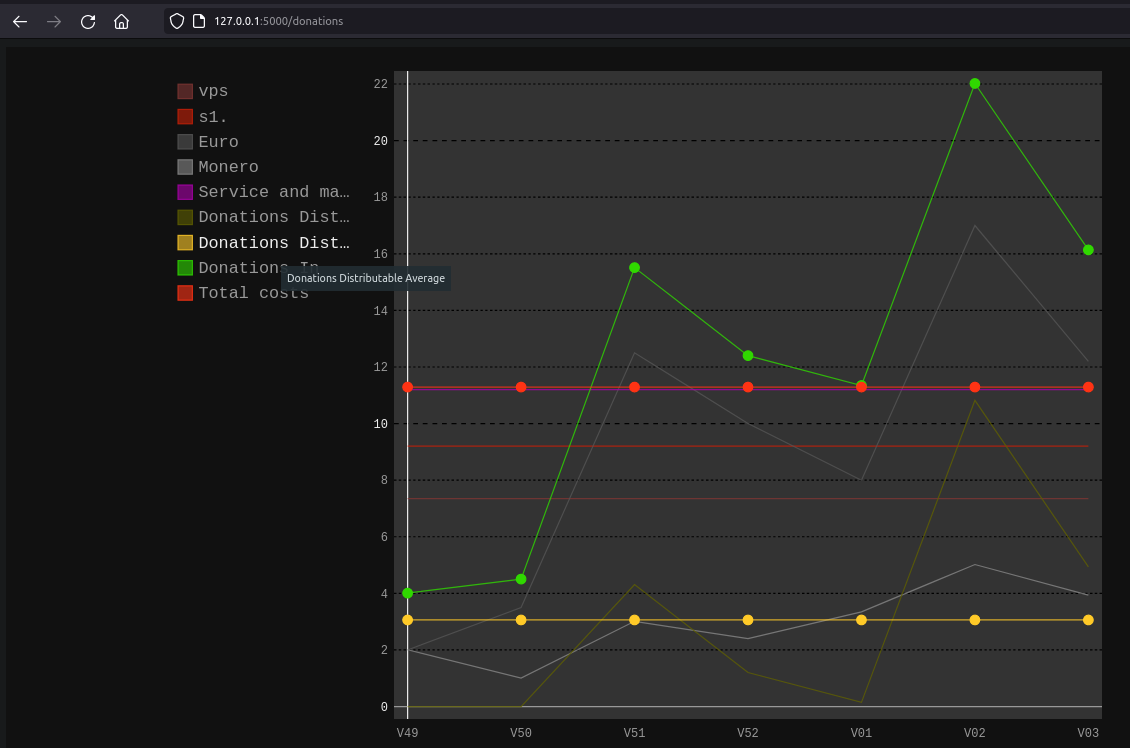 Example chart using random test data, showing costs, income, excess (weekly base)
- vps = The PeerTube instance
- s1. = First S3 storage tier (blocks of like 500GB)
- Euro = Donation in euro's
- Monero = Donations XMR in Euro
- Service and maintenance = Margin uncovered costs and little growth
- Donations distributeble = Excess of donations
- Donations distributeble Average = Average amount of income to redistribute internally (federations/local channels)
- Donations in = Sum of all donation channels
- Total cost = Cost of active elements (like the S3 storage 'S1.')
Where you could ask the question, distribute equal or define a tunable formula based on instance storage size likes/dislikes of it's content + views(be aware of bots :p), same for content creators (ratio posts likes/dislikes and views).
But that made me think about what happens if I have tiered up storage/serving capacity but income decreases, could I scale down S3 storage for example? And how can I scale down to a bare minimum instance worse case, without pulling the plug and rebuild later?
Some scenario thoughts for an organic instance: first compromise: When using a roughly 50% redundancy / 50% local user storage balance. If storage shortage, simply drop some of the redundancy(ring some notifying bells and whistles on the instance), this acting as buffer to keep the instance active for user activity without expanding(adding extra costs).
If operation cost are not covered for an amount of time(and storage was at it's limit), tier storage down(but just moving the files breaks the instance/although empty dummy files are somewhat ok for runtime to start, still breaking the video and generating errors).
This require peertube to be able to archive "mode" videos(move them(+symlink(might be broken if moved offline)) on to some /archive directory, this could be towards cheap storage/cold storage or whatever method(IPFS would leave the public a final decision to sign content off) preferred to be able to scale down storage costs), prioritized by unmirrored, least playbacks and oldest video's fist. With this, present the videos as being archived. and maybe present a single placeholder video asking for donation support to bring content back up available(could be automated/manual on daily/monthly interval whatever meets the instance owner possibilities). While other instances; if holding a copy of the content, could still provide playback.
Result if things go bad everywhere? all historical content would be unavailable(being degraded to on request/investment threshold) being archived waiting for donations, only the most recent/trending video's would be very well cost effective distributed available. maybe in/exportable video's (file + $filename_sqlite.db)?
Would be a thing long term, if subcultures create charities funding to preserve historical content from instances who offer their archive to be restored.
Please break down this thought of concept in order to improve.

I think you're suggesting to monetize based on donations to groups of instance owners instead of each instance owner directly. That way instances can group together and donations to all instances can be pooled and it should be easier to cover the costs together and compensate content creators on those instances as well. But like you said near the end, this would indeed be quite similar to "charity" organizations (or perhaps more like non-profit foundations). In order to do this well, it requires quite a lot of overhead, especially since it concerns money. There need to be safeguards in place to ensure that the money is actually going where you're saying it should go. Since this is entirely outside of Peertube, it is actually already possible. But I think that these problems simply make it infeasible, at least on a larger scale.
I think the more scalable approach for donations is to just have people donate directly to the people they want to give the money to. The less people/organizations in between them, the better. And even for that, you already have organizations in between, like Liberapay, Patreon, PayPal, etc. for donations and Coil for streaming micropayments. But these organizations are large enough that they can justify the overhead needed to put the necessary safeguards in place to show their trustworthiness.
Of course, this should not discourage any content creators or instance owners that do get donations directly to share those donations with others that have helped them. I think this is a good thing and suits the idea of the kind of communities we want around Peertube. The only difference is that you're not promising this to the people that donate to you. The people donate to you and leave you free to use that donations as needed. Which includes giving it to someone else. This is perfectly acceptable. But if you promise the people that donate to you that you will give it to someone else and you end up not doing it (for whatever reason), this is entirely unacceptable. This will break the trust that those people have in you. This is the difference between these 2 approaches (in my opinion), even though they seem very similar.
Your idea about the storage does seem interesting. It's not really about monetization but about cost reduction. Since storage costs money, you may end up needing to reduce the amount of storage you use if you cannot purchase more storage. Changing your redundancy level seems interesting but risky. Since this is likely entirely outside of Peertube, you could just do this already, assuming your storage provider/system allows for this.
The other suggestion, about "archiving" videos, does seem more like something that could be within Peertube. Though I feel like having videos "archived" and only accessible behind a donation link (or accessible after a certain amount of donations is reached) would go against the ideology of Peertube (though I may not be the right person to say that, as I'm not involved with the Peertube project). So it seems unlikely that such functionality would be built into Peertube. Though perhaps this is something that could be implemented as a plugin.
It may be more suitable to reduce the video quality instead of "archiving" the video entirely. Peertube will already create separate files for each level of quality you want, when uploading it. So for videos that are old or are not viewed often, you could delete the higher quality ones. So you could first delete the 4K version, then the 1080p version, and in the end maybe just leave the 480p version. You could already do this right now (I think, I'm not sure how Peertube reacts to files being deleted in the filesystem). And for these videos, you could add a note to the video description that the higher quality versions will be made available when sufficient funds are available for the additional storage that is required. This should all be possible already, though it is all manual work. If this ends up being useful for reducing costs, perhaps some functionality can be built into Peertube to automate some of this work. I can imagine that it wouldn't be that hard to remove the highest quality version of the oldest/least-viewed videos (leaving at least 1 version of each video) until enough storage space is freed. And optionally adding the donation-text to those videos should also be feasible. Assuming that you back up your Peertube data or the original videos that were uploaded, you should be able to add the higher quality videos back again when you have sufficient space for it.
@peertubehubgit I'm not sure I understood everything correctly so feel free to correct me if I'm wrong. I think your perspective as an instance owner is really useful to this discussion. And I think the graph you showed could also provide interesting insights. Unfortunately, I don't quite understand what it means. Could you perhaps elaborate on that?
PS: Back to walls-of-text :smile:
Yes, the idea is that federated instances and local content providers support each other at least semi-automated when they peek income(since they rely on each other already), this while each has their own balance. The example of Libberapay(teams) would give such insight of income, and lists who is in to receive if any excess(the overall wealth of the instance, but I think for most being able to just covering monthly operation cost would be a great achievement already).
Giving some simple insights may stimulate the donate action.(as in my favorite channel/(content creator) could use some(to achieve it's goal for new gear, this instead of some storage tier) or It seems better now to support the instance). So being open about it would be important for the trust and would be motivational for donating.
-If people donate to the instance owner, the creators and other federated instances get a little extra if any excess(unless there are some major donations then everybody gets a quite noticeable amount) -If people donate to the channels/creators, the instances get a little extra if any excess(unless there are some major donations then everybody gets a quite noticeable amount) Users to decide, either way supporting both. intended to be non-profit.
I agree with you on the serving lower quality only, archiving higher quality, much more playback/availability friendly, if PeerTube can deal with this(I assume flooding logs, and spit errors)
Have to mention relying on views only might be a soil for click bate trash content.
*added some info to the chart concept image.
@peertubehubgit Did you see my proposal earlier in this discussion for a Flattr-like service that is designed to work with PeerTube and where content hosts take a cut of donations? I would suggest it'd solve all the problems you outlined in an elegant way.
As a brief recap of what Flattr is (bear in mind I'm not suggesting using Flattr but instead a new service that works similarly):
https://en.m.wikipedia.org/wiki/Flattr
Basically users pay a fixed amount per month, based on what they can afford, into their account, and based on which content they consume in that month, the money is split. With PeerTube you could base it on time spent watching videos. So for example, if a user paid $5 into their account, and watched 1000 minutes of video in that month, each minute would be worth 0.5 cents. The income from all user activity would be paid out at the end of the month. The difference in what I'm proposing is that content hosts (and potentially PeerTube developers) would also see a cut of this money.
@arucard21
Keep in mind that this is not a subscription, the streaming micropayments are intended as donation. So what is considered "fair" is slightly different. There should be no expectation that you're paying some predetermined amount for the content you're consuming.
Thanks for the reminder, this indeed makes a difference. With this, I think some more of my following comments in my previous message don't apply either, because I was thinking in subscriptions when I was writing them.
The other suggestion, about "archiving" videos, does seem more like something that could be within Peertube. Though I feel like having videos "archived" and only accessible behind a donation link (or accessible after a certain amount of donations is reached) would go against the ideology of Peertube (though I may not be the right person to say that, as I'm not involved with the Peertube project). So it seems unlikely that such functionality would be built into Peertube. Though perhaps this is something that could be implemented as a plugin.
I think PeerTube itself might be able to assist a little, with having a concept of archived content,
- which is either on medium that is much slower to access, so the viewers needs to "stand in a queue" if they want to watch the video
- or is not available on demand, and the instance owner can bring back some of them on request in few days or weeks intervals.
Some details, collapsed because off topic here
The difference is that in the first case the the viewer can expect that when their time comes their video will be accessible, but in the second one retrieving the video requires manual intervention, and the user is told to come back later, maybe ask if they want to get notified. In both cases there could be a queue, which at least in the first case is visible to the user and where they stand in it. In the first case, there could be a dynamic archive cache, that caches retrieved videos until some time or until they are evicted because the space is needed for other retrieved videos, **but** it might also be possible to serve the fragments of the video right to the viewer and not cache, if that's not possible for some reason. In the second case, a "cache" is natural, because it cannot be counted on when will the video be available.Also, it could possibly automatically sign video files before moivng them to the archive, to check if they have degraded or have been tampered with. And if integrity is checked, and we are talking about a distributed video service, it might also be useful to make it possible that if the instance really cannot store some videos right now, they could outsource archiving to the audience, and then the archive could be reimported later. This could work in some communitities.
So for videos that are old or are not viewed often, you could delete the higher quality ones.
I think this could be an instance-policy setting, maybe along with a channel-policy setting which could only define a more strict policy. Whether it's preferred to start with removing the high quality, or the low qualitiy versions. Or rather, which quality is the most important to preserve. This could be useful to do this way because the goal could change based on the circumstances:
- deleting the highest quality versions means you get a lot of free space, but information is lost
- deleting everything but the highest quality version means you still get a lot of free space, but not that much, but at least no information is actually lost.
- deleting everything but FullHD versions, because your instance considerered that lower versions can be reencoded again if needed, and higher versions are not used by the audience
Then this could be further fine grained, with only deleting any versions of videos that is not regularly watched, that is x days old, for channels who didn't pay additional maintenance costs for storing videos in 8k resolution, etc.
@ZenoArrow
Basically users pay a fixed amount per month, based on what they can afford, into their account, and based on which content they consume in that month, the money is split. With PeerTube you could base it on time spent watching videos. So for example, if a user paid $5 into their account, and watched 1000 minutes of video in that month, each minute would be worth 0.5 cents.
To me this seems similar to streaming micropayments and Coil. Is there a difference to it?
@ZenoArrow
Basically users pay a fixed amount per month, based on what they can afford, into their account, and based on which content they consume in that month, the money is split. With PeerTube you could base it on time spent watching videos. So for example, if a user paid $5 into their account, and watched 1000 minutes of video in that month, each minute would be worth 0.5 cents.
To me this seems similar to streaming micropayments and Coil. Is there a difference to it?
Coil and Flattr are similar, but there is a difference in what I'm proposing, and that comes in the form of income sharing.
Correct me if I'm wrong, but it doesn't seem like Coil or Flattr allow payments to be split between content creators and content hosts.
Coil and Flattr work fine when the website is the content, or when the platform is being bankrolled by other forms of income (such as advertising money for YouTube), but without the ability to split payments, I don't see it working well for PeerTube.
It's worth keeping in mind why platform scaling matters. If you don't support the platform hosts financially, a PeerTube instance cannot grow to the scale where it makes it attractive enough to content creators to use it as a source of income (cannot unless the host has money to burn). They may choose to support a platform out of principal, but it's clear that balancing the needs of content creators and content hosts is likely to lead to a much healthier platform overall.
Third-party solutions like Coil are unlikely to be a good enough fit for PeerTube to support that growth, but if I've misunderstood what payment options Coil offers feel free to correct me.
To me this seems similar to streaming micropayments and Coil. Is there a difference to it?
I initially thought the same and Flattr does seem very similar. But the suggestion from @ZenoArrow is different in that it focuses on revenue sharing. This is how I understand these options (hopefully this will make it clearer to others as well)
All options would require the user to pay a monthly fee.
- Coil: The monthly fee is $5 (no more, no less). When you watch videos, Coil directly pays the content creator (or whoever is configured as recipient for web monetization) at a fixed rate. If you've used $4.50, that fixed rate gets lowered further and further to make it last until the next month.
- Flattr: The monthly fee is up to the user (minimum $3). When you watch videos, Flattr keeps track of which ones you watched. At the end of the month, Flattr pays out proportionally to what you watched to the site where you watched it.
- Flattr-like alternative by @ZenoArrow: The monthly fee is up to the user. When you watch videos, this Flattr-like alternative would keep track of which ones you watched, like Flattr. At the end of the month, it would pay out proportionally to what you watched to the site where you watched it, but also sharing that payout across the stakeholders on that site (which would be the instance owner and content creators, possible also the Peertube project). Presumably, the payout ratios would be configured in this alternative system, possibly retrieved from Peertube.
Correct me if I'm wrong, but it doesn't seem like Coil or Flattr allow payments to be split between content creators and content hosts.
Coil (or to be more specific, the web monetization standard) does allow for this, or at least something very similar. I described this in an earlier comment, it is called probabilistic revenue sharing. The idea is almost the same as @ZenoArrow, I think the most notable difference is that the payout ratios would have to be configured within Peertube. The "probabilistic" part of the revenue sharing is not exactly according to the payout ratio, though on average it should. This is necessary due to the fact that none of the usage is tracked, which is good for privacy, but means that you cannot pay the exact ratio of that monthly fee to the recipients. (More details about this in my earlier comment)
It's worth keeping in mind why platform scaling matters. If you don't support the platform hosts financially, a PeerTube instance cannot grow to the scale where it makes it attractive enough to content creators to use it as a source of income (cannot unless the host has money to burn).
I agree with this and this is why revenue sharing would be very useful. But I also think that it can make sense to focus on content creators with the understanding that the content creators will then support the platform, the Peertube instance owners. Of course, that would only happen if the content creators can earn enough. And the other way around could also work, if instance owners earn enough. So some combination of having direct donations (streaming or direct) and revenue sharing would be necessary. Which means that Peertube should support many of these revenue streams and the instance owners and content creators can pick and choose what works best for them.
When I look at PeerTube monetization in the context of the problem we are actually trying to solve - make PeerTube competitive against YouTube - I see the following major points to address:
- Users need good experience with content consumption, including good quality moderation and recommendations.
- Creators want visibility and money.
- Instance owners need sustainable scalability, moderation and an option to make some profit to empower the service.
Please take a look and challenge my design that provides solutions to these major tasks:
Micro-donations are triggered with a thumb-up like button. Transactions are stored on a public decentralized ledger, free, anonymous, non-profit, commission-less. No cryptocurrency: I send a regular donation with, say, PayPal to one of my favorite trusted bloggers in any currency, the amount is deposited on my donation account that I can use to spread anonymous one-click micro-donations (even $0.01) to the rest of the world. Micro-donations create recommendation value for users, accumulate to support creators, increase their visibility. Instance owners can specify a sharing model they prefer: "5% cut", "10% cut but not more than $1K a month in total" or any other they consider to be fair and competitive. Efficient moderation can hardly be achieved with instance owners doing it on their own. The current PeerTube design leads to segmentation, federation of islands. Micro-donations enable decentralized crowdsourced moderation that creates a competitive moderation market to let users choose moderation policies. Moving from instance-centric to user-centric, breaking down the platform walls...
An interesting (ethical) question with this approach is what to do when the instance owner has their web monetization set up but the content creator has not.
A key question @arucard21, indeed. I suggest the following approach to this chicken-and-egg problem: Users don't have to wait for creators, platforms or instances to join. They just send their likes/micro-donations that are accumulated based on URL and wait for a few weeks(months?) until creators join. If the latter don't care, the money is distributed among all registered creators which makes perfect sense since these micro-donations create recommendation value for other users, help build charts and feeds, incentivize creators and instance owners.
Links: read more, try, check the PeerTube integration prototype.
Please break down this thought of concept in order to improve.
I think it's fair to say at this point that donations (streaming and like-based microdonations, one-time or periodic donations) are the most likely revenue stream that Peertube would have to deal with. Other revenue streams (like sponsors and merchandising) can be just as important to the content creators and instance owners (or even more important) but those can be implemented without much help from Peertube itself.
Focusing on the donation aspect, I think it's clear that there are many options. I think it makes sense to support many different options, which seems most suitable as plugins. Some donation options may require some changes to Peertube itself to allow such plugins to behave the way we want them to. Like providing a consistent way to configure donations in Peertube or show donation links. But I would hope that such changes in Peertube would then apply to multiple donation plugins so they can be configured and shown in a consistent way and it has a good user experience for everyone involved.
Another important part of donations is revenue sharing. I think that donations would be heavily biased towards content creators, since they are the most visible to the viewers (who are the ones that donate). So I think that revenue sharing might work best if you take an "upstreaming" approach. I think the stream looks like this:
Peertube project ---> instance owner ---> content creator ---> content consumer (viewer)
So the donations would primarily be made by the viewer to the content creator. But the content creator can automatically "upstream" part of that to the instance owner or Peertube directly, who can in turn "upstream" part of it to Peertube. Of course, the viewer can still donate directly to the instance owner or Peertube as well, though that would not automatically flow downstream anymore. That can still be done manually though. The idea is that this simplifies the automated sharing of donations for the most likely type of donations (which is my assumption, might not be true) but doesn't exclude other possibilities for revenue sharing. It also ensures that nobody ever has any money that should not belong to them. So configuring whether or not to upstream part of it, and how much, is entirely up to them as it is their money. If you also have to downstream the donations, you need to start tracking who should get how much which can quickly get very complicated.
This article from a company trying to look for ethical ways to advertise their products reminded me that advertising is not inherently unethical, and they are even necessary for most companies to be successful.
Fundamentally, it is just a way for companies to make people aware of the products that they sell so they can buy them, if they want to. With the internet, this could be optimized to only show a product advertisement to people that are likely to buy it. This becomes unethical because of the vast amounts of personal data that is gathered to figure out which people are likely to buy what product. Unfortunately, this approach is highly effective so there is no commercial incentive to move away from this. But there is an ethical incentive to move away from this.
So if we can just remove this unethical optimization, we can have ethical advertising. However, if a company has the option of putting their money into highly-effective advertising or ineffective advertising, most will choose the former. Only companies that specifically look for ethical, privacy-respecting options for advertising will choose the latter. And perhaps it's okay for PeerTube to only focus on providing advertising options for those companies.
One interesting aspect about PeerTube, and any other services in the fediverse, is that it consists of instances that are usually focused on specific interests. This also allows advertisements to be slightly optimized by only showing advertisements relevant to those interests, assuming the advertisements can be classified as such. This is also what @mpeter50 described in his previous reply to the advertising revenue stream. You could even leave it to the advertising company to choose which interests they want to target (to the extent that's possible).
In the article, they mention that they want to create a template for ethical marketing. Perhaps people from PeerTube can collaborate on that. I think there would need to be some focus on ensuring that if you do show an ad in PeerTube, it does not become annoying. People with ad-blockers should probably still be able to block them, and they can choose to disable their ad-blocker on that PeerTube instance. And you don't want to make it possible to spam the user with ads. But if you have some specific location on the page for 1 ad that is defined in the PeerTube software, with predefined size, that could be acceptable.
I have no idea how to get those advertisements though. Perhaps there is already an ethical ad provider that can be used. If not, this may become a problem as this is not really something that PeerTube should be doing. But maybe others have some ideas about this.
Now that I've explained how I think advertising can be done ethically, I would also like to explain why I think it is actually necessary for PeerTube, and for content creators in general.
To see this, it's useful to look at when a content creator is actually able to make use of the revenue streams I listed earlier.
- Sponsors, Affiliates, Merchandising, Donations, Streaming micropayments
- Each of these require the content creator to already have a reasonable amount of followers and/or reputation. Sponsors and affiliates are unlikely to work with someone who just created their first video. And people are unlikely to buy merchandise from them or donate to them, simply because they are not yet familiar enough with them.
- Streaming micropayments makes it slightly more likely that people will donate to new content creators since anyone that has set this up for the larger content creators would automatically be streaming payments to the smaller content creators as well. But this is still a fairly new concept and not many people are likely to have this set up at all.
- Advertising
- This is the only revenue stream that can provide revenue to new content creators. If a PeerTube instance has ads enabled, all creators on that instance can share that revenue. This allows new content creators to benefit from this ad revenue while they are still growing and increasing their amount of followers, in order to be able to incorporate other revenue streams.
- Revenue sharing becomes a tricky business here though. Because essentially, all money goes to the instance owner since they are the one hosting the site and including the ads. So the content creator would rely on the instance owner to share that revenue ethically. I don't see any easy way to guarantee this from within PeerTube, as it essentially requires a way to access the payment system (which seems overkill for PeerTube). I also think that this may not be necessary since the instance owner likely also benefits from the content creators on their instance, providing more viewers and generating more ad revenue. This is something where it's beneficial to have the PeerTube instance remain small since that allows the relations between an instance owner and the content creators to be much closer. There were also already some suggestions done on some payment systems that allow revenue sharing to be configured within them. So you could also leave the trust aspect to those payment systems that are likely more suitable for it. But we should be aware of the potential for abuse here.
- The revenue sharing problem actually also applies to donations given to the instance, if the instance wishes to share those donations. This shows that donations to the instance can also help smaller content creators. The difference is that with donations, the money comes from the viewer and is entirely voluntary without them getting anything in return. But with advertising, the money comes from a company and it is payment for showing the ad. So advertising could provide more revenue, and more consistent revenue, since there is a commercial incentive (though only for companies specifically looking for ethical advertising options).
- Data monetization
- This should just be avoided entirely. I only mention it here for the sake of completeness.
I think advertising can be used to fill the gap for new content creators, allowing them to grow enough to be able to incorporate other revenue streams (like merchandising and sponsors). I think this is also how it works on other, proprietary platforms and I think this is crucial in allowing content creators to become more prominent with PeerTube as platform. If you want to truly become an alternative to those existing, proprietary platforms, I think the PeerTube would need to allow content creators to be commercially successful. But I am not a content creator so it would probably be good for PeerTube to try and collaborate with new and established content creators (probably in the FOSS space) to see whether any of this is actually useful to them.
I have no idea how to get those advertisements though. Perhaps there is already an ethical ad provider that can be used. If not, this may become a problem as this is not really something that PeerTube should be doing. But maybe others have some ideas about this.
A few years earlier I heard about Ethical Ads, they still exist, maybe it could be an option.
According to uMatrix their webpage is very promising considering its behavior (no cookies, no fetch requests, has analytics but with a known privacy focused provider).
Though, it looks like they are an IT-specific ad provider, so that may also limit its use.
Then while pretty controversial, maybe Brave ads could also be considered. But it's possible they only serve their ads in their browsers. In that case, it could be used as an example on how to do service specific adervtising, if we want to do that.
Also, maybe there are some more ad providers to consider in this list: https://trackingfreeads.eu/supporters/
An other option could be something that makes it easier for instance admins to place advertisements that is relevant for their community. I don't have much of an idea how ad providers get the ads, but if it's reasonable that instance admins could work with companies to obtain ads to display, that could work too. This would be useful if the supported ad providers don't have relevant ads, but the advertised company is willing to work with instance admins.
advertising is not inherently unethical, and they are even necessary for most companies to be successful.
This is a gross oversimplification that overlooks the myriad of downsides with advertising. Let's break this down step by step. Do you accept that online advertisers have gotten used to the ability to track the effectiveness of their ads, and that this is a core part of how online advertising works?
@mpeter50 I finally got a chance to look at those links. And EthicalAds does look promising. But its focus on developers as an audience means it probably isn't suited for being shown on PeerTube instances. I did like their policies, it seems a good starting point for anyone that wants to show ads ethically.
When you show an ad on your site:
- EthicalAds should be the only ad network on your site (your own promotions are fine)
- The ad should appear when the user first visits, above the fold, on both desktop and mobile.
- The ad should not disrupt the natural reading flow of the page. It should be placed above, beside or below the main content, not within it.
They also manually check how the ad looks on your site as part of their approval process. And you can only have a single ad on the page.
From the other link, I checked out some of their supporters. Most of them were not advertisers but just companies interested in privacy. I found 2 advertisers among them, https://optoutadvertising.com and https://kobler.no. These seem to focus on specific countries though. The former focuses on Netherlands, Belgium and Germany. The latter on Norway and Sweden.
With advertisers already focused on a specific group of people, perhaps we could make a plugin for advertising that allows you to select from them. So if your PeerTube instance is focused on developers, you could select EthicalAds, if it's in Germany, you select Opt Out Advertising instead. If you then get enough of these local but ethical advertisers in the list, we could have ads for any interest or region that PeerTube instances might cover.
@ZenoArrow I clearly do not accept that. And I elaborate on that right after the text that you quoted. This tracking is an optimization that makes online advertising unethical. But advertising by itself is not unethical. You can also check the links to these ethical ad providers. They explain this as well, and probably better than I can. It seems to also be described as behavioral marketing (with all the tracking) vs contextual marketing (without tracking), if that helps understand it better.
I clearly do not accept that. And I elaborate on that right after the text that you quoted. This tracking is an optimization that makes online advertising unethical. But advertising by itself is not unethical. You can also check the links to these ethical ad providers. They explain this as well, and probably better than I can. It seems to also be described as behavioral marketing (with all the tracking) vs contextual marketing (without tracking), if that helps understand it better.
@arucard21 Ethical marketing companies are like ethical slaughterhouses, they may be better than the competition but they're still in an industry of questionable ethics.
Consider how advertising works, and I mean how it really works rather than some idealised version. Advertising is more than just presenting you with information about new purchasing options, if that's all it was then I'd have less of a problem with it. Advertising also relies on emotional manipulation to try to get you to change what you value in order to create desire for a product.
Even if you think you're immune from the influence of advertisers it's clear that most people are not, and that the overall impact has been to drive us towards an hyper-capitalistic society that is currently set to severely damage the life-support systems of the planet.
Furthermore, in the case of "ethical" advertising, think about it from a company perspective. Why would a company looking to advertise their goods choose to do so on a federated platform like PeerTube that has far fewer users than YouTube and less ability to track the effectiveness of their ads? Very few companies would risk this, so what you're proposing is very unlikely to work financially, even if you don't have an issue with the ethical issues I hinted at.
I think I understand your point now. But from that perspective, isn't all communication essentially a type of manipulation? Everyone that has something to say presents it in the way that best serves their purpose. Even the PeerTube website could be considered emotionally manipulative from that perspective. It tries to convince you that you do not have control over your videos and that PeerTube is what you should use to gain back that control. Technically, the PeerTube website is also an advertisement. And I don't think there's anything wrong with that. How else would I learn about what PeerTube is and whether I actually want it.
So while I understand your point, I think it's a bit pessimistic (I mean no offense by this). But you're probably not alone in this. That's why I think that people should be able easily opt-out of these ads. So even if an instance owner enables ads, your existing adblocker should just be able to block it easily. I think that should cover most people that share your perspective since I can't imagine that they would not have an adblocker. :smile:
I think your analogy with ethical slaughterhouses is quite appropriate. I assume you meant that you consider slaughterhouses themselves unethical so you shouldn't eat meat. But I think that for those that still like to eat meat, it's nice that there are ethical slaughterhouses to choose from :smile: I assume you meant the slaughterhouses for animals and not some kind of murder room for psycho killers. I really hope that wasn't something that got lost in translation, otherwise my reply might seem kinda crazy. :rofl:
As for why companies might want to advertise on PeerTube instances, I think that's because they could reach the kind of audience that would be hard to reach elsewhere. People that value their privacy and thus block ads and scripts and tracking almost everywhere. For some companies, for example a privacy-focused VPN provider, that might actually be quite appealing. But ultimately, it's not really like they choose to advertise on PeerTube. They will usually advertise through ad providers, of which PeerTube would only use ethical ones, and then they would be shown on instances that have it enabled. So the company doesn't really control where exactly they advertise, they just indicate what kind of audience they want to reach. But I'm not an expert on this, I just base this on what I read on the sites that were linked earlier.
Technically, the PeerTube website is also an advertisement. And I don't think there's anything wrong with that. How else would I learn about what PeerTube is and whether I actually want it.
But the PeerTube website is not shown on other webpages and at the beginning or middle of video content. It is not advertised, and I think that is more of an informational page. All the while advertisements appear on unrelated websites, at the beginning or in the middle of video content, and other places.
I also agree that there is (probably, and currently) no incentive for most companies to advertise for PeerTube. A few (1-2) years earlier Twitch very rarely had ads in my country. I think that changed by now, but not sure since my tracker blocker disables them. However your points about it are worth considering, maybe more privacy focused service providers/software developers/hardware manufacturers (?) start to appear in the future.
So the company doesn't really control where exactly they advertise, they just indicate what kind of audience they want to reach
How does the platform provide information about what kind of audience a video is associated with without tracking content creators and/or PeerTube users?
@ZenoArrow I think the type of audience can be identified through the PeerTube instance. Each instance should already indicate what they focus on, what kind of community it is. Since this is how users can find a suitable instance for themselves. So advertisers could then indicate that they want their ads to reach specific types of communities based on that same information.
I'm not sure if such information about interests and communities is currently provided in any suitable form for such an advertising platform to use. But the point is that such information is already made available in some form so it should not reduce the privacy of the users.
@mpeter50 I see the distinction you're making. Fair enough. And I'm also not sure if there's incentive for companies to advertise on PeerTube instances. But there's also currently no way to do so. So even if there is, we won't know. But I have no expertise in the field of advertising. So I'm just trying to make educated guesses, maybe I'm completely wrong :smile:
@arucard21
Each instance should already indicate what they focus on, what kind of community it is.
Should they? I don't think this is necessary. Even if we run with your assumption, let's say a PeerTube instance focuses on news, what advertisers would you expect this instance to attract?
Furthermore, PeerTube is proud of being ad-free, look at the description of the project on their GitHub homepage...
https://github.com/Chocobozzz/PeerTube
"Be part of a network of multiple small federated, interoperable video hosting providers. Follow video creators and create videos. No vendor lock-in. All on a platform that is community-owned and ad-free."
Have you thought about why being ad-free would be a selling point?
@arucard21 well, why do you want to reinvent the wheel? go to YT, they do exactly what you are expecting for.... the thing you must know is users and developers who are using PeerTube are especially the guys who are fed up of advertising cancer.... now if you really wish all what you ask, do it in plugin and create a PR.
I wasn't saying that we must have ads in PeerTube. I was just discussing it as one of many monetization options. To see if it can be done in an ethical and privacy-respecting way. And for all monetization options (not just advertising), it was already considered best if it were only implemented as plugins. I also don't like ads but when it comes to monetization options, it's one of very few options where the money comes from a third-party and not the viewers. So if there are better ways to support content creators without viewers having to pay for it directly, I'd love to hear it.
So if there are better ways to support content creators without viewers having to pay for it directly, I'd love to hear it
there is no solution to support content creators in a rigged system where the big corrputed corp have free money since 25 years breaking and killing the so called business competition. you can faint monetization by creating your own crypto, but again, doing that you play the game of the fully corrupted system where the bad guys control the money used by the everyday (ignorant) masses... welcome to the hard reality...
@arucard21
So if there are better ways to support content creators without viewers having to pay for it directly, I'd love to hear it.
This is the core of your stance, but you're missing the forest for the trees. Asking viewers to (voluntarily) pay for content is preferable to a system where advertisers get their claws into the platform. It doesn't matter how "ethical" the advertising is, the end result is still emotional manipulation of the user base. Looking for ways to get advertisers onto PeerTube is like saying "I don't mind if I'm lied to if you give me free stuff", it's an abusive relationship, and you should re-evaluate what damage it's causing to society at large.
Just throwing in some visual concept binding donations to storage, exposing the creator's quota to the viewer of the channel in which payment plugins? could API access/supply data for.
Instead of showing an ad, create confronting awareness based on storage being over threshold and/or underfunded per channel. This on the page where a video of the channel is shown.
Value's would include instance and creator individually configurable margins.
