

 BorisTheBrave
Added AdjacentModel.NormalizeWeights and made SetFrequency/MultiplyFrequency optionally aware of RotatedTile
When using the AdjacencyModel via AddSample I have found it very useful to be able to normalize the weights of each tile afterwards. I do not find the concept makes much sense in the OverlappingModel so I have not attempted to implement that.
Additionally, I found myself wanting to multiply the frequency of a tile and not have to manually specify every rotated/reflected variant of it, so I modified MultiplyFrequency in both models to support dereferencing a RotatedTile to it's base representation.

Thanks for this. The changes are a good idea, but I'm going to spend a bit of time reviewing. I'd like to find a more principled way of dealing with generated tiles, as right now it seems I have to make the entire code base aware of them, which is annoying.

Yea, the RotatedTile thing bit me a bit at first as I was using the API. I feed RotatedTiles directly into the AddSample calls since my input tilemaps are using rotation in many situations. I can see situations where I'd want to explicitly control the weights of a RotatedTile vs. its base Tile, but so far I've just needed the functionality in this PR.
Is it expected API usage to provide a RotatedTile to the AddSample API or is it a coincidence that it works currently?
Yes, it's deliberate that you can input RotatedTile. The Tiled importer makes use of it. Though I always expected it to be pretty obscure.
On reflection, the general pattern I've been following is:
MyFunction(foo); // Does something with foo, doesn't deal with rotations of foo
MyFunction(foo, tileRotations); // Does something with foo and all it's rotations.
That's how AddSample and AddAdjacencyPair work. I think I'll change Set/MultiplyFrequency to work the same way.
Can you explain what your intention is behind NormalizeWeights, I'm a bit unclear on the use case.
So in this example the collection of tiles in the bottom left are my "corpus". I use that tilemap to define adjacency pairs and valid placements.
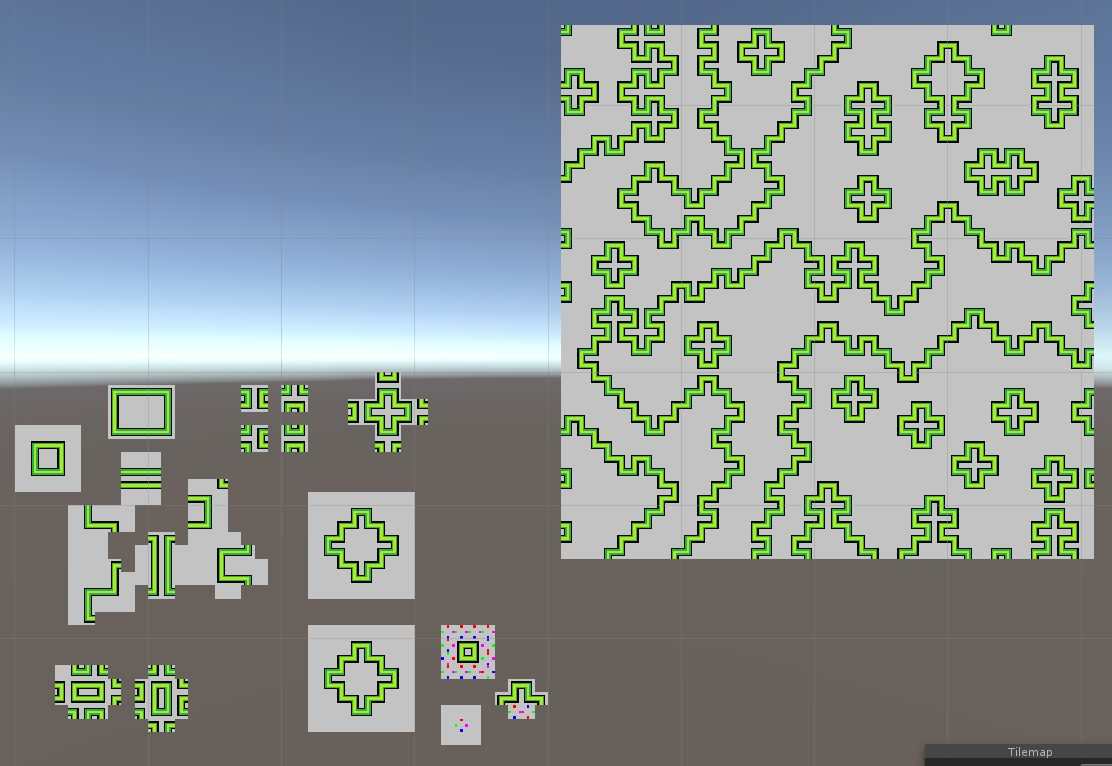
And in my TileGenerator class I use these corpora as input for my generation process:
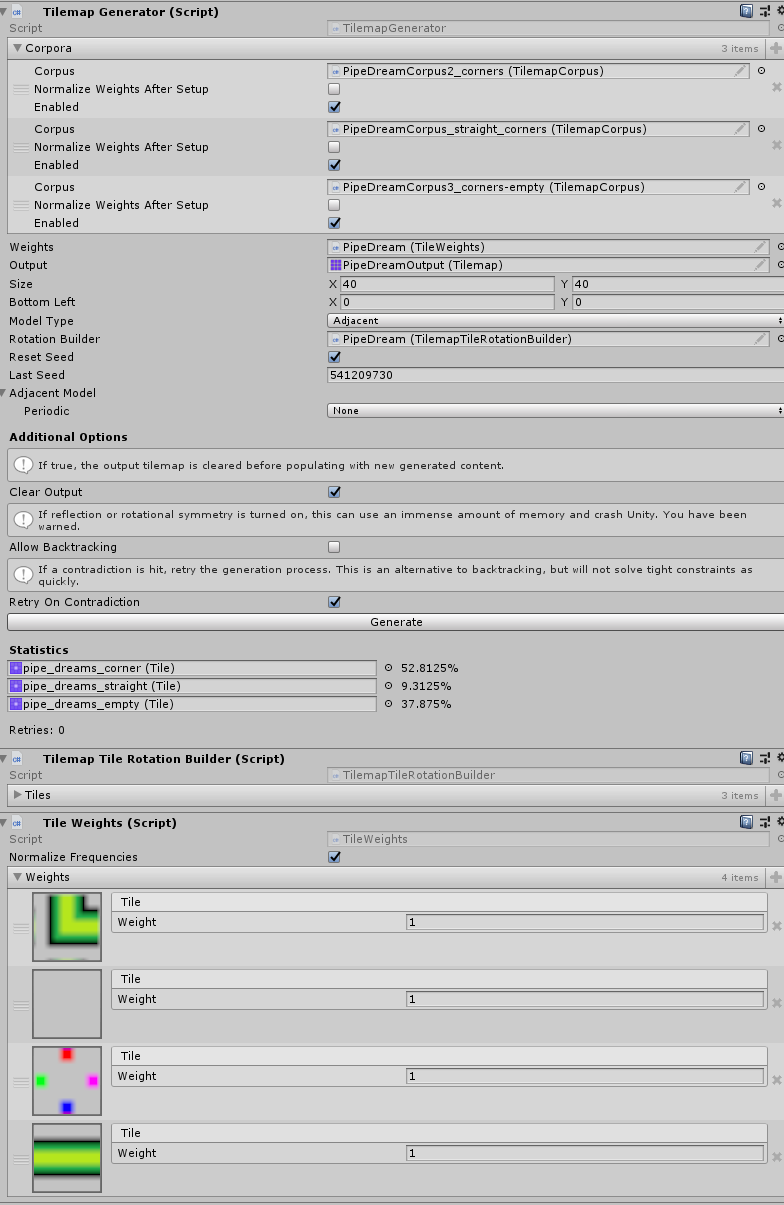
Without normalizing weights of each tile and its rotations, my output would be skewed towards the frequency of tiles in my input corpus, where instead I want to control frequencies of tiles independently of how they may be defined (via SetFrequency).
Ok, so if I've understood correctly:
NormalizeFrequencies(false) just sets every value in frequencies to 1 / n.
NormalizeFrequencies(true) sets the combined frequency tile and all it's rotations to 1 / n, spreading the frequency in proportion to their original frequencies?
NormalizeFrequencies(false), yes frequency[x] = x/n where n == totalFrequency.
For the NormalizeFrequency(true) case, the goal is the same but a tile and its rotations all "share" their chunk of x/n so that they are not over-represented in the final normalized frequencies.
Ok, I see. That makes sense, but I think I prefer to fold that sharing behaviour into a new overload of SetFrequency.
So if you did that the psuedocode equivalent for me would be (?):
foreach (tile) { model.SetFrequency(tile, 1, includeRotations:true); }
model.NormalizeWeights()
I was thinking that I'd set things up so that you don't need NormalizeWeights, as something like the following would be equivalent:
// NormalizeWeights(false)
for(var tile in model.Tiles)
  model.SetFrequency(tile, 1.0);
// NormalizeWeights(true)
for(var tile in model.Tiles)
  model.SetFrequency(tile, 1.0, tileRotation);
I.e. the idea is that passing a tileRotation argument means "be rotation aware".
Ah yea got it, the actual value of frequency doesn't matter as long as every tile has the same value. When I think "normalized" I am biased towards [0,1].
I've overhauled how rotations work a bit to standarize and hopefully simplify it. As part of that added overloads of SetFrequency and MultipleyFrequency which are "rotation aware", which I think is a useful generic operation.
You should now be able to get normalize frequencies behaviour as described in this comment.