
yolov5
 yolov5 copied to clipboard
 ultralytics
YOLOv5 (6.0/6.1) brief summary
Content
- 1. Model Structure
- 2. Data Augmentation
- 3. Training Strategies
- 4. Others
- 4.1 Compute Losses
- 4.2 Balance Losses
- 4.2 Eliminate Grid Sensitivity
- 4.3 Build Targets
1. Model Structure
YOLOv5 (v6.0/6.1) consists of:
- Backbone:
New CSP-Darknet53 - Neck:
SPPF,New CSP-PAN - Head:
YOLOv3 Head
Model structure (yolov5l.yaml):
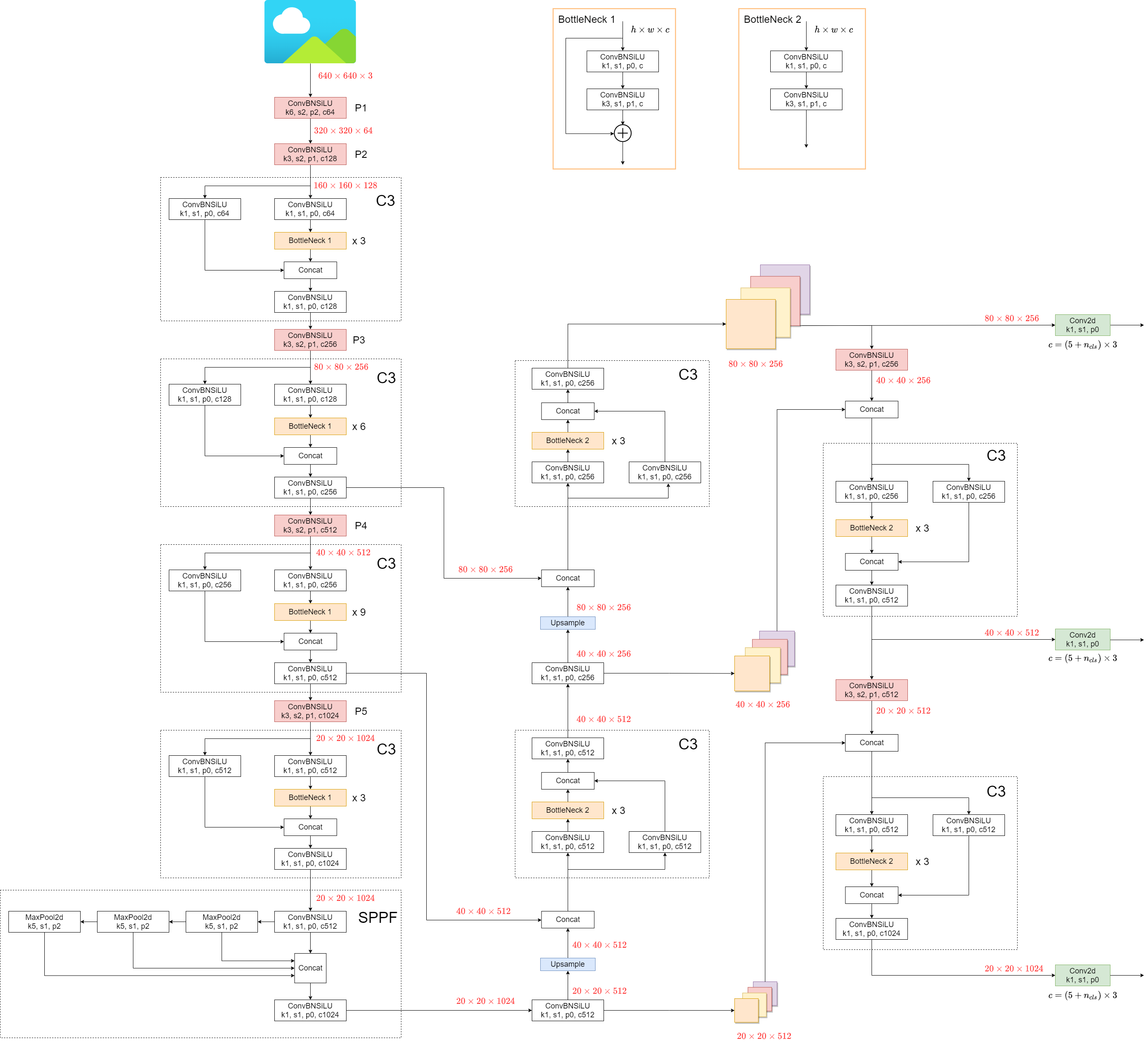
Some minor changes compared to previous versions:
- Replace the
Focusstructure with6x6 Conv2d(more efficient, refer #4825) - Replace the
SPPstructure withSPPF(more than double the speed)
test code
import time
import torch
import torch.nn as nn


class SPP(nn.Module):
    def __init__(self):
        super().__init__()
        self.maxpool1 = nn.MaxPool2d(5, 1, padding=2)
        self.maxpool2 = nn.MaxPool2d(9, 1, padding=4)
        self.maxpool3 = nn.MaxPool2d(13, 1, padding=6)

    def forward(self, x):
        o1 = self.maxpool1(x)
        o2 = self.maxpool2(x)
        o3 = self.maxpool3(x)
        return torch.cat([x, o1, o2, o3], dim=1)


class SPPF(nn.Module):
    def __init__(self):
        super().__init__()
        self.maxpool = nn.MaxPool2d(5, 1, padding=2)

    def forward(self, x):
        o1 = self.maxpool(x)
        o2 = self.maxpool(o1)
        o3 = self.maxpool(o2)
        return torch.cat([x, o1, o2, o3], dim=1)


def main():
    input_tensor = torch.rand(8, 32, 16, 16)
    spp = SPP()
    sppf = SPPF()
    output1 = spp(input_tensor)
    output2 = sppf(input_tensor)

    print(torch.equal(output1, output2))

    t_start = time.time()
    for _ in range(100):
        spp(input_tensor)
    print(f"spp time: {time.time() - t_start}")

    t_start = time.time()
    for _ in range(100):
        sppf(input_tensor)
    print(f"sppf time: {time.time() - t_start}")


if __name__ == '__main__':
    main()
result:
True
spp time: 0.5373051166534424
sppf time: 0.20780706405639648
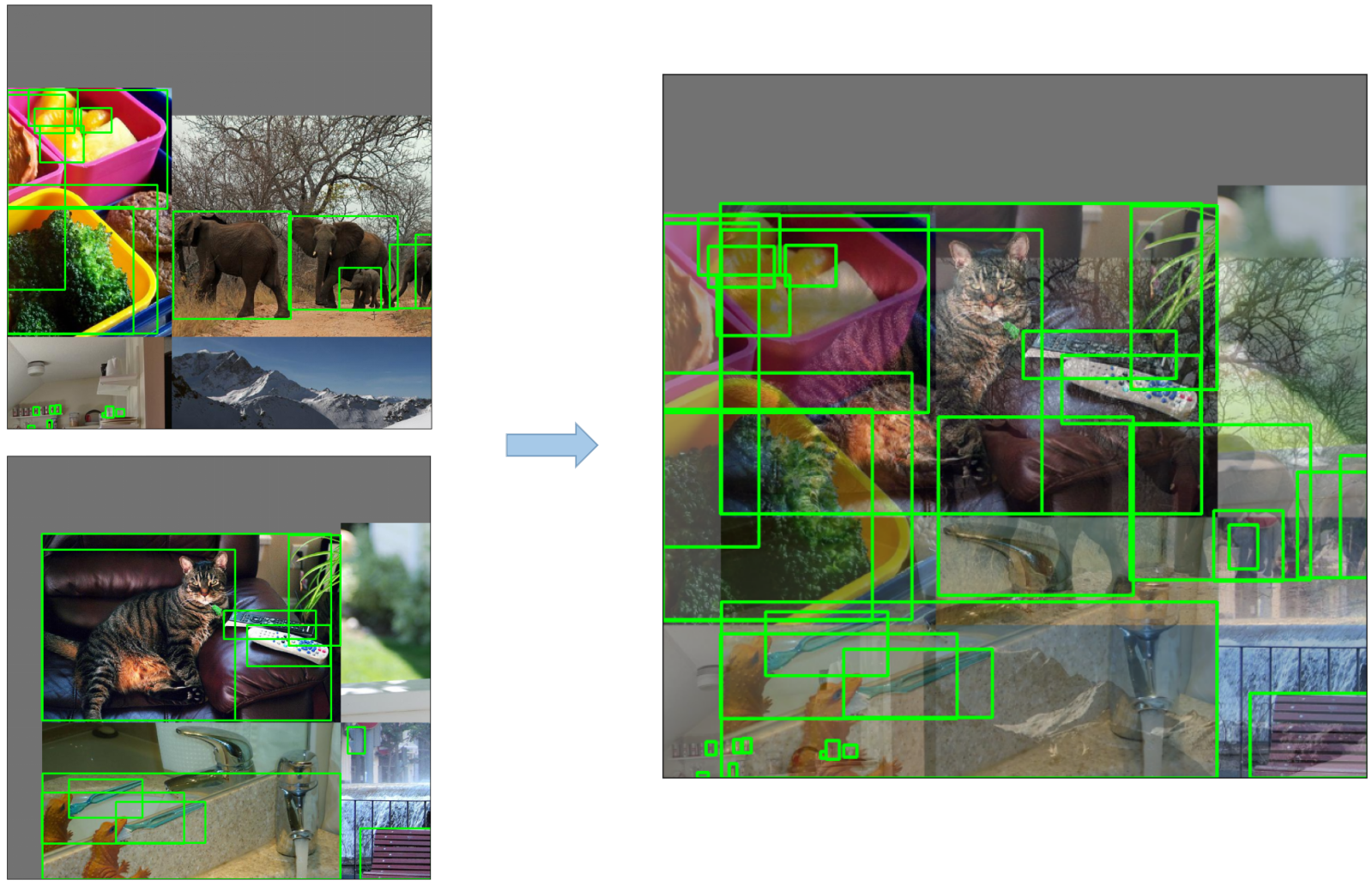
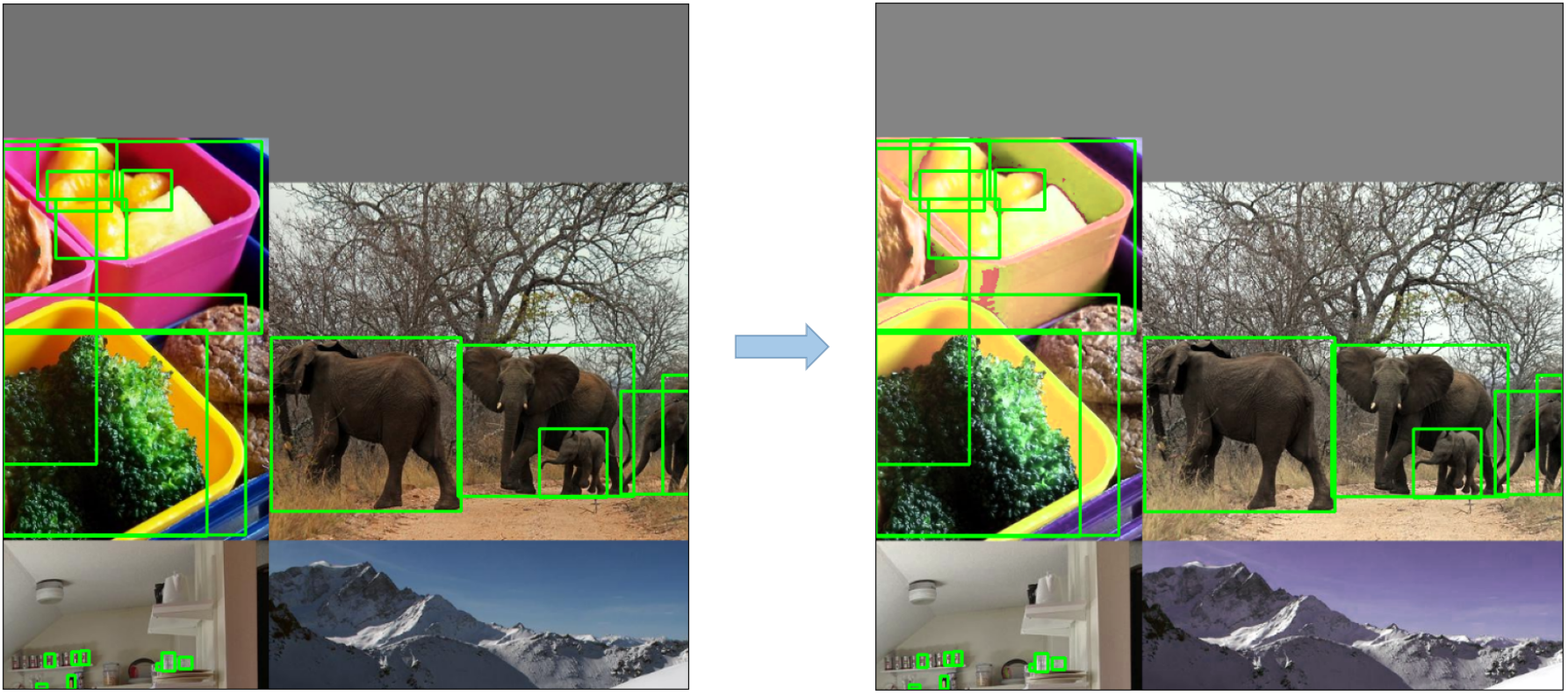
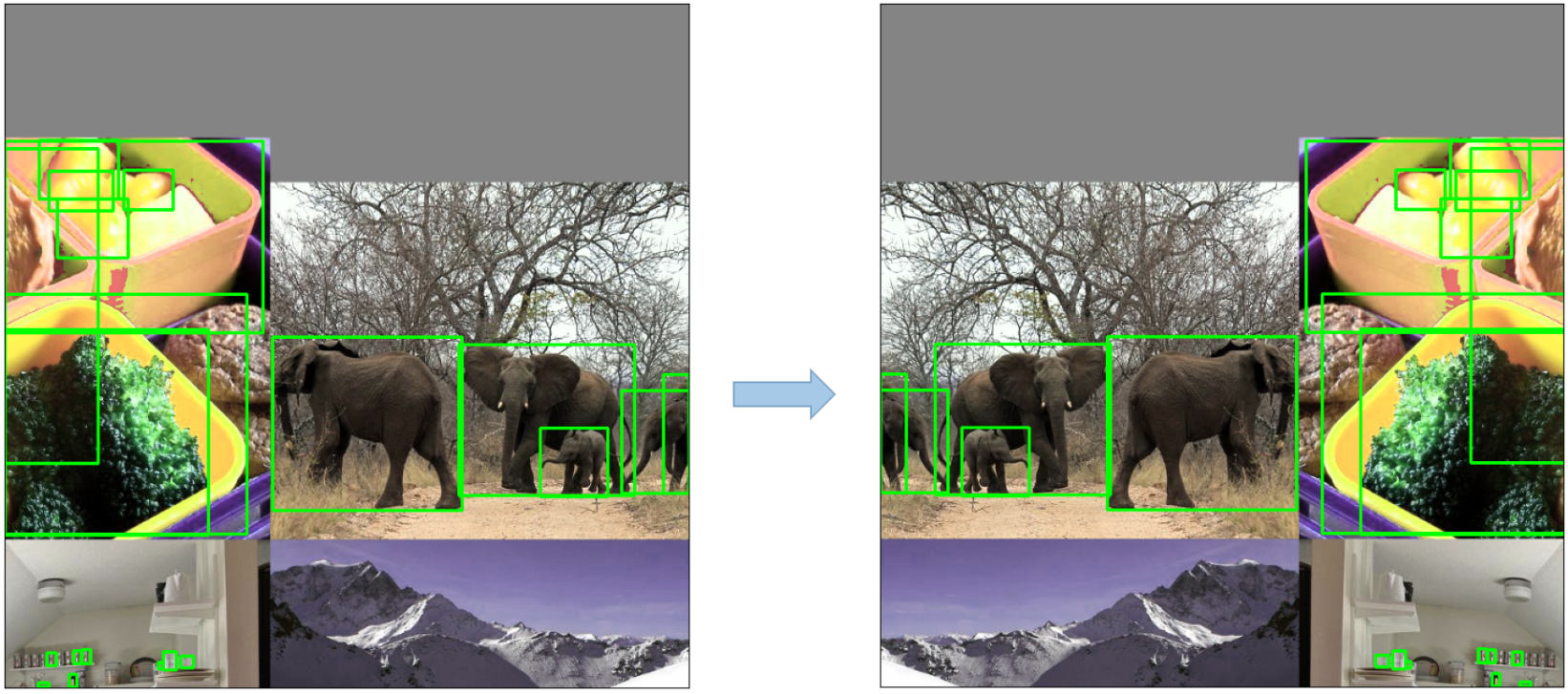
2. Data Augmentation
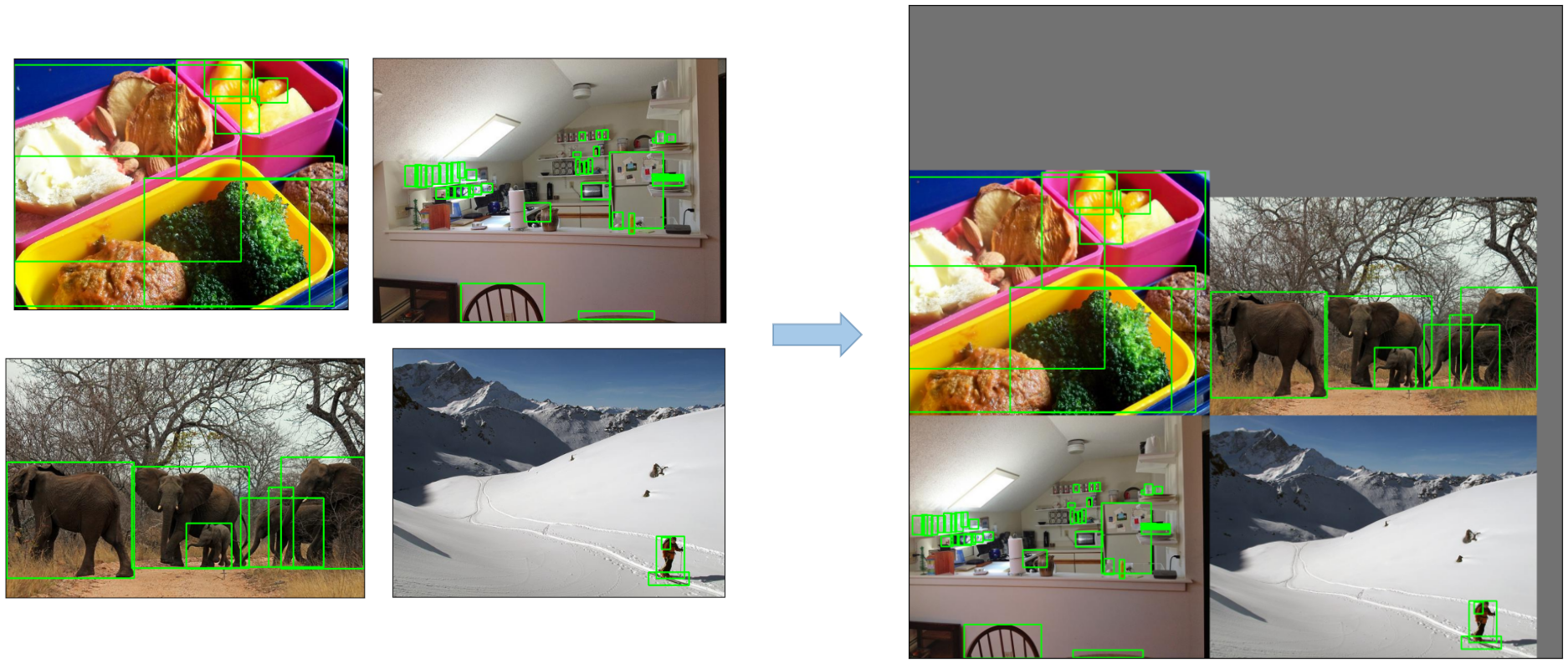
-
Mosaic
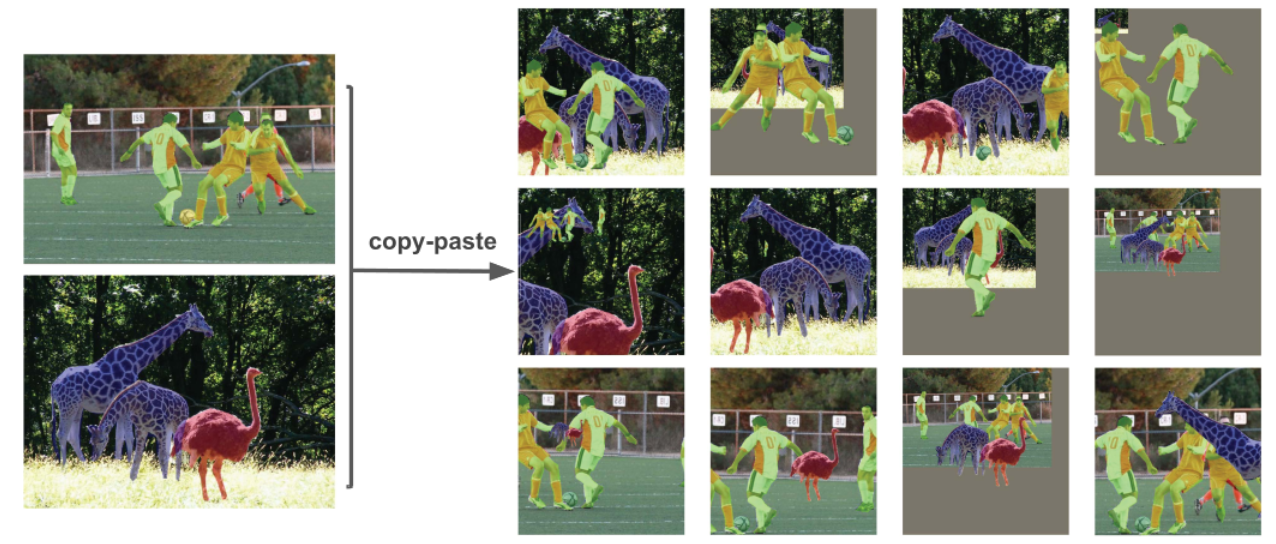
-
Copy paste
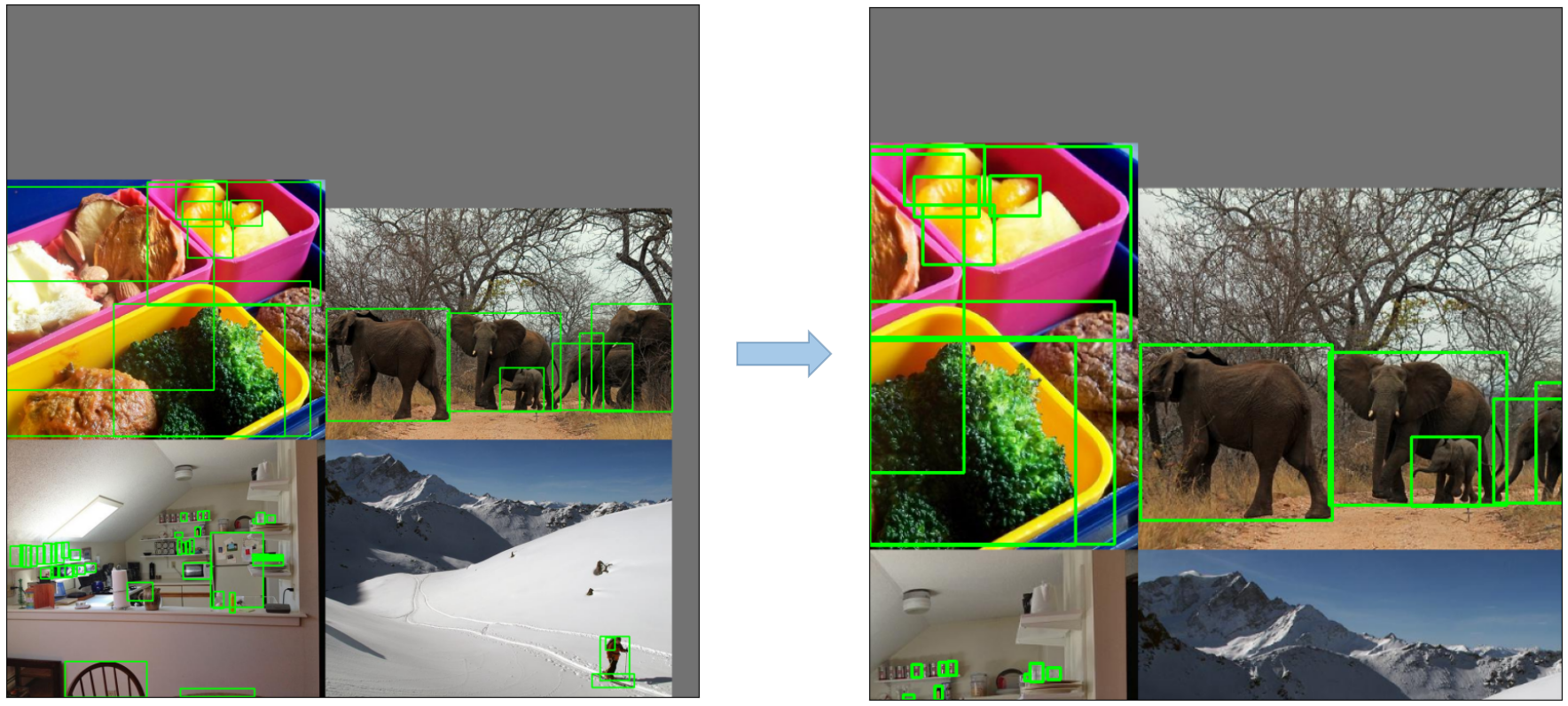
-
Random affine(Rotation, Scale, Translation and Shear)
-
MixUp
-
Albumentations
-
Augment HSV(Hue, Saturation, Value)
-
Random horizontal flip
3. Training Strategies
- Multi-scale training(0.5~1.5x)
- AutoAnchor(For training custom data)
- Warmup and Cosine LR scheduler
- EMA(Exponential Moving Average)
- Mixed precision
- Evolve hyper-parameters
4. Others
4.1 Compute Losses
The YOLOv5 loss consists of three parts:
- Classes loss(BCE loss)
- Objectness loss(BCE loss)
- Location loss(CIoU loss)
4.2 Balance Losses
The objectness losses of the three prediction layers(P3, P4, P5) are weighted differently. The balance weights are [4.0, 1.0, 0.4] respectively.
4.3 Eliminate Grid Sensitivity
In YOLOv2 and YOLOv3, the formula for calculating the predicted target information is:

In YOLOv5, the formula is:
Compare the center point offset before and after scaling. The center point offset range is adjusted from (0, 1) to (-0.5, 1.5). Therefore, offset can easily get 0 or 1.

Compare the height and width scaling ratio(relative to anchor) before and after adjustment. The original yolo/darknet box equations have a serious flaw. Width and Height are completely unbounded as they are simply out=exp(in), which is dangerous, as it can lead to runaway gradients, instabilities, NaN losses and ultimately a complete loss of training. refer this issue

4.4 Build Targets
Match positive samples:
- Calculate the aspect ratio of GT and Anchor Templates

-
Assign the successfully matched Anchor Templates to the corresponding cells

-
Because the center point offset range is adjusted from (0, 1) to (-0.5, 1.5). GT Box can be assigned to more anchors.

Environments
YOLOv5 may be run in any of the following up-to-date verified environments (with all dependencies including CUDA/CUDNN, Python and PyTorch preinstalled):
- Notebooks with free GPU:



- Google Cloud Deep Learning VM. See GCP Quickstart Guide
- Amazon Deep Learning AMI. See AWS Quickstart Guide
- Docker Image. See Docker Quickstart Guide

Status

If this badge is green, all YOLOv5 GitHub Actions Continuous Integration (CI) tests are currently passing. CI tests verify correct operation of YOLOv5 training, validation, inference, export and benchmarks on MacOS, Windows, and Ubuntu every 24 hours and on every commit.

@glenn-jocher hi, today I briefly summarized yolov5(v6.0). Please help to see if there are any problems or put forward better suggestions. Some schematic diagrams or contents will be added later. Thank you for your great work.
hi, 'prediction layers(P3, P4, P5) are weighted differently', how do I find it in the code, and further, modify it?

hi, 'prediction layers(P3, P4, P5) are weighted differently', how do I find it in the code, and further, modify it?
https://github.com/ultralytics/yolov5/blob/c09fb2aa95b6ca86c460aa106e2308805649feb9/utils/loss.py#L111 and
https://github.com/ultralytics/yolov5/blob/c09fb2aa95b6ca86c460aa106e2308805649feb9/utils/loss.py#L156
@WZMIAOMIAO awesome summary, nice work!
@zlj-ky yes the balancing parameters are there, we tuned these manually on COCO. The idea is to balance losses from each layer (just like we balance losses across loss components (box, obj, class)). The reason I didn't turn these into learnable weights is that as absolute values the gradient would always want to drag them to zero to minimize the loss. I suppose we could constantly normalize them so they all sum to 1 to avoid this effect. Might be an interesting experiment, and this might help the balancing adapt better to different datasets and image sizes etc.

@WZMIAOMIAO yes maybe it's a good idea to document this somewhere. Which document do you mean though?
@glenn-jocher I think it could be added to the Tutorials. What do you think?
@WZMIAOMIAO all done in #7146! Thank you for your contributions to YOLOv5 🚀 and Vision AI ⭐
@HERIUN built_targets() implements an anchor-label assignment strategy so we can calculate the losses between assigned anchor-label pairs.
@glenn-jocher what's the adjustment strategy for the balancing parameters?How to change them to learnable weights?
@WZMIAOMIAO awesome summary, nice work!
@zlj-ky yes the balancing parameters are there, we tuned these manually on COCO. The idea is to balance losses from each layer (just like we balance losses across loss components (box, obj, class)). The reason I didn't turn these into learnable weights is that as absolute values the gradient would always want to drag them to zero to minimize the loss. I suppose we could constantly normalize them so they all sum to 1 to avoid this effect. Might be an interesting experiment, and this might help the balancing adapt better to different datasets and image sizes etc.
@glenn-jocher what's the adjustment strategy for the balancing parameters?How to change them to learnable weights?

@xinxin342 the balance params are here, you'd have to convert them to nn.Parameter types assigned to an existing class and set their compute grad to True:
https://github.com/ultralytics/yolov5/blob/c9a3b14a749edf77e2faf7ad41f5cd779bd106fd/utils/loss.py#L112
@xinxin342 the balance params are here, you'd have to convert them to nn.Parameter types assigned to an existing class and set their compute grad to True:
https://github.com/ultralytics/yolov5/blob/c9a3b14a749edf77e2faf7ad41f5cd779bd106fd/utils/loss.py#L112
@glenn-jocher
I try to convert the weight to a learnable parameter like this(Limited by my limited experience)
 However, this parameter was not updated during training, I don't know why or how to revise my method. Can you teach me, even though it's a very simple question
@zlj-ky that seems like a good approach, but you might need to place self.w inside the model so it's affected by model.train(), model.eval(), etc. You can just place it inside models.yolo.Detect and then access it like this. (Note your code is out of date):
class ComputeLoss:
    sort_obj_iou = False

    def __init__(self, model, autobalance=False):
        device = next(model.parameters()).device  # get model device
        h = model.hyp  # hyperparameters

        # Define criteria
        BCEcls = nn.BCEWithLogitsLoss(pos_weight=torch.tensor([h['cls_pw']], device=device))
        BCEobj = nn.BCEWithLogitsLoss(pos_weight=torch.tensor([h['obj_pw']], device=device))

        # Class label smoothing https://arxiv.org/pdf/1902.04103.pdf eqn 3
        self.cp, self.cn = smooth_BCE(eps=h.get('label_smoothing', 0.0))  # positive, negative BCE targets

        # Focal loss
        g = h['fl_gamma']  # focal loss gamma
        if g > 0:
            BCEcls, BCEobj = FocalLoss(BCEcls, g), FocalLoss(BCEobj, g)

        m = de_parallel(model).model[-1]  # Detect() module
        self.balance = {3: [4.0, 1.0, 0.4]}.get(m.nl, [4.0, 1.0, 0.25, 0.06, 0.02])  # P3-P7
        self.ssi = list(m.stride).index(16) if autobalance else 0  # stride 16 index
        self.BCEcls, self.BCEobj, self.gr, self.hyp, self.autobalance = BCEcls, BCEobj, 1.0, h, autobalance
        self.na = m.na  # number of anchors
        self.nc = m.nc  # number of classes
        self.nl = m.nl  # number of layers
        self.anchors = m.anchors
        self.w = m.w  # <------------------------ NEW CODE
        self.device = device
This might or might not work as I don't know if this will create a copy or access the Detect parameter.
Even if you get this to work though It's not clear that these are learnable parameters as I'm not sure if they can be correlated to the gradient directly, i.e. the optimizer seeks to reduce loss, so the rebalance may just weigh higher the lower loss components to reduce loss, which may not have the desired effect.
The same concept applies to anchors, which don't seem learnable either during training.
@zlj-ky that seems like a good approach, but you might need to place self.w inside the model so it's affected by model.train(), model.eval(), etc. You can just place it inside models.yolo.Detect and then access it like this. (Note your code is out of date):
class ComputeLoss:
    sort_obj_iou = False

    def __init__(self, model, autobalance=False):
        device = next(model.parameters()).device  # get model device
        h = model.hyp  # hyperparameters

        # Define criteria
        BCEcls = nn.BCEWithLogitsLoss(pos_weight=torch.tensor([h['cls_pw']], device=device))
        BCEobj = nn.BCEWithLogitsLoss(pos_weight=torch.tensor([h['obj_pw']], device=device))

        # Class label smoothing https://arxiv.org/pdf/1902.04103.pdf eqn 3
        self.cp, self.cn = smooth_BCE(eps=h.get('label_smoothing', 0.0))  # positive, negative BCE targets

        # Focal loss
        g = h['fl_gamma']  # focal loss gamma
        if g > 0:
            BCEcls, BCEobj = FocalLoss(BCEcls, g), FocalLoss(BCEobj, g)

        m = de_parallel(model).model[-1]  # Detect() module
        self.balance = {3: [4.0, 1.0, 0.4]}.get(m.nl, [4.0, 1.0, 0.25, 0.06, 0.02])  # P3-P7
        self.ssi = list(m.stride).index(16) if autobalance else 0  # stride 16 index
        self.BCEcls, self.BCEobj, self.gr, self.hyp, self.autobalance = BCEcls, BCEobj, 1.0, h, autobalance
        self.na = m.na  # number of anchors
        self.nc = m.nc  # number of classes
        self.nl = m.nl  # number of layers
        self.anchors = m.anchors
        self.w = m.w  # <------------------------ NEW CODE
        self.device = device
This might or might not work as I don't know if this will create a copy or access the Detect parameter.
Even if you get this to work though It's not clear that these are learnable parameters as I'm not sure if they can be correlated to the gradient directly, i.e. the optimizer seeks to reduce loss, so the rebalance may just weigh higher the lower loss components to reduce loss, which may not have the desired effect.
The same concept applies to anchors, which don't seem learnable either during training.
@glenn-jocher Thank you for sharing your views on this matter and for your patient guidance. I will try it latter.
@HERIUN built_targets() implements an anchor-label assignment strategy so we can calculate the losses between assigned anchor-label pairs.


I can't match from code to explaining figure... where c_x, c_y are in code?? and during calculating pwh in code.. why anchor[i] is p_w,h ??

@HERIUN built_targets() implements an anchor-label assignment strategy so we can calculate the losses between assigned anchor-label pairs.
I can't match from code to explaining figure... where c_x, c_y are in code?? and during calculating pwh in code.. why anchor[i] is p_w,h ??
This figure shows the coordinate calculation formula of yolov2 and v3, not v5. For coordinate calculation, please refer to the following code: https://github.com/ultralytics/yolov5/blob/7926afccde1a95a4c8dbeb9d2b8a901d9f220ca7/models/yolo.py#L66-L72
If there is anything unclear, I suggest you check each variable through debug
For the doubts about ‘grid-0.5’, I see many such problems, eg #6252, #471... Compared with the previous code(y[..., 0:2] *2 - 0.5 + grid), I found that the step of subtracting 0.5 was put into the calculation of grid; I don't quite understand why? Doesn't the mesh grid(i,j) exactly represent the top left corner vertex of the mesh in row I and column J? After subtracting 0.5, the center will move to the center of the upper left grid(i-1, J-1). We look forward to your reply

@isJunCheng grid computation now embeds offsets (after https://github.com/ultralytics/yolov5/pull/7262) to reduce FLOPs in detect.py and simplify export models. The change has no mathematical implications, the result is exactly the same as before.
@isJunCheng grid computation now embeds offsets (after #7262) to reduce FLOPs in detect.py and simplify export models. The change has no mathematical implications, the result is exactly the same as before.
thank you for your reply. I haven't found an article that can make me understand. Can you explain it? After subtracting 0.5, where is the center of the anchor? The upper left corner of the (I, J) grid or the center of the (i-1, J-1) grid. I want to know where the anchor center is.
@zlj-ky that seems like a good approach, but you might need to place self.w inside the model so it's affected by model.train(), model.eval(), etc. You can just place it inside models.yolo.Detect and then access it like this. (Note your code is out of date):
class ComputeLoss:
    sort_obj_iou = False

    def __init__(self, model, autobalance=False):
        device = next(model.parameters()).device  # get model device
        h = model.hyp  # hyperparameters

        # Define criteria
        BCEcls = nn.BCEWithLogitsLoss(pos_weight=torch.tensor([h['cls_pw']], device=device))
        BCEobj = nn.BCEWithLogitsLoss(pos_weight=torch.tensor([h['obj_pw']], device=device))

        # Class label smoothing https://arxiv.org/pdf/1902.04103.pdf eqn 3
        self.cp, self.cn = smooth_BCE(eps=h.get('label_smoothing', 0.0))  # positive, negative BCE targets

        # Focal loss
        g = h['fl_gamma']  # focal loss gamma
        if g > 0:
            BCEcls, BCEobj = FocalLoss(BCEcls, g), FocalLoss(BCEobj, g)

        m = de_parallel(model).model[-1]  # Detect() module
        self.balance = {3: [4.0, 1.0, 0.4]}.get(m.nl, [4.0, 1.0, 0.25, 0.06, 0.02])  # P3-P7
        self.ssi = list(m.stride).index(16) if autobalance else 0  # stride 16 index
        self.BCEcls, self.BCEobj, self.gr, self.hyp, self.autobalance = BCEcls, BCEobj, 1.0, h, autobalance
        self.na = m.na  # number of anchors
        self.nc = m.nc  # number of classes
        self.nl = m.nl  # number of layers
        self.anchors = m.anchors
        self.w = m.w  # <------------------------ NEW CODE
        self.device = device
This might or might not work as I don't know if this will create a copy or access the Detect parameter.
Even if you get this to work though It's not clear that these are learnable parameters as I'm not sure if they can be correlated to the gradient directly, i.e. the optimizer seeks to reduce loss, so the rebalance may just weigh higher the lower loss components to reduce loss, which may not have the desired effect.
The same concept applies to anchors, which don't seem learnable either during training.
Hey @glenn-jocher ,
I've been dealing with the issue of balancing losses in another project of mine. I feel that adding multiple losses and passing that loss to the Adam (or AdamW etc.) optimizer will not be able to optimize well. (Since the learning rate is adjusted for each parameter, Adam can't figure out which loss component has bigger effect. )
for example:
loss1 = BCEWithLogitLoss(pred[0:2]) , target[0:2]) loss2 = MSE(pred[2:4]), target[2:4]) loss = loss1 + loss2 loss.backward() optimizer.step()
More reference for the same : https://discuss.pytorch.org/t/how-are-optimizer-step-and-loss-backward-related/7350/14
The stackoverflow page the above post mentions : https://stackoverflow.com/questions/46774641/what-does-the-parameter-retain-graph-mean-in-the-variables-backward-method
There's something called MTAdam for the same. Are these considerations needed if I'm training on a dataset with just one tiny object per image and only one class in the dataset [without any pretraining]? (Assuming that the difference in losses would be massive, no-object loss would dominate in this case since we only have one object per image and the rest of the cells should predict no-object).

@AnkushMalaker you can find the objectness loss hyps here: https://github.com/ultralytics/yolov5/blob/d059d1da03aee9a3c0059895aa4c7c14b7f25a9e/data/hyps/hyp.scratch-low.yaml#L16-L17
In terms of balancing losses this has nothing to do with the amount of labels an image has, this balancing is across output layers P3-P6
@glenn-jocher Dear, I still don't quite understand what criteria are taken into account to define these weights: P3 (4.0), P4 (1.0) and P5 (0.4)? That is, how were these weights arrived at and what is the influence of these weights on the detection, for example, of small objects?

@glenn-jocher Another question I have is about the number of neurons and hidden layers in the network. How do I get this information?
@carlossantos-iffar the purpose is the balance the loss contributions from the difference outputs.
@carlossantos-iffar the purpose is the balance the loss contributions from the difference outputs.
Perfect! But my question is how did you arrive at these weight values? 4.0, 1.0 and 0.4?
@carlossantos-iffar from empirical observations of actual losses on default COCO trainings
@carlossantos-iffar from empirical observations of actual losses on default COCO trainings
Thanks!
I would like to ask how can I change this function if my output layer has four layers

The Balance Losses is objectness loss? Can you elaborate on the loss function? thank you.
