
forest-confidence-interval
 forest-confidence-interval copied to clipboard
 scikit-learn-contrib
NaNs in V_IJ
On a toy problem, in which I am using Random Forests + ForestCI to prototype some ideas, I will randomly get NaNs in the V_IJ estimates.
This toy problem is using a random forest to fit a 1D curve. Code to try reproducing the problem is below.
import numpy as np
import matplotlib.pyplot as plt
from sklearn.ensemble import RandomForestRegressor
from forestci import random_forest_error

def func(x):
    return x**2 + 3*x - 3

x_train = np.hstack([np.linspace(-10, -3, 10), np.linspace(3, 10, 10)])
x_test = np.linspace(-10, 10, 1000)

fig, axes = plt.subplots(nrows=2, ncols=5, figsize=(20, 8))


for i in range(10):
    rfr = RandomForestRegressor(n_estimators=100, n_jobs=1)
    rfr.fit(x_train.reshape(-1, 1), func(x_train))
    preds = rfr.predict(x_test.reshape(-1, 1))
    var_est = random_forest_error(rfr,
                                  x_train.reshape(-1, 1),
                                  x_test.reshape(-1, 1),
                                  calibrate=True)
    axes.flatten()[i].errorbar(x_test, preds, yerr=var_est)
I noticed two observations. Firstly, the estimated errors are unstable. Please see image below.
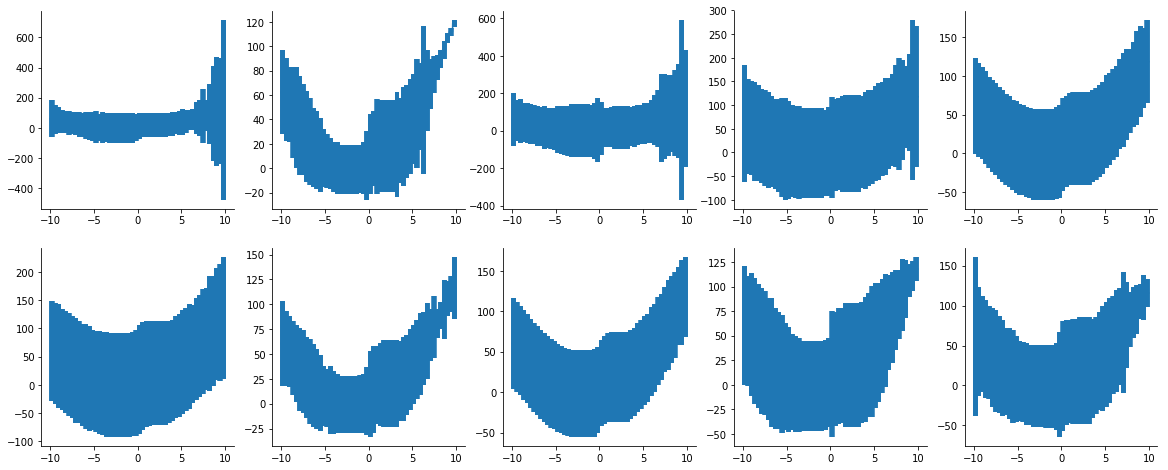
Is this a result of having few training samples (only 20 observations on the curve)? Or is there something else I'm missing conceptually?
Secondly, I will occasionally get NaNs in var_est (the estimate of V_IJ), hence the errors are unplottable.
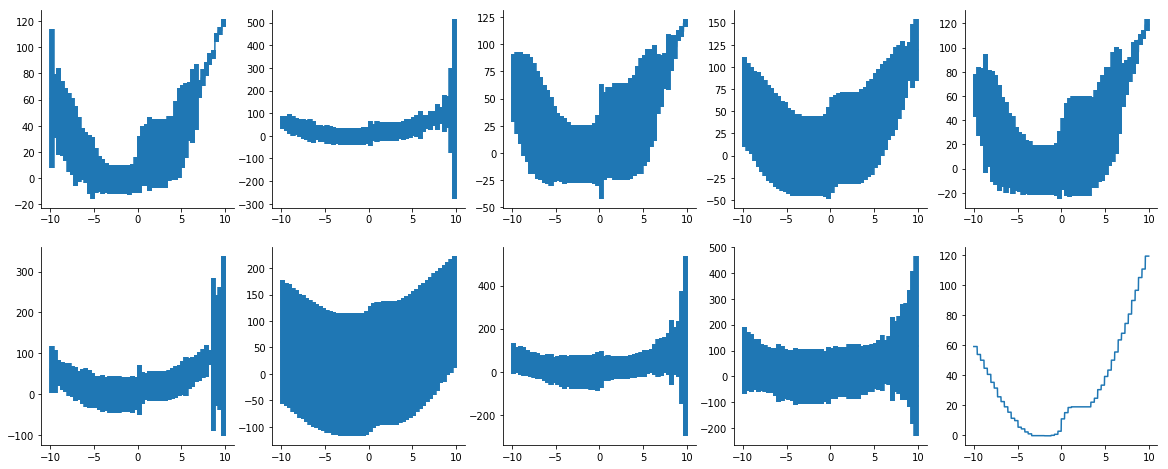
I'm not quite sure how to diagnose what is happening here. Would you guys be able to provide some input on where I might be doing something wrong?

I have faced a similar issue. I have a target variable with a long right tail. If I cap my target variable the forest error does not have missing values. As I raise my target variable cap the missing variables increase. Any insight as to why this issue occurs would be useful! Thanks!


Is there any solution for this problem? My NaNs seem to derive from eb_prior = gfit(variances, sigma) in calibrateEB. Thanks in advance!

Similar to @MillHaus33 I see this problem with a target variable with a long-tailed distribution (or more specifically, quite a few large value outliers). The problem appears for certain test/train splits, so it's the case that the distribution of the target variable always causes the problem. From a practical point of view, there may some kind of data transformation that doesn't impair the model performance but also avoids this problem. I have not found evidence to support this yet though.
