
compas
 compas copied to clipboard
 compas-dev
Request: Vector.from_line, Line.point_from_start, Cylinder.from_line_radius
Feature Request
As a [user], I want [the following functions] so that [others and I do not have to reimplement it].
Details
Is your feature request related to a problem? Please describe. I find myself often struggling with the limited set of geometry constructors. I know it is just two lines of code to do these functions, but implementing these in the core code made my 'user' code more readable. These three are what I have had in mind over the past few days.
Describe the solution you'd like A clear and concise description of what you want to happen.
Vector.from_lineandCylinder.from_line_radiusis rather self descriptive.Line.point_from_start(distance)is similar toLine.point(t)but take adistanceparameter, so I can have a point on the line at a certain distance.
[edit for more]
Line.flip(): Flip the line in place.Line.from_start_direction_length(point, vector, length)

I have an implementation for Cylinder.from_line_radius (I'm not sure if it is correct):
    @classmethod
    def from_line_radius(cls, line, radius):
        """Construct a cylinder from its width, height and depth.

        Note that width is along the X-axis, height along Z-axis, and depth along the Y-axis.

        Parameters
        ----------
        line : :class:`compas.geometry.Line`
            Center line of the cylinder.
        radius : float
            Diameter of the cylinder.

        Returns
        -------
        Cylinder
            The constructed cylinder.

        Notes
        -----
        `cylinder.circle` is located at the mid point of the cylinder.

        """
        radius = float(radius)
        normal = Vector.from_start_end(line.start, line.end)
        circle = Circle(Plane(line.point(0.5), normal), radius)

        return cls(circle, line.length)
Line.point_from_start(distance)
    def point_from_start(self, distance):
        """A point along the line, at the specified distance from start.

        Parameters
        ----------
        distance : float
            The distance from start. Can be negative or larger than line.length.

        Returns
        -------
        Point
            A point on the line.

        Examples
        --------
        >>> line = Line([10.0, 0.0, 0.0], [20.0, 0.0, 0.0])
        >>> line.point(2.0)
        Point(12.000, 0.000, 0.000)
        """
        if distance == 0:
            return self.start

        v = self.direction * (distance)
        return self.start + v
This last thing almost already exists under the name Line.point(t), the only difference being that t represents a percentage of length of the line rather than the distance from the start.

Yea, I'm aware @beverlylytle . In fact the last thing I modified from Line.point(t) . I think my point is to make my 'user' code easier to read with more choice of constructors. In this case, evaluating length.
Here I attach a sample of my 'user' code to illustrate what I mean. It is a function that generates boolean geometry for a 4-stage complex screw hole.
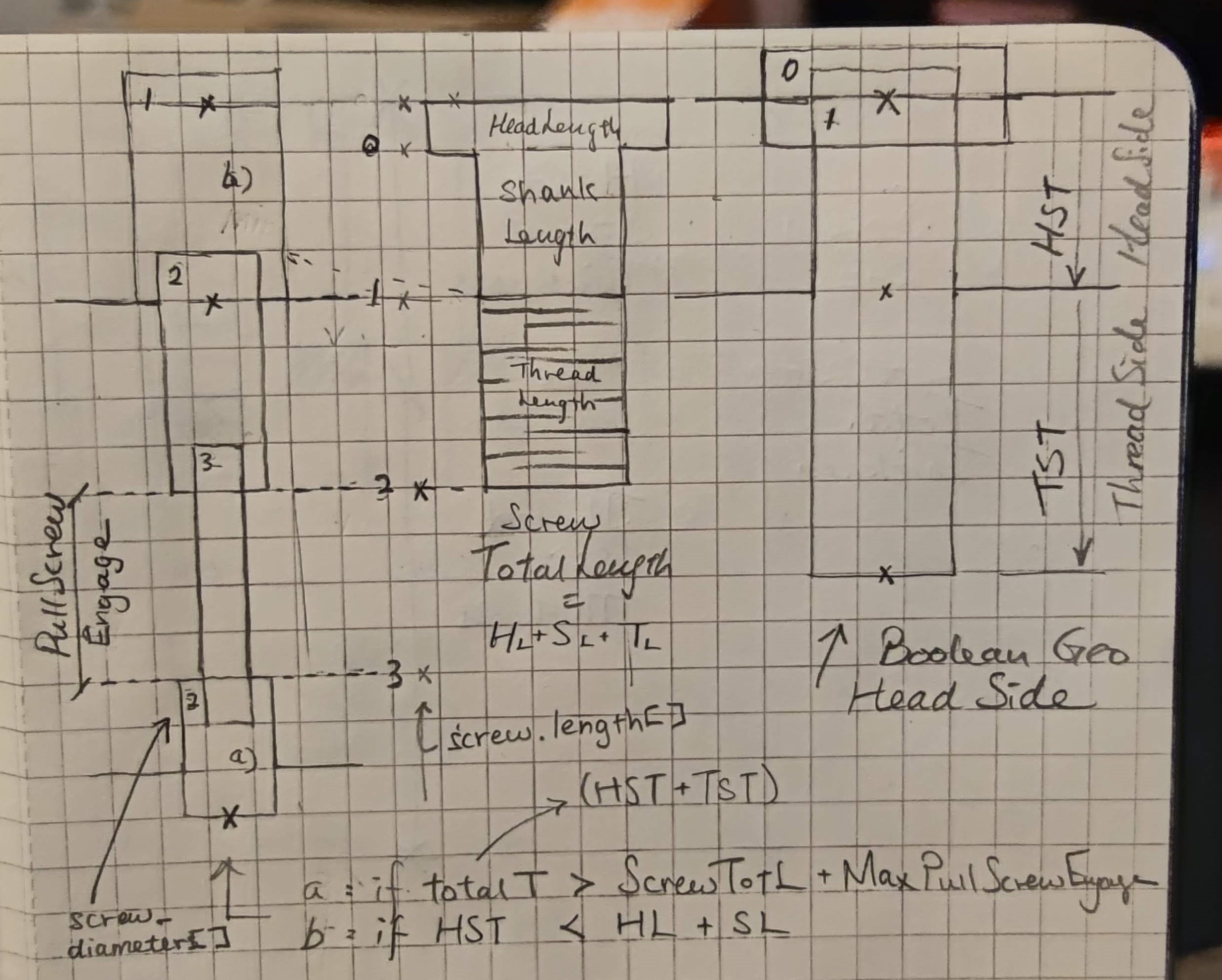
    def get_head_side_feature_shapes(self):
        # type: () -> list[Shape]
        """Returns the negative features of the screw.
        (Screw Head Side)
        """
        features = []

        # Larger diameter cylinder / Screw Head
        start_pt = self.center_line.point_from_start(-OVERSIZE)
        end_pt = self.center_line.point_from_start(self.screw_lengths[0])
        features.append(Cylinder.from_line_radius(Line(start_pt, end_pt), self.screw_diameters[0]/2))

        # Smaller diameter cylinder / Through hole
        start_pt = self.center_line.point_from_start(0)
        end_pt = self.center_line.point_from_start(self.screw_lengths[2])
        features.append(Cylinder.from_line_radius(Line(start_pt, end_pt), self.screw_diameters[1]/2))

        return features

    def get_thread_side_feature_shapes(self):
        # type: () -> list[Shape]
        """Returns the negative features of the screw.
        (Screw Thread Side)
        """
        features = []

        # Shank extending to thread side
        if self.head_side_thickness < self.screw_lengths[1]:
            start_pt = self.center_line.point_from_start(0)
            end_pt = self.center_line.point_from_start(self.screw_lengths[1])
            features.append(Cylinder.from_line_radius(Line(start_pt, end_pt), self.screw_diameters[1]/2))

        # Larger diameter cylinder / Screw Thread
        start_pt = self.center_line.point_from_start(self.screw_lengths[1]-OVERSIZE)
        end_pt = self.center_line.point_from_start(self.screw_lengths[2])
        features.append(Cylinder.from_line_radius(Line(start_pt, end_pt), self.screw_diameters[2]/2))

        # Smaller diameter cylinder / Pull Screw Thread
        start_pt = self.center_line.point_from_start(self.screw_lengths[2]-OVERSIZE)
        end_pt = self.center_line.point_from_start(self.screw_lengths[3]+OVERSIZE)
        features.append(Cylinder.from_line_radius(Line(start_pt, end_pt), self.screw_diameters[3]/2))

        # Final pull screw relief for extra long joint.
        if self.total_length >  self.screw_lengths[3]:
            start_pt = self.center_line.point_from_start(self.screw_lengths[1]-OVERSIZE)
            end_pt = self.center_line.point_from_start(self.screw_lengths[2])
            features.append(Cylinder.from_line_radius(Line(start_pt, end_pt), self.screw_diameters[2]/2))

        return features
@yck011522 || @gonzalocasas this is a nice issue, @yck011522 closing it could be a good omen?

@jf--- @gonzalocasas
This is super old one, but I found the function rather practical after years of use in my own fork.
I can open a PR if someone can let me know whether this function is worth included in the core library.
just so you know, there are:
Line.from_point_and_vectorLine.from_point_direction_lengthCylinder.from_line_and_radiusVector.from_start_end
also, every line has a vector and a direction

@yck011522 Tom's diplomatic & informative answer reads as a subtle crystal clear "close" when round off, don't you think?
from_line_radius vs from_line_and_radius shouldn't keep this issue from keeping this open?
Agree. Either we close this, or we decide on what to include in a PR, move forward and close it as well :)

I think the functions that I originally propose is more of a usability sugar that helps reduce user code, especially for beginners. Probably slightly inspired by the functions that grasshopper offer, and thus able to ease beginners' adoption of compas.
I think each of the functions I proposed above can probably discussed and voted for separately:
Line.point_from_start
"""Get a point along the line at the given distance from start towards end."""
- I believe still highly relevant as illustrated in the drill hole example above
- saves a lot of user code lines
Line.point_from_end
- for completeness sake
Line.point_at(t) (existing function)
"""Construct a point at a specific location along the line."""
- we need to clarify that 'specific location' does not meaning distance.
Line.flip
"""Flip the line in place"""
- Quite helpful one liner, similar function offered by Grasshopper.
Line.flipped
"""Returns a new line that is flipped."""
- same as above but offer a copy
Vector.from_line
- probably quite redundant as Line.direction and Line.vector now covers it.
- ignore
Cylinder.from_line_radius
- As mentioned, now covered by
Cylinder.from_line_and_radius. this wasn't available back then. - ignore
Can I suggest a quick vote on the functions, I can prepare the PR.
Besides the ignore ones, the rest look like a go in my opinion. @tomvanmele ?
perhaps reverse and reversed instead of flip and flipped?
would also add the same for Vector (i do vector.scaled(-1) a lot)
I'm slightly inclined to keep the terminology borrowed from Rhino / Grasshopper where
- Vector (and other non tangible things, such as list) are reversed
- Lines (and other tangible entity, such as curves, meshes and surfaces) are flipped.
Oh I just found that Vector already has Vector.invert() and Vector.inverted().
For some reason, I never knew this is there and I also do vector.scaled(-1) a lot. Should we consider add an aliases name of reversed to inverted? Or we should from now on remember that inverted is there.